Les évaluations de rendement et les inspections post-évaluation sont-elles vraiment importantes ?

Trackforce
December 21, 2015 · 12 min read

Nous prétendons tous faire des évaluations de rendement et des inspections après chaque mission. Ça fait partie de notre argumentaire de vente. Mais en tant qu'entreprise de taille moyenne comptant une centaine d'employés, nous n'avons pas nécessairement les moyens de déployer suffisamment de superviseurs sur le terrain pour assurer des évaluations régulières.
If you have software in place, you can see performance metrics without having to be there. The record is ongoing, it’s time-stamped, and it has GPS information that can include photos. As an owner, you can see what your officers’ activity levels are over long periods of time.
That record is what turns quality assurance from a promise into proof. Below, we break down three common myths, the four biggest benefits, a practical post inspection checklist, a performance review scorecard and a realistic cadence, plus how TrackTik security workforce management software helps contract security companies run both programs without adding supervisors.
Points clés à retenir
- Post inspections and performance reviews are proof, not paperwork.
Clients renew on documented quality, and growing firms need that documentation to win and keep larger accounts. - Field supervisors alone cannot carry quality assurance.
In a lean company, the people doing inspections are also running patrols and alarm responses, so checks get skipped without a system behind them. - Inspections and reviews work best together.
Post inspections show what is happening at a site, and performance reviews turn those findings into coaching, recognition and promotion decisions. - A consistent cadence beats a perfect form.
A short checklist used on a regular schedule produces more useful data than a long one used whenever someone remembers. - Software makes the record continuous.
With TrackTik, tours, site tasks, incident reports and inspection forms are timestamped and GPS-tagged, so every review starts from evidence instead of memory.
3 mythes sur les évaluations de rendement et les inspections post-évaluation
Myth 1: “We don’t need performance reviews because we have supervisors in the field.”
We all have supervisors in the field, but if we’re a 100-person firm, they’re the same people who are doing our patrols and our alarm responses. By the end of the shift, if they have five minutes to check on another officer, they’re probably going to use that time to grab something at a drive-through. Clients know that.
The fix is not more supervisor hours. It is making every visit count with a structured inspection form, and letting the system capture what officers do between visits.
Myth 2: “We don’t need post inspections because we know our guys.”
Sure, when you’re a 100-person company you probably can know every officer. But when you get to 150 people, you have to have quality assurance documentation to keep your contracts. You’re not going to grow to 300 people unless you can show clients performance reviews that prove you’re doing your job.
Myth 3: “We don’t need performance reviews because we have a great reputation.”
It’s not your reputation that raises client questions; it’s the industry’s reputation. Even if you’re doing a great job, you’ll have to prove it when rumors about another company raise questions about security services. Documented inspections mean your answer is ready before the client asks.
4 avantages des évaluations de rendement et des inspections a posteriori
1. They create a clear channel for communicating expectations
Without performance reviews and regular post inspections, you have to communicate everything during officer onboarding. That puts you in a position where, if you correct an officer, they can complain that they weren’t trained properly. Regular reviews reinforce your digital post orders on an ongoing basis, so expectations stay current as sites change.
2. They help identify needs
Without reviews and inspections, you won’t understand the gaps between what your officers are doing and what the customer expects. The expectation could be as simple as having a flashlight on site. But you have to meet it, otherwise your contract won’t renew. The market’s too competitive. Reviews also show you each officer’s strong and weak points, so you can help them do their best and be ready for the next opportunity you offer.
3. They show owners how well supervisors are doing
If performance reviews differ among divisions, you know how you need to train or support your managers. Do they need help finding good guards? Are they having trouble keeping customers? Many guard companies struggle to retain good people, so anything you can do to equip your team will help. Measuring supervisor performance alongside officer results gives you the full picture.
4. They inform compensation and promotion decisions
You want to pick your supervisors, operations and management staff from the ranks. You can’t make objective decisions without good information from performance reviews and post inspections. Recognizing strong performers on the record is also one of the most practical security guard retention tools you have.
What to Check During a Post Inspection
A post inspection is a structured visit, or a remote review, that confirms a site is being covered the way the contract and post orders describe. Keep the form short enough that a supervisor can finish it in a single visit, and capture evidence for anything that falls short. For a step-by-step walkthrough, see our article on how to conduct a security post inspection.
| Inspection area | Quoi vérifier | Preuves à recueillir |
|---|---|---|
| Officer readiness | Uniform, ID and required equipment such as a flashlight, radio and charged phone | Photo and checklist items |
| Post order knowledge | The officer can explain key duties, site contacts and escalation steps | Supervisor notes and post order acknowledgment |
| Patrols and tours | Tours started and finished on schedule, with every checkpoint scanned | Guard tour report with timestamps and GPS |
| Rapports quotidiens d'activités | Reports are complete, specific and written in plain language | Report review with a pass or coaching note |
| Incident handling | Recent incidents were reported promptly and followed the right workflow | Incident report audit and follow-up status |
| Site conditions | Lighting, doors, gates, alarms and hazards match expectations | Photos of exceptions and maintenance requests |
| Client relationship | Feedback from the site contact, open requests and any concerns | Client comments logged against the site |
A Performance Review Scorecard for Security Officers
Post inspections tell you how a site is doing on a given day. Performance reviews look across weeks or months to tell you how an officer is doing over time. A simple scorecard keeps reviews objective and comparable from one supervisor to the next. Our article on conducting a performance review that makes an impact covers the conversation itself. Here is what to measure.
| Catégorie | À quoi ressemble le bien | D'où proviennent les données ? |
|---|---|---|
| Fiabilité | Arrives on time, no unexcused absences, covers shifts as scheduled | registres de temps et de présence |
| Patrol performance | Completes assigned tours and checkpoints with few missed scans | Guard tour reports |
| Reporting quality | Clear, accurate and timely daily activity and incident reports | Report reviews and supervisor edits |
| Task completion | Finishes assigned site tasks on time with required photos or signatures | Site task history |
| Inspection results | Consistently meets the standard during post inspections | Inspection forms |
| Conduct and feedback | Professional with clients and visitors, supportive of teammates | Client notes and supervisor observations |
| Growth and initiative | Completes training and takes on extra responsibility | Training records and supervisor notes |
Score each category on a simple scale, such as 1 to 3 or 1 to 5, and add a short comment. The comment often matters more than the number, because it is what the officer will remember and act on.
How Often Should You Run Inspections and Reviews?
There is no single right cadence, and consistency matters more than frequency. These starting points work for most contract security operations. Adjust them to contract requirements and site risk.
- New posts and new officers: inspect weekly for the first month, so problems surface while habits are still forming.
- Established, stable posts: inspect at least monthly, with some unannounced visits mixed in.
- High-risk or high-value sites: inspect more often, and review tour and incident data weekly between visits.
- After an incident or client complaint: inspect promptly and document the corrective action.
- Officer performance reviews: check in with new hires at 30 and 90 days, then hold formal reviews at least once or twice a year, with short coaching conversations in between.
- Client reviews: share inspection trends and corrective actions at your quarterly business reviews.
How to Build a Post Inspection Program in 7 Steps
- Define the standard. Start from the contract and post orders, and write down what good looks like at each site.
- Build one short inspection form. Use the checklist above as a base and add site-specific items only where they matter.
- Set a schedule and assign ownership. Name who inspects which sites and how often, so no post goes unchecked.
- Capture evidence, not opinions. Require photos, timestamps and specific notes for every exception.
- Close the loop with the officer. Share results the same week, recognize what went well and agree on one or two improvements.
- Roll results into performance reviews. Use inspection trends, not a single visit, to inform scores, raises and promotions.
- Report to the client. Summarize inspection results and corrective actions so the client sees your quality program at work.
Clients rarely renew on reputation alone. They renew on what you can show them, and post inspections are how you build that record one site at a time.
How TrackTik Helps
TrackTik, the security workforce management platform from Trackforce, gives you the continuous record this article started with: what officers are doing when nobody is watching.
Guard management and mobile inspections
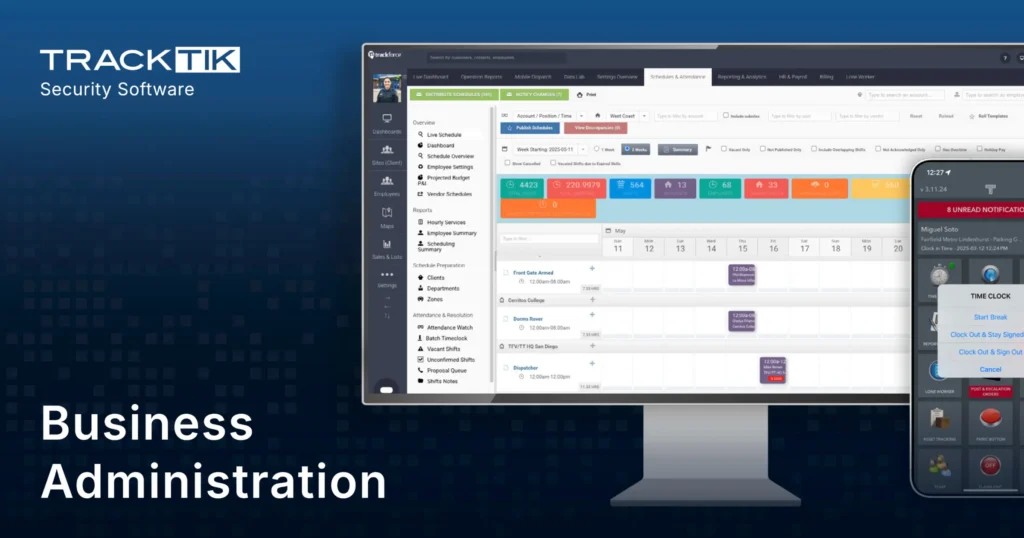
With TrackTik guard management, officers record daily activity reports, incidents and time and attendance from the mobile app, and supervisors can complete inspection forms on site with photos and GPS location. Every entry is timestamped and flows to a central dashboard.
Site tasks and checklists
Site Tasks lets you schedule recurring checks or create them on the fly, assign them to posts, and require reports, signatures or photos to close them out. Missed tasks are flagged, so supervisors can focus inspections on exceptions. Read TrackTik’s Site Tasks, up close for a deeper look.
Guard tours and checkpoints
The TrackTik security guard tour system confirms checkpoints with NFC, barcode, QR code, GPS or manual check-ins and notifies supervisors about missed tours or checkpoints, so patrol performance shows up in reviews automatically.
Rapport d’incident
Configurable security incident reporting templates keep reports consistent across officers and sites, which makes reporting quality much easier to assess during reviews.
Business intelligence and client reporting
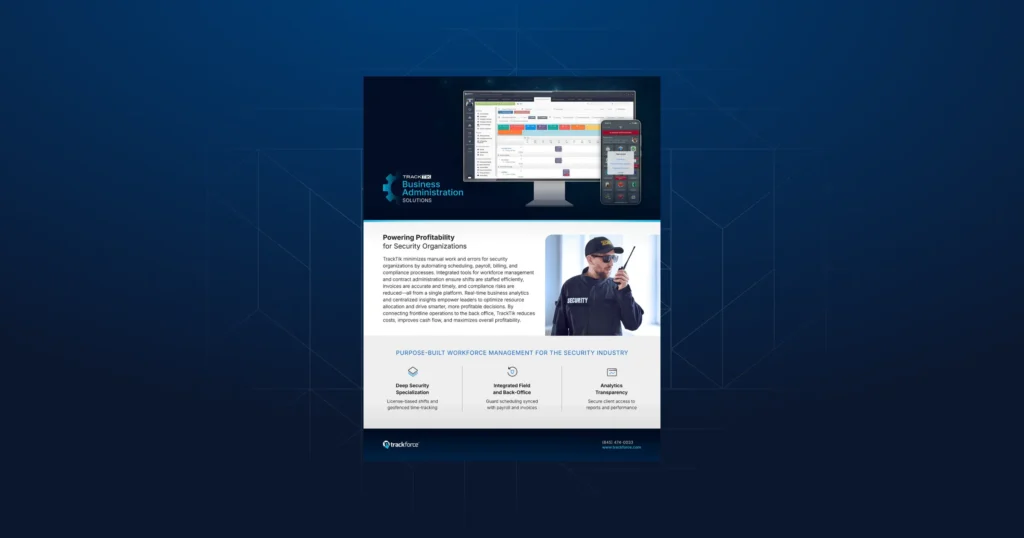
TrackTik business intelligence dashboards turn tours, tasks, incidents and inspections into KPIs by officer, site or region, so you can compare supervisors and spot trends early. Shareable reports let clients see the work for themselves.
Ready to see how this works with your own sites? Book a TrackTik demo and we will walk through your inspection and review process with you.
Foire aux questions
Derniers articles




Ressources en vedette


Découvrez Trackforce en action
Réservez une visite avec notre équipe et voyez comment ça s'intègre à votre activité.