What to Do if an Employee Falsifies Their Security Guard Report

Trackforce
November 24, 2016 · 14 min read
A falsified officer report can have serious consequences for your clients and your security business. When a security guard or officer provides false information within a client-facing security report, it must be dealt with swiftly.
Key takeaways
- Separate an error from a falsification before you act. A wrong timestamp, a lazy narrative and an invented incident are three different problems with three different responses, and treating them the same way costs you good officers.
- Falsification is caught by comparison, not by instinct. The report says one thing and the checkpoint scans, GPS trail and photo timestamps say another. Without that second record there is nothing to compare the narrative against.
- Correct the record with the client the same day. An amended report plus a short letter explaining what was wrong and what you did about it is recoverable. A client discovering it themselves usually is not.
- Take the employment and legal steps in the right order. Investigate, document, consult counsel, then act. Reversing that order is how a justified dismissal turns into a claim.
- The real fix is making falsification hard rather than punishing it later. Officers filing through TrackTik submit on scene with GPS, time stamps and photos attached, so the report and the evidence are created together instead of written up hours afterwards.
Why a False Report Carries Legal Weight
An incident report has significant legal bearing and any errors, omissions, or outright falsehoods can result in the dismissal of the case. In some cases, it can lead to a lawsuit being filed on behalf of the perpetrator against your company. In the state of California, penal code 148.5 states that anyone who reports a false crime (misdemeanor or felony) & knows it to be false can be charged with a misdemeanor themselves and potentially face up to six months in county jail.
How Falsification Actually Gets Caught
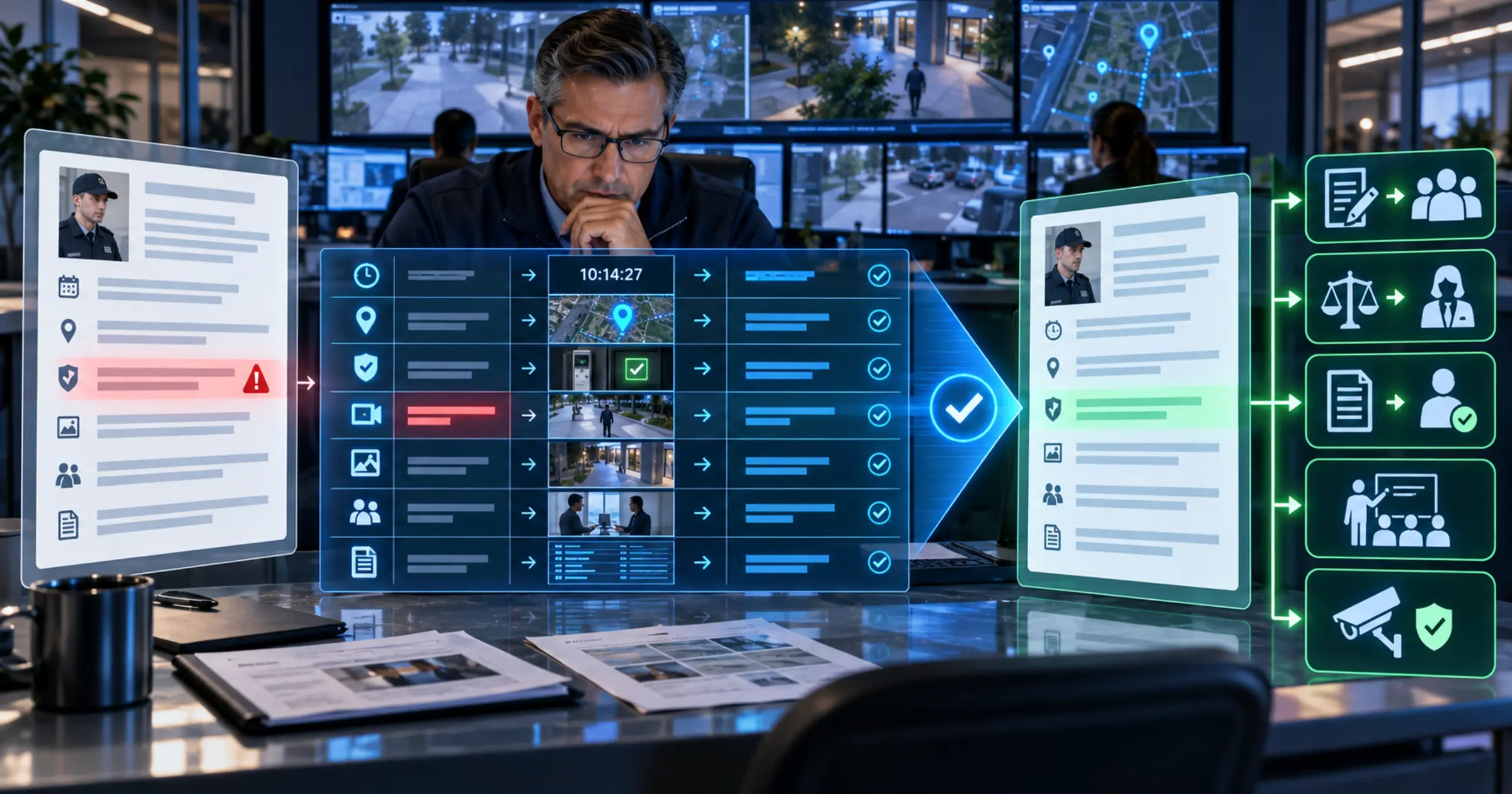
Almost nobody catches a false report by reading it carefully. It gets caught because the narrative disagrees with a second record that the officer did not control. If your only record is the report itself, there is nothing to compare it against, which is why falsification tends to surface months later through a client complaint or a subpoena rather than through supervision.
None of these is proof on its own. Two or three of them pointing the same way, with time stamps that contradict the narrative, is what turns a suspicion into something you can put in front of an attorney.
Telling an Honest Error From a Falsification
This is the step most firms skip, and skipping it is expensive in both directions. Treat every inaccuracy as fabrication and you will lose officers who simply wrote a poor report. Treat fabrication as an honest slip and you will carry the liability into the next contract. Work out which one you are holding before you decide what to do about it.
|
What you are looking at |
What it usually means |
Proportionate response |
|---|---|---|
|
A wrong time, date or name |
Carelessness or a rushed clock-out rather than deception |
Correct it, note it on file, and have a short conversation about checking before submitting |
|
A required field left blank |
Usually the form rather than the officer. Fields that can be skipped get skipped |
Make the field mandatory in the template and reissue the report. Fix the process, not the person |
|
A vague narrative with no usable detail |
Thin training, or an officer who is not confident writing, rather than dishonesty |
Coaching plus a template that prompts for each element. Configurable templates do most of this work |
|
The same narrative copied from a previous shift |
A shortcut that has hardened into a habit. Serious, but not the same as inventing an event |
A formal disciplinary step, and a review of that officer’s other reports across the same site |
|
A patrol or checkpoint claimed that the data says never happened |
Deliberate misrepresentation of work that was billed to a client |
Suspend pending investigation, pull the full tour record from TrackTik Guard Management, and involve HR before anything is said to the officer |
|
An incident described that never occurred |
Fabrication, and the category that carries the legal exposure described above |
Formal investigation, preserve every version and audit trail, and take counsel’s advice before you act or notify anyone externally |
Correct and Refile the Report
Once the report has been corrected, it is necessary to file it with the client, and with law enforcement. This should be done immediately. Along with the amended report, it is advisable to file a letter identifying the incorrect information filed within the original report and the corrective measures the company has taken. It is a black mark for sure, but it is necessary to accept responsibility and show that the company has taken the proper steps to correct the erroneous security guard report.
Employment and Legal Action
It is also advisable to terminate the employee’s employment. A false security guard report is one of the most serious offenses a security officer can commit. It is not something that a company can take a chance on. Guards who file a false security report once will likely do it again in the future.
The next step that should be taken is to meet with the company’s attorney. The employee will likely face criminal charges of filing a false police report. This does not necessarily mean that the company will face criminal charges, but there does exist the possibility that the client could pursue a civil claim against the security provider. Thus, consulting legal counsel is a wise step that shouldn’t be delayed.
Retrain the Team on Report Standards
Finally, bring the team together and retrain your officers in the proper steps and procedures for filing accurate security reports. Make sure that they have a thorough understanding of the information they must include. During this training, remind them the importance of accuracy, and not including information that is an outright falsehood or extrapolation of known details.
This training should reinforce the basics of security guard reports. Start with the “Five W’s:
- Who – Who was actually involved in the incident & who was on the scene at the time of officer arrival? Provide descriptions of all parties.
- What – What exactly happened? Be as descriptive as possible.
- When – Time of arrival & departure for the officer on-shift (use time-stamping whenever possible).
- Where – Include specific details about the property and distinguishable details like lighting, scenery, etc.
- Why – Do not speculate. Try & articulate the motive, but do not guess.
Make sure that the team knows how to identify these each & every time. These details should be included in as detailed a manner as possible. Also, impress upon the team that only known facts should be included within any submitted reports. If they have any questions about the facts of the incident, they should be certain to discuss these with their supervisor prior to filing the official report.
It is also important to go over evidence collection and field recording. This includes training in the use of camera and video technology to capture photos, videos, or audio, as well as the preservation and collection of physical evidence that may be at the scene of the crime.
Employees may file a false security guard report for any number of reasons. Even so, a sharp-eyed supervisor with zero tolerance for this behavior can help protect the business and the strength of any legal actions being pursued against the perpetrator. Without question, swift and decisive corrective measures are the best defense when it occurs.
Designing Falsification Out of the Process
Retraining helps, but it treats falsification as a character problem when it is usually an opportunity problem. Officers fabricate when the report is written hours after the fact, from memory, on a form nobody checks. Close those gaps and the behaviour largely stops being available.
- Make the report and the evidence the same act. A report filed on scene with location, time stamp and photo attached is far harder to invent than one typed up at clock-out. Security incident reporting captures all three together rather than asking the officer to remember them.
- Make the fields mandatory rather than advisory. If any of the Five W’s can be left blank, some of them will be. A template that will not submit without them removes the argument entirely.
- Verify patrols with scans rather than signatures. A paper sheet signed at the desk only proves that the sheet was signed. GPS-backed verification gives you a record the officer cannot author.
- Sample reports weekly instead of trying to read all of them. Ten minutes across five random reports, checked against that shift’s tour data, catches drift long before a client does. Business intelligence reporting makes the comparison quick enough to actually keep up.
- Remove the friction that makes shortcuts tempting. Most copied narratives come from an officer facing a long form at the end of a twelve hour shift. ReportPro AI shortens the write-up without letting the detail drop out, which takes away the reason to reuse last night’s text.
Preserve these the moment you suspect a false report
- Every version of the report, not just the final one. Drafts and edits, with the audit trail showing who changed what and when, are often the most useful evidence you have.
- The tour and location data for that shift, exported. Export it rather than leaving it in the system, so the copy you rely on is fixed at a known date.
- Any attached photos or media, with metadata intact. Re-saving or emailing images around strips the very timestamps that make them worth having.
- Radio, dispatch and phone logs for the window. These are the records the officer had no hand in creating, which is exactly what gives them weight.
- That officer’s other reports from the same site. Pull them before anyone mentions an investigation, because a pattern is far more informative than a single report and far harder to argue with.
A falsified report is a serious matter, but the firms that handle it well are rarely the ones with the strictest policy. They are the ones whose reports are created alongside the evidence, checked often enough that problems surface in days rather than months, and documented well enough that the decision holds up afterwards. If you want to see how the report, the tour data and the audit trail sit together in one record, you can book a TrackTik demo and test it against your own sites.
Frequently Asked Questions
Latest Articles


Featured Resources

See Trackforce in action
Book a walkthrough with our team and see how it fits your operation.