Hospital Security Incident Reporting and Why Every Hour Counts

Trackforce
November 20, 2026 · 9 min read
Strong hospital security incident reporting gives security leaders the evidence they need to protect staff, satisfy surveyors, and secure budget for the programs that work. It also happens in one of the most demanding environments any security team can face.
Hospitals run around the clock, with open public entrances, emotionally charged emergency departments, behavioral health units, and thousands of people moving through every day. A single event can involve a patient, a visitor, a nurse, and a contractor at once. The report a security officer files in the first few minutes often becomes the starting point for decisions made by Employee Health, HR, Nursing, Risk, and Compliance.
That makes accuracy and speed more than good practice. In healthcare physical security, the incident report is the record that regulators, accreditors, attorneys, and your own leadership will rely on long after the event is over.
Key takeaways
- Hospitals answer to several reporting authorities at once, including The Joint Commission, OSHA, and state workplace violence laws, each with its own timelines.
- Joint Commission NPG 2a, in effect since January 1, 2026, requires workplace violence reporting systems, data analysis, and reporting to the governing body.
- Underreporting of workplace violence leaves security leaders without the pattern data they need to adjust staffing, training, and post placement.
- TrackTik helps hospital security teams capture complete reports at the point of care, notify the right departments quickly, and show trends to leadership.
- The free Cross-Functional Incident Workbook for Hospitals maps incident handoffs across seven departments, aligned to NPG 2a and 11.
What makes hospital incident reporting requirements unique
Most organizations answer to one or two reporting authorities. Hospitals answer to several at once, and each one has its own definitions, timelines, and expectations for what the record should show.
Accreditation standards. The Joint Commission’s National Performance Goals took effect January 1, 2026. NPG 2a requires a documented, multidisciplinary workplace violence prevention program that includes reporting systems, data collection and analysis, post-incident strategies, and reporting to the governing body. NPG 11, now largely folded into the Physical Environment standards, covers the monitoring, reporting, and investigation of security incidents. Surveyors will expect to see trend data and corrective action, which only exists if incidents were captured consistently in the first place.
Federal OSHA reporting. When a hospital security incident injures an employee, federal recordkeeping rules apply. OSHA requires employers to report a work-related fatality within 8 hours and an in-patient hospitalization, amputation, or loss of an eye within 24 hours. Recordable injuries must also be entered on the OSHA 300 log within seven calendar days.
State workplace violence laws. A growing number of states set their own rules for healthcare workplace violence reporting. In California, for example, Cal/OSHA requires covered hospitals to report violent incidents within 72 hours, or within 24 hours when the incident involves serious injury, a firearm or other dangerous weapon, or an urgent threat to staff. That obligation applies whether or not an employee was hurt.
Internal stakeholders. Then there are the hospital’s own departments. A single incident report may need to reach Employee Health, HR, Nursing leadership, IT, Risk and Patient Safety, Facilities, and Compliance, each with a different need and a different deadline.
| Reporting obligation | Who it covers | Typical timing |
|---|---|---|
| Joint Commission NPG 2a and 11 | Accredited hospitals | Ongoing data collection, trend analysis, and governing-body reporting |
| OSHA severe injury reporting | Employers covered by the OSH Act | 8 hours for a fatality, 24 hours for hospitalization, amputation, or eye loss |
| OSHA 300 log | Employers required to keep injury records | Within seven calendar days |
| Cal/OSHA hospital workplace violence reporting (example) | Covered California hospitals | 24 or 72 hours, depending on severity |
Requirements vary by state and facility type, so security leaders should confirm their own obligations with compliance and legal teams.
Why accurate and timely reporting matters in hospital security
Workplace violence is the clearest example of what is at stake. According to OSHA, as cited by The Joint Commission, healthcare workers are four to five times more likely to suffer workplace violence injuries than workers in private industry overall. The Joint Commission has also noted that the true prevalence may be underestimated because staff often perceive incidents as minor and leave them unreported.
Underreporting creates a blind spot. When a verbal threat in the emergency department or an assault on a behavioral health unit never makes it into the system, leaders lose the pattern data they need to adjust staffing, post placement, or de-escalation training. Staff who report and see nothing happen may stop reporting at all.
Timeliness matters just as much. Regulatory clocks start when the hospital knows, or should have known, about an incident. A paper report that sits in a supervisor’s inbox until Monday can put a 24-hour deadline at risk and delay care and support for the employee involved.
Accuracy protects everyone. A complete record with consistent fields, timestamps, and supporting evidence helps investigators reconstruct events, gives Risk Management what it needs if a claim follows, and shows surveyors that the workplace violence prevention program runs as documented. Vague or inconsistent reports make trend analysis unreliable, which weakens the case for the resources a security program needs.
To benchmark your program against what surveyors now expect, the Hospital Workplace Violence Prevention 2026 Evidence Brief walks through the operational records that matter most under NPG 2a and 11 and includes a six-question self-assessment.
How TrackTik helps hospital security teams report faster and with more confidence
Trackforce’s TrackTik platform gives healthcare security teams one system to capture, route, and analyze incidents across units, shifts, and facilities.
Capture complete reports at the point of care
With TrackTik security incident reporting, officers file guided, step-by-step reports from an Android or iOS device without leaving their post. Each report can include time-stamped photos, video, audio, and GPS location, so the record holds up when Risk, Legal, or a surveyor reviews it later. Configurable forms let you build fields that match your own workplace violence definitions and severity levels.
Turn field notes into clear, consistent documentation
ReportPro AI helps officers turn rough notes into clear, structured reports and gives supervisors one-click executive summaries for faster triage. Every AI-assisted change is logged, with the original and enhanced text stored side by side for a defensible audit trail.
Notify the right departments while the clock is running
Automatic email and text notifications, escalations, and scheduled reports help the right people hear about an incident quickly. Hospitals can configure routing so a workplace violence report from the emergency department reaches Employee Health, Nursing leadership, HR, and Risk at the level of detail each role needs, with every notification timestamped. Teams that coordinate response in real time can pair this with the TrackTik Security Command Center and patrol and guard tour tools that document coverage across the campus.
Show trends and program health to leadership
TrackTik Business Intelligence turns incident data into trend reporting that security leaders can bring to the governing body, accreditation teams, and budget conversations. Historical data supports the trend analysis and corrective action tracking that NPG 2a calls for.
Map your incident handoffs before the next survey
Technology works best when everyone agrees on who owns each step. Most hospitals can name the departments involved in a security incident, yet far fewer can name the person in each one who owns the handoff or how quickly that notification should land.
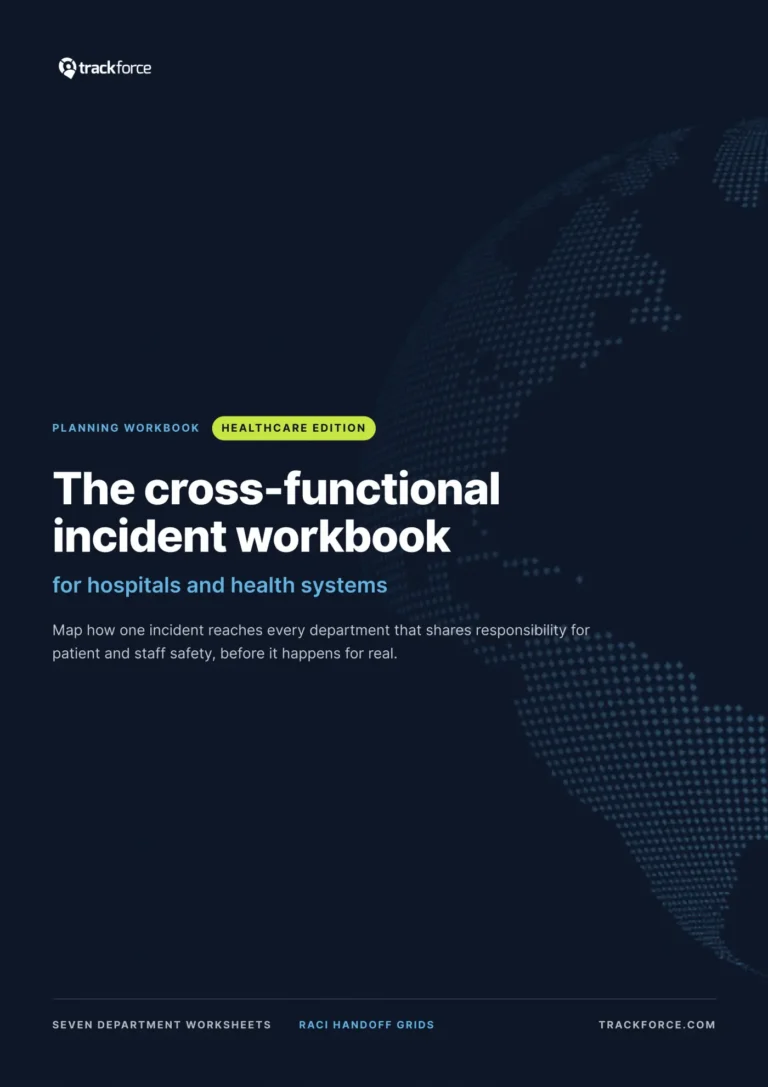
The free Cross-Functional Incident Workbook for Hospitals helps you close that gap. It includes seven department worksheets covering HR, Nursing, IT, Compliance, Risk, Facilities, and Employee Health, each with first-hour information needs, routing triggers, and a RACI grid aligned to NPG 2a and 11. You will finish with a first draft of your cross-functional incident communication plan and documentation you can fold into your workplace violence prevention program.
Free download
The Cross-Functional Incident Workbook for Hospitals
Map who owns each handoff across seven departments, then see how TrackTik can turn that plan into automated incident notifications.
Hospital security incident reporting FAQs
Latest Articles




Featured Resources





See Trackforce in action
Book a walkthrough with our team and see how it fits your operation.