Calling All Employers — Either Prohibit Personal Cell Phones or Prepare to Pay for Business Use

Trackforce
January 22, 2019 · 14 min read
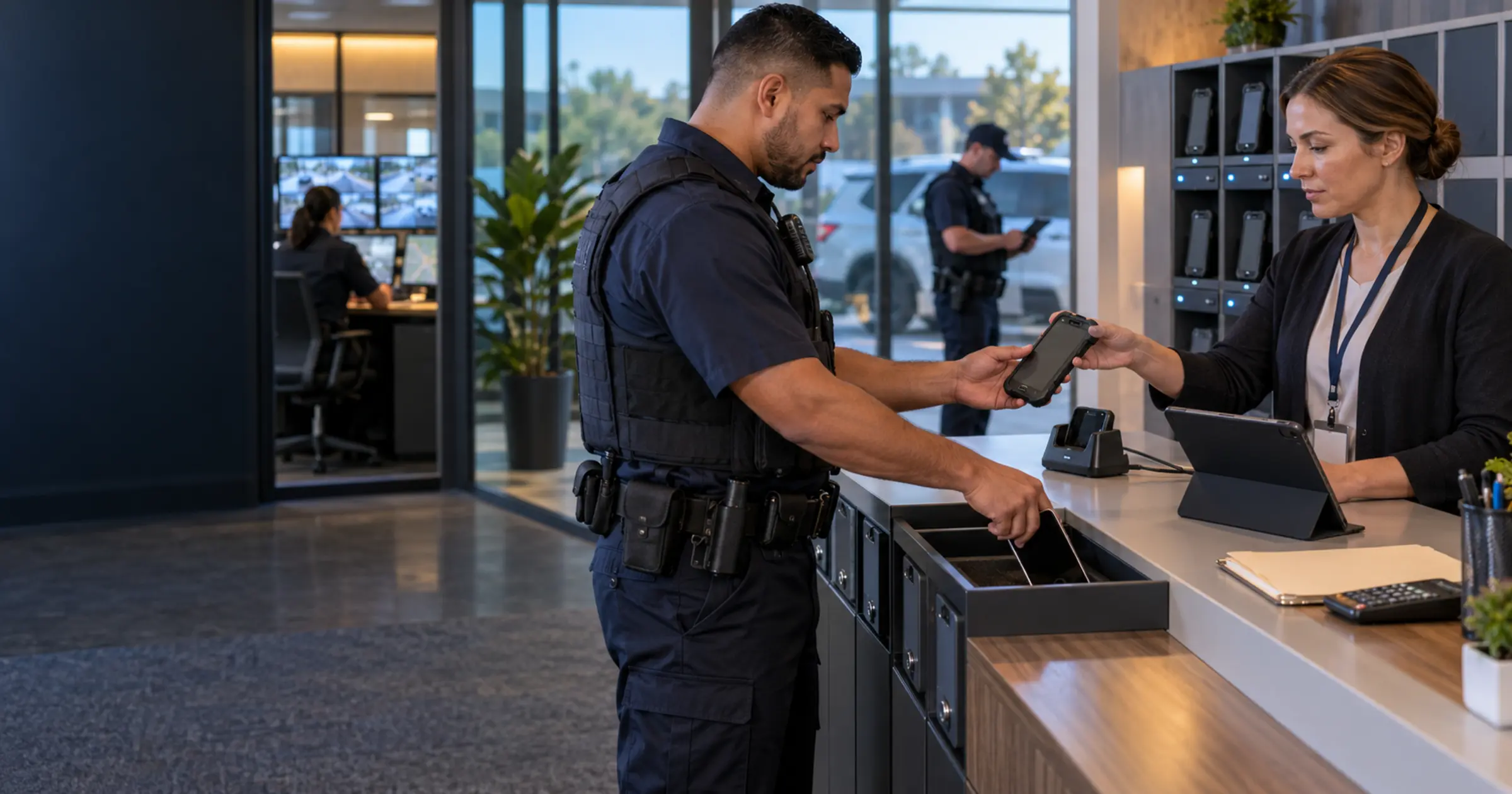
The growth of the smartphone market has been both a blessing and a curse for the security industry.
On one hand, having a smartphone with a mobile security guard app in every officer’s pocket presents the opportunity for better communication, increased transparency, and reduced costs.
But requiring an officer to bring their own device to work also presents several issues both logistically and legally.
Key takeaways
- In California, required work use of a personal phone triggers reimbursement.
That holds even where the officer has an unlimited plan or somebody else pays the bill. - A policy banning personal-phone use does not end the exposure.
If officers use their phones for work in practice, the obligation follows the practice rather than the policy document. - California is no longer alone.
The prediction in this article proved correct, and several other states now require reimbursement of necessary work expenses. - Company-issued devices are the only option that removes the question entirely.
Every other route leaves you calculating or defending a “reasonable percentage”. - If officers run a guard app, that is work use by definition.
TrackTik runs on company-issued handsets as readily as personal ones, which makes the device decision a genuine compliance lever.
California Setting the Standard
The State of California has led the way in defining what employers are required to do when asking officers to bring their personal phones to work.
While these standards don’t apply in every state or country, employers should be aware of the standards being enforced in California, because history tells us that most U.S. states that favor the employee will be following suit. As the update further down this page sets out, that is exactly what happened.
Cochran v. Schwan’s Home Services
Personal cell phone use for any work-related calls is no different than unauthorized overtime. In fact, it may be worse because it applies to all California employees, exempt and non-exempt.
What does this mean for businesses?
If an employee in California uses a personal cell phone for business-related use (i.e., “in direct consequence of the discharge of his or her duties or his or her obedience to the directions of the employer,”), a California employer must reimburse the employee, even if the employer prohibits the employee from using his or her personal cell phone for business use.
The California Court of Appeal in Cochran v. Schwan’s Home Services, Inc., 228 Cal.App.4th 1137 (2014), resuscitated a putative class action lawsuit filed on behalf of 1,500 customer service managers who were not reimbursed for expenses incurred as a result of work-related use on their personal cell phones.
The Court held that “when employees use their personal cellular phones for work-related calls,” California law (i.e., Labor Code Section 2802) “requires an employer to reimburse them.”
This is so even if the employee incurs no additional expense due to the work-related calls, such as if the calls are within the employee’s plan for unlimited minutes or the cell phone bill is paid by someone other than the employee.
Otherwise, the Court reasoned, “the employer would receive a windfall because it would be passing its operating expenses onto the employee.” In these types of cases the employer must pay “some reasonable percentage of the employee’s cell phone bill.”
But how do you calculate “an undefined reasonable percentage?” Unfortunately, the Court didn’t answer the question, but said, “because of the differences in cell phone plans and work related scenarios, the calculation of reimbursement must be left to the trial court and parties in each particular case”.
The obligation follows what officers actually do, not what the handbook says they may do. A policy prohibiting personal-phone use does not help much if supervisors are texting officers on their personal numbers every shift.
What Are The Solutions Available to Employers?
So, how does an employer reduce or eliminate the risk of unknowingly violating the law? Let’s consider the pros and cons of the options at hand.
Option 1: Issue Company Owned Cellular Phones
The Advantages
- Guaranteed compliance with the law and better protection of the company’s intellectual property, which is put at risk by personally owned phone policies.
- If the employer owns the phone and maintains appropriate policies, it will go a long way toward enforcing and monitoring cell phone usage.
- You’ll know your employees have the proper tools to communicate and report when they’re on the job.
The Disadvantages
- The cost. Although data plans and cell phone prices have dropped considerably over the last decade, it’s still not cheap to purchase company phones.
- You also have to worry about the damage careless employees do to the devices themselves. It’s not uncommon to see company phones damaged, abused, or stolen.
- Finding a spot to store the device on post can also be a challenge.
Option 2: Pay the Employee’s Entire Personal Cell Phone Bill
Advantages
- Guaranteed compliance with the law and the cost is relatively easy to compute.
Disadvantages
- The cost of going this route could get extremely high.
- No protection of the company’s intellectual property.
Option 3: Pay a Fixed Amount to Employees
This would require employees to submit proof if the proportion of work to non-work calls exceeds the fixed amount.
Advantages
- Less administrative support, and a simpler response to an employee if the fixed amount is exceeded.
- Makes it easier to plan and estimate costs.
Disadvantages
- The employee has an incentive to use their personal cell phone for work-related use.
- Opens the door to a discrepancy between the employer’s and the employee’s definition of “some reasonable percentage”.
Option 4: Establish a Policy for Employees to Prove Their Work Cell Phone Usage
With this method you would have to calculate the average proportion of time spent on work calls and pay that percentage of the total bill for that period.
Advantages
- Averaging is probably the most accurate method to calculate the “reasonable percentage” an employer is expected to pay.
- The employer only pays for what they are using, so the employee isn’t making money by using their phone.
Disadvantages
- The time it takes to compute the reimbursement for each employee.
Option 5: Require Employees to Submit Expense Reports
This redirects responsibility for providing proof of work-related phone usage to the employee, so that they can be compensated for the cost of that usage to the extent the actual cost can be determined.
Advantages
- The most accurate way to track and pay work-related cell phone usage costs.
Disadvantages
- Administration costs increase, and it is not practical when employees are on unlimited plans.
What Has Changed Since This Article Was Published
This piece was written in 2019 and predicted that other employee-friendly states would follow California. They did, and the California position has since been widened rather than narrowed. The table below summarises the main developments, and the closing note about speaking to counsel applies to every line of it.
| Development | What it means for a security employer |
|---|---|
| Cochran still stands | Required work use of a personal phone remains reimbursable in California, unlimited plan or not |
| Thai v. IBM, Court of Appeal, July 2023 | Expenses are reimbursable because the work caused them, even where a government order caused the working arrangement |
| Other states adopted reimbursement duties | Reported alongside California are Illinois, Iowa, Massachusetts, Minnesota, Montana, New Hampshire, New York, Pennsylvania and the District of Columbia |
| Public-sector carve-out | Krug v. CSU (2025) is reported as holding that California public-sector employers fall outside section 2802 |
| Practical benchmark | Employer phone stipends are commonly reported in the $30 to $50 per month range |
| Enforcement has teeth | Claims can reach back three years plus interest and attorney’s fees, and large settlements have followed |
Two practical consequences for a contract security firm. First, if you operate across state lines, a single national device policy is now easier to defend than a patchwork. Second, a stipend set years ago and never revisited is the most common weak point, because the benchmark has moved and the paperwork proving adequacy usually has not.
What This Means If Your Officers Run a Guard App
This is where the compliance question stops being abstract for a security company. If officers scan checkpoints, file reports and receive assignments on a phone, that is work use of a device by any reading. It is not occasional, it is not incidental, and it happens on every shift.
That cuts both ways, and it is worth being clear about both.
- On personal devices, the app makes the work use undeniable. You cannot argue the use was incidental when there is a login record for every shift. If you run a BYOD model with guards using their own phones, budget for reimbursement rather than hoping the question never comes up.
- On company devices, the question disappears. Option 1 above is the only route that removes the calculation entirely, and a guard app is the thing that most often justifies the handset cost in the first place. BYOD best practices for physical security covers how to structure it either way.
- TrackTik runs on either. The tour app works the same on a company-issued handset as on a personal one, so the device decision can be made on compliance and IP grounds rather than being forced by the software.
- Shift records show the actual scope of use. Guard management holds the clock-in and shift data, which is the factual basis for any reasonable-percentage calculation you end up defending.
- Stipends have to reach payroll consistently. Whichever option you pick, it becomes a recurring pay element, and the back office suite is where that kind of item stops being a manual monthly adjustment.
- Device inventory is its own control. If you go the company-phone route, knowing which handset is with which officer matters, and asset tracking covers that alongside keys and equipment.
Worth noting that the same wage-and-hour logic drives several other exposures in this industry. Meal and rest breaks are the obvious neighbour, and security guard break laws covers where firms most often get caught there.
A Practical Compliance Checklist
None of this requires a legal department, but it does require someone to own it. Work through these in order and review annually.
- Write down what officers actually do on a phone. Guard app, dispatch calls, supervisor texts, schedule checks, multi-factor codes. This list is your exposure, and it is usually longer than management assumes.
- Decide device strategy per state, then simplify. Work out which of your operating states impose a reimbursement duty, then consider whether one policy across all of them is cheaper to run than several.
- Pick one of the five options and document why. The reasoning matters as much as the amount. An employer who can show how a figure was reached is in a very different position from one who cannot.
- Make the payment visible and separately identified. A reimbursement buried inside a wage rate is hard to evidence later. Keep it a distinct, labelled line.
- Close the gap between policy and practice. If the handbook prohibits personal-phone use, check that supervisors are not routinely texting officers on personal numbers. The practice is what counts, and keeping signed policy acknowledgements alongside the roster in people management makes that far easier to evidence.
- Diarise an annual review with counsel. Benchmarks move, states change their rules, and a stipend set once and forgotten is the most common failure point.
Final Thoughts
As you can guess, cell phone usage is only the tip of the iceberg, because it can easily extend to laptop computers, tablets, internet charges and more, all of which could theoretically be the subject of employee compensation under the Cochran reasoning. The remote-work cases since 2019 have borne that out.
We highly recommend you check with your labor and employee relations attorney, as there may be other parts of the case to be considered and the position continues to develop.
That being said, in California there are many other issues to be aware of, including heat illness awareness, meal and rest breaks, and overtime, all of which make our business lives just a little more exciting. Regardless, employers need to prepare for the worst. These things can be handled case by case, but each one could be the next arrow in the class-action quiver.
This article is general information for security employers and is not legal advice. Case law and state requirements change, so confirm your own position with qualified employment counsel before setting or revising a policy. If you want to see how device strategy, shift records and payroll items fit together operationally, you can explore the TrackTik platform or request a demo.
Frequently Asked Questions
Latest Articles





Featured Resources





See Trackforce in action
Book a walkthrough with our team and see how it fits your operation.