What is the True Measure of a Leader in the Security Industry?

Trackforce
December 11, 2015 · 13 min read

The security industry is tough. At the best of times, you’re dealing with thin margins and high turnover. During the rough patches, you might have to deal with constant calls from customers, competitors trying to undercut you, and rapidly shifting procedures in order to keep up with new technology.
At these moments, it can feel like the entire company is going to crumble. What keeps it together is strong leadership from the owner and other higher ups. Good leaders can inspire their employees, solve problems, and position their team to succeed.
In the notes below, we take a quick look at what it means to be an effective leader at a contract security firm, and at the operational habits that tend to separate the leaders who last from the ones who burn out.
Key takeaways
- Composure is the first competence.
When an owner or manager loses their temper, officers copy it, stop respecting it, or stop reporting to it, and all three are expensive. - Transparency includes admitting your own mistakes.
Publicly owning an error buys more credibility than never appearing to make one. - Leaders persuade, managers instruct.
Officers who understand why a decision was made follow it when nobody is watching, which is the only time it matters. - Proactive firms adopt technology early, not under duress.
The rollouts that go badly are almost always the ones forced by a client demand or a lost contract. - Leadership instinct gets better with data behind it.
TrackTik turns tours, incidents and staffing into a record a leader can read, so problems surface while they are still small.
Keep Cool
First and foremost, a good leader knows how to stay calm in the midst of adversity. We highlighted “Reacting Emotionally” as the top mistake security operators make when dealing with customers, but that really applies to all areas of the business. Good leaders stay in control of their emotion and can make cool, rational decisions when others start to panic.
“There’s going to be a trickle down effect,” said Johnny Page. “As an operations manager or a supervisor, if you lose your cool, all hell’s going to break loose.”
When the owner and managers start losing their cool, three things can happen.
- Officers start to lose their cool as well
- Officers lose respect for the higher ups
- Officers become afraid of the angry outbursts that come from their bosses
All of those scenarios can be disastrous for a company. The first results in careless mistakes, the second results in insubordination, and the third leads to a lack of communication and officers failing to bring pressing issues to the attention of their supervisors.
That third outcome is the one that quietly does the most damage, because it removes your early warning system. A supervisor who is afraid to call you is a supervisor who lets a small problem at a site become a client complaint. One practical guard against it is making the reporting route impersonal: when an officer files through incident reporting rather than having to decide whether to phone the boss, the information reaches you regardless of how approachable you were that week.
Actions speak louder than words, but words can be pretty loud on their own, especially if you’re shouting them. Losing your cool and yelling at officers, other managers, or customers can only result in bad things happening.
Be Transparent
Another point we’ve advocated in the past, transparency and open communication with your officers is a key aspect of effective leadership. A big part of being transparent means taking criticism and understanding when your officers come to you with issues.
Everyone makes mistakes. You need to accept that and stay calm when it happens with your employees, but you also need to be prepared to accept responsibility when it’s you that messes up. If you’ve made a strategic error or just had a minor slip up in running the day-to-day operations, publicly accepting responsibility and fixing the problem will do a lot to earn respect.
“Be willing to use yourself as an example of what not to do,” said Johnny Page.
In addition, transparency gives you the opportunity to explain your decisions and share your vision for the company. The difference between a dictator and a leader is that one commands, while the other persuades. Convincing officers that your decisions are right will be a lot more effective in the long run than just expecting them to follow policies they don’t agree with.
Be Proactive, Not Reactive
By definition, a good leader needs to be proactive, pushing the company forward rather than just responding to issues as they arrive. This requires some strategic foresight, it means paying attention to developing trends in the industry and looking for ways to get out ahead of them so that you’re the one going after your competitors’ contracts and not the other way around.
Being able to weather disasters is great, and every business will have to go through them, but the best leaders are able to steer their companies away from those disasters ahead of time. A business that is constantly lurching from crisis to crisis will never be able to institute a long-term strategy for growth.
We’ve found in our own experience that the most successful guard management software customers are the ones that are proactive. They adopt the software when things are already going well, so that they can keep improving and optimising an operation that is not currently on fire.
On the other hand, when firms are forced into adopting guard management software because a client demanded it or because they lost a contract to a competitor who had it, the onboarding process is much rougher. The team is already under pressure, nobody has time to learn a new system properly, and the rollout competes with the crisis that triggered it.
A good leader has to be calm and communicative in a crisis, but a great leader has the foresight to see the crisis coming and take the steps to avoid it.
Leadership And Management Are Not The Same Job
The three habits above are leadership. Most of what fills an owner’s week is management, and the two get confused constantly in this industry because the same person usually does both. Management is making sure the schedule is covered and the invoices go out. Leadership is deciding where the company is going and convincing people to come with you.
The practical problem is that management expands to fill all available time, so leadership only happens if it is deliberately protected. That is one of the strongest arguments for automating administrative work: not the cost saving, but the hours it frees for the part of the job only the owner can do. A retired commander from the L.A. County Sheriff’s Department made this distinction well in our conversation on leadership versus management, and if you are working out how to lead through a supervisor layer rather than directly, the owner’s dilemma is the place to start.
Where Leadership Shows Up In The Numbers
Leadership sounds unmeasurable, which is why it tends to get discussed in the abstract and then ignored on a Monday morning. In practice it leaves fingerprints all over the operational data. If you want to know how a company is being led, these are the places to look.
| What you see in the data | What it usually says about leadership |
|---|---|
| Incident reports cluster at shift end | Officers are writing to satisfy a rule, not to inform anyone |
| Few reports from one site, then a client complaint | Somebody did not feel safe escalating early |
| The same officers always cover the gaps | Scheduling is running on goodwill that will eventually run out |
| Turnover concentrated under one supervisor | A management problem being read as a labour market problem |
| Checkpoint completion drops quietly over months | Standards were set once and never reinforced |
None of these are technology problems and none of them are solved by buying something. What a platform does is make them visible early enough to be a conversation rather than a resignation or a lost account.
How Proactive Leaders Use Their Operating Data
Foresight is not a personality trait, it is usually just better information arriving sooner. TrackTik, the security workforce management platform from Trackforce, is where most of the signals in that table above become visible while they are still small.
- See the whole operation in one place. Business intelligence reporting across sites turns a hunch about a problem account into a trend you can show somebody.
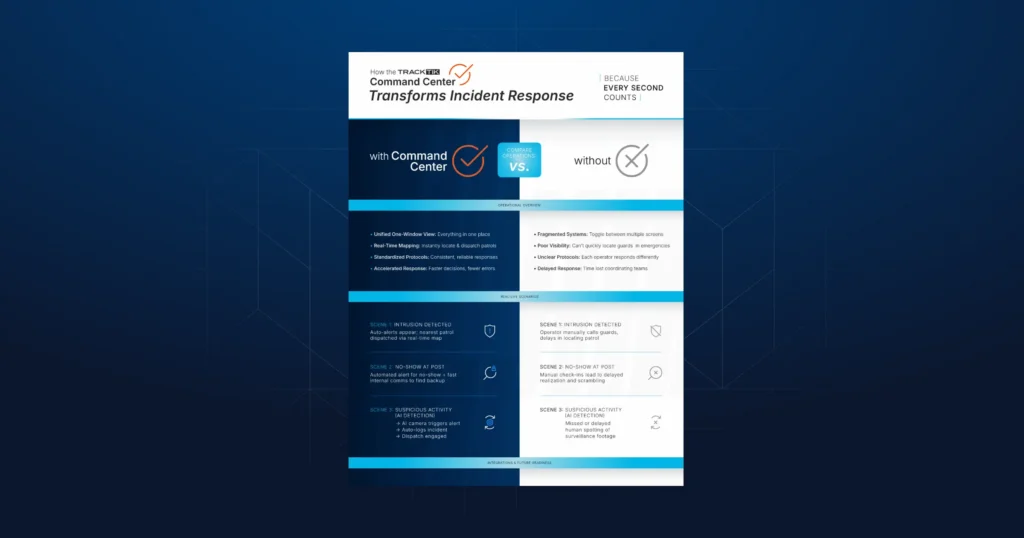
- Know what happened before the client calls. The command center gives a live view of dispatch and incidents, which is the difference between leading an incident and being briefed on one afterwards.
- Protect the early warning system. Structured reporting means a concern reaches the right person without an officer having to judge the mood of their supervisor first.
- Buy back the hours leadership needs. Business administration removes the scheduling, payroll and invoicing rework that otherwise consumes the week.
- Keep one version of the truth. The TrackTik platform holds tours, incidents, dispatch, scheduling and billing on one record, so a difficult conversation with a client or an officer starts from facts rather than recollections.
A supervisor who is afraid to call you is not a loyalty problem. It is a reporting problem, and it is the most expensive one on this list.
A Weekly Leadership Habit Worth Building
Leadership in this industry rarely fails through a single bad decision. It fails through a hundred weeks where the urgent crowded out the important. A short fixed routine is the most reliable defence, and thirty minutes is enough.
- Read the exceptions, not the totals. Missed checkpoints, late clock-ins and sites with unusually few reports tell you more than a completion percentage ever will.
- Pick one account to look at properly. Rotate through your client list so every contract gets genuine attention a few times a year rather than only when it is in trouble.
- Ask one supervisor what they are worried about. Not a status update. Specifically what is worrying them, and then do something visible about one answer.
- Name one thing you got wrong. In front of the team, briefly, without drama. This is the habit that makes the previous question produce honest answers.
- Decide one thing that is not urgent. A rate review, a training gap, a supervisor who needs developing. Protecting this slot is the whole point of the exercise.
Done consistently, this is what the difference between a good leader and a great one actually looks like week to week. It is far less dramatic than the phrase suggests. If you want to see what the exception reporting behind step one looks like against your own sites, you can request a TrackTik demo.
Frequently Asked Questions
Latest Articles



Featured Resources
See Trackforce in action
Book a walkthrough with our team and see how it fits your operation.