Establishing a Culture of Communication for Physical Security

Trackforce
March 11, 2021 · 15 min read

Ask most people in physical security about communication and you get the same answer: it is critical to operations. That is true, and it is also not very useful. It says nothing about which messages need to flow, in which direction, through which channel, or how a security company actually builds the habit across hundreds of officers on dozens of sites.
A culture of communication has two directions. Top-down communication carries post orders, task assignments, training and company news from the office to the officer. Bottom-up communication carries incident reports, site feedback, safety status and ideas from the officer back to the supervisor and the company. Firms that run both well tend to see lower turnover and better client retention, and the reason is simple: officers who know what is expected and feel heard stay longer and perform better.
This article walks through the communication types that fit each direction, the channels that work in the field, a 30-day plan to put them in place, and how TrackTik security workforce software from Trackforce turns both directions into a single operational record.
Key takeaways
- Communication has two directions, and most firms only manage one.
Post orders and training flow down; feedback, incidents and safety status need an equally reliable path back up. - Paper is the biggest gap.
Notebooks, sign-in sheets and printed post orders leave no record, so supervisors cannot see what was read, done or missed. - The phone in the officer’s pocket is the channel.
Mobile apps, push notifications, group messaging and push-to-talk reach deskless officers where email never will. - Bottom-up communication is a retention tool.
Officers who can report, ask and be acknowledged from the field are more engaged and less likely to leave. - One platform beats five apps.
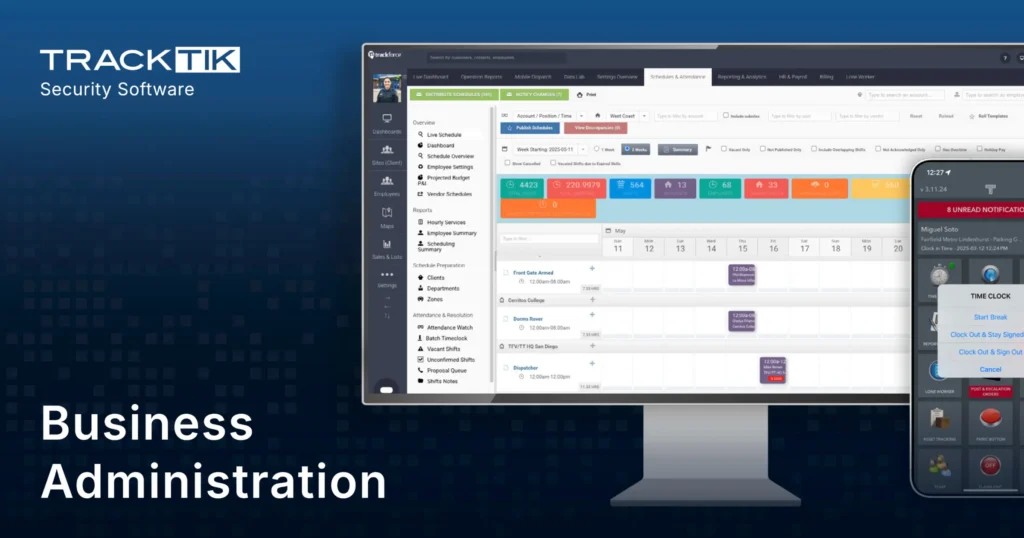
With TrackTik, post orders, site tasks, incident reports, messaging and lone worker alerts live in the same app the officer already uses for tours and shifts, so communication becomes part of the operational record instead of a separate chore.
What a Culture of Communication Means in Physical Security
Security officers are deskless workers. They rarely sit at a computer, they often work alone or overnight, and a supervisor may see them once a shift or once a week. In that environment, communication cannot depend on hallway conversations or a shared inbox. It has to be built into the tools officers already carry and the routines they already follow.
A culture of communication means three things in practice. Every officer can find what is expected of them on a site without asking. Every officer has a fast, low-friction way to report what they see and raise a concern. And every message in either direction is recorded, so a supervisor, a client or an auditor can see what was communicated and when. Firms that get this right reduce the daily friction that drives officer turnover and the service failures that cost contracts.
Types of Communication Best Suited for Top-Down (Employer to Employee)
Top-down communication is the information an officer needs in order to do the job correctly on a specific site. For physical security this usually means officer post orders, task assignments in a digital logbook, reporting instructions for specific site reports, training content and company-wide announcements. It also includes how the company hires and onboards new officers, because onboarding is the first and most lasting communication a new hire receives.
Far too much of this still happens on paper. Printed post orders, notebooks, sign-in sheets and paper reports have created a chasm between officers and their supervisors. A paper post order cannot tell you whether the officer on the overnight shift ever read it, and a notebook entry cannot alert anyone when a critical task is missed. Digital post orders close that gap because the instruction, the acknowledgement and the completed task all live in the same record.
Research by theEMPLOYEEapp found that only 9% of companies used mobile apps as a channel to reach their employees, even though nearly every employee already owns and uses a smartphone every day. Of the roughly 2.7 billion deskless workers worldwide, more than a million are security officers in the United States alone. Mobile technology is essential to a security firm’s survival, and it is also the easiest channel to deploy, because the device is already in every officer’s pocket.
How Can Physical Security Improve Top-Down Communications?
Top-down methods vary by company, but firms that run communication through a mobile app tend to rely on the following every day.
Digital Post Orders and Site Tasks
Post orders are the foundation of top-down communication. When they are delivered through the officer’s app, a supervisor can update them in minutes, require an acknowledgement, and attach site tasks with a deadline and a required photo. In TrackTik guard management, post orders are tied to the site and the shift, so the right instructions appear automatically when the officer clocks in, and missed or late tasks surface in real time instead of at the next site visit. Firms often find that tasks are the most effective communication channel they have, because every task is a message with a built-in confirmation.
Push-to-Talk (PTT)
Push-to-talk over a smartphone gives supervisors direct verbal communication without the cost of dedicated radios. Beyond urgent instructions, supervisors can monitor channels to pick up on officer behavior and reinforce company standards on site. The use of PTT in security guard communications works best when it complements, rather than replaces, written channels that leave a record.
Video and Online Task Training
Digital training modules let a security company prove that officers were trained on a procedure, which matters for state licensing and for client service agreements. Rich media such as PDF uploads, short videos and quizzes improves the experience for the officer, especially for need-to-know onboarding content. Configurable training modules that track completion by officer and by site make the compliance side automatic.
HR and Company-Wide Onboarding Communication
Phone screens, online job boards and video interviews are now standard recruiting practice for security firms. Applicant tracking and onboarding that connects directly to scheduling means a new hire’s licenses, certifications and site assignments are captured once and communicated everywhere, rather than retyped by HR, the scheduler and the site supervisor.
A Channel Map for Two-Way Security Communication
The right channel depends on how urgent the message is and whether it needs a permanent record. Use this map as a starting point and adjust it to your sites.
| Message | Direction | Best channel | Needs a record? |
|---|---|---|---|
| Post orders and site procedures | Top-down | Digital post orders in the officer app, with acknowledgement | Yes |
| Daily task assignments | Top-down | Site tasks with deadlines and photo proof | Yes |
| Urgent instruction during a shift | Top-down | Push-to-talk or dispatch message | Yes, via dispatch log |
| Training and policy updates | Top-down | In-app training modules with completion tracking | Yes |
| Company news and recognition | Top-down | Push notification or group message | No |
| Incident and activity reports | Bottom-up | Mobile incident reporting with photos and location | Yes |
| Site feedback and suggestions | Bottom-up | Group channel to the supervisor, plus periodic surveys | Helpful |
| Officer safety status | Bottom-up | Lone worker check-ins and panic alerts | Yes |
| Confidential concerns | Bottom-up | Anonymous survey link or private channel | Protected |
Types of Communication Best Suited for Bottom-Up (Employee to Employer)
Not every security company treats officer feedback as valuable. The ones that do tend to see lower turnover and higher retention, because an officer who is asked for input and sees it acted on has a reason to stay. Trackforce’s research on reducing turnover and increasing officer engagement keeps returning to the same point: how a company listens shapes who stays.
Bottom-up communication generally includes:
- Incident, activity and maintenance reports from the site
- General surveys and employee feedback questionnaires
- Questions about post orders, schedules and pay
- Employee engagement and community building
- Employee safety status and requests for assistance
The key is giving officers a real opportunity to be heard. A solution that actively seeks officer input, and makes it visible that someone responded, tends to be the best at retaining both new and experienced talent.
How Can Physical Security Improve Bottom-Up Communications?
Officer engagement works when it is easy. Email and shared documents have a place, but the ability to report, comment or ask for help from the field, in the moment, is what matters. Mobile apps take advantage of a device the officer already owns and carries for the entire shift, which also makes the phone the most reliable safety channel the company has.
Mobile Incident and Activity Reporting
The most important bottom-up message is the report. When officers can file an incident from their phone with photos, time stamps and GPS location, supervisors see what happened while it is still happening, and clients receive a professional report instead of a phone call the next morning. TrackTik security incident reporting structures the report so the officer answers the right questions, and ReportPro AI cleans up the writing so a quick field note reads like a finished document.
Push Notifications and Mass Group Messaging
Push notifications and group messaging are familiar to every officer. For bottom-up communication, group messaging can be as simple as a channel for the officers on a site, a supervisors-only channel, or a direct channel where an officer can reach their supervisor when needed. These channels carry the need-to-know information and the want-to-know information that builds a team. A separate confidential channel, such as a link to an anonymous survey, gives officers a safe way to raise concerns. When supervisors set up these expectations in advance, it shows the company is serious about hearing from the field.
Lone Worker Protection
Workplace safety is changing, and incidents can and do occur even on well-run sites. With comprehensive lone worker protection, an officer has a direct line to help through timed check-ins, a panic button and automatic alerts if a check-in is missed. A mobile device makes this simple: one touch tells the office that an officer needs assistance, and the officer knows that communication is never interrupted.
A 30-Day Plan to Build Two-Way Communication
You do not need a company-wide program to start. Pick two or three sites, run this sequence, and expand once the habits hold.
- Week 1: Audit what exists. Collect every paper post order, notebook, sign-in sheet and group text thread on the pilot sites. Note which messages have no record and which officers have no reliable way to reach a supervisor.
- Week 2: Move post orders and tasks into the app. Publish the current post orders as digital post orders with an acknowledgement, and convert the three most important daily duties on each site into site tasks with a deadline and a photo requirement.
- Week 3: Open the channels going up. Set up a site channel and a direct supervisor channel, turn on mobile incident reporting with a short required template, and send a three-question survey asking officers what gets in the way of doing the job well.
- Week 4: Close the loop and measure. Reply to every survey response and every report, in writing, within one shift. Then compare task completion, report volume and acknowledgement rates against week one and share the results with the officers who produced them.
Common Mistakes That Break a Culture of Communication
- Treating a group text as a system. Consumer messaging apps have no audit trail, no site context and no way to confirm that an instruction was read. They are fine for banter and dangerous for post orders.
- Asking for feedback and never answering it. One unanswered survey teaches officers that the channel is decorative. If you cannot respond, do not ask.
- Running five apps for one shift. A separate app for scheduling, another for reports, another for messaging and another for check-ins guarantees that something gets skipped. Officers adopt one app; they abandon five.
- Letting pass-down notes live in a binder. Shift-to-shift handoff is one of the highest-risk moments on a site. If the note does not reach the incoming officer’s phone, it may as well not exist.
- Measuring nothing. Acknowledgement rates, task completion and report turnaround are easy to track once communication is digital. Firms that measure them can prove service levels to clients; firms that do not are guessing.
How TrackTik Supports a Culture of Communication
TrackTik was built for the way security work actually happens: on a phone, in the field, often alone. Both directions of communication run through the same officer app and the same back office, so nothing has to be copied between systems.
Top-down: Post orders, site tasks and training are delivered through the TrackTik security guard tour app, tied to the site and the shift, with acknowledgement and completion tracked automatically. Supervisors in the Command Center see every site in one view and can push an instruction to one officer, one site or the whole company in seconds.
Bottom-up: Officers file incident and activity reports, check in as lone workers, and request help from the same app. Security guard dispatch turns a request from the field into an assigned, time-stamped response, and TrackTik business intelligence rolls up acknowledgement rates, task completion and report volume by site and by officer, so leadership can see which sites communicate well and which need attention.
Because all of it sits on the same platform as scheduling, time and attendance and security operations, the communication record and the operational record are the same record. That is what lets a firm show a client exactly what its officers were told and exactly what they did about it.
Solidifying Your Culture of Communication
Improving officer retention, establishing two-way communication and creating value in every message are critical to any security operation. Top-down and bottom-up communication together create a true employee-to-employer connection, and a positive work culture starts when every effort points toward clear, transparent and recorded communication.
Whether your organization needs to strengthen the instructions going down or the feedback coming up, the tools exist to do it in one place. Book a TrackTik demo to see how post orders, site tasks, incident reporting and lone worker protection work together on a single officer app.
Frequently Asked Questions
Latest Articles
Featured Resources
See Trackforce in action
Book a walkthrough with our team and see how it fits your operation.