The 2020 Security Letter: What it Says (and Doesn’t Say) about the Security Industry

Trackforce
July 7, 2020 · 9 min read
It has only been 7 months since the last Security Letter was released in 2019, but in that short span of time, so much has changed in the world. Founded by Dr. Robert McCrie, with help from Keith Oringer of Security ProAdvisors and Jeff DiDomenico of Trackforce, the Security Letter has been a long-standing benchmark for the security industry. For the past two decades, the Security Letter has provided an overview on the top physical security firms in North America.
This year’s letter feels a bit different. Coming out in a time when the industry is in a fluid state, it will be interesting to see how the companies in this letter will change the next time around. With that in mind, there are some interesting takeaways and trends to look at as we compare 2019 to 2020 letters. Let’s take a look and see what trends and analysis we find.
Key takeaways
- The Security Letter benchmarks North America’s top physical security firms.
Founded by Dr. Robert McCrie, it is a long-running snapshot of the contract security market. - Reported revenue rose to just under $19 billion.
The 2020 letter showed growth of 18% from 2019, driven by organic growth, acquisitions and new participants. - The largest firms dominate.
The top six companies held nearly 90% of reported revenue. - Read the numbers with care.
Participation is voluntary and the 2020 figures were collected before COVID-19. - Consolidation raises the bar for everyone else.
Growing firms compete on service quality, proof and efficiency, which is where TrackTik helps.
The Challenge with the 2020 Security Letter
As stated above, the challenge with looking at this security letter when compared to the previous versions stems from the unforeseen turn of events in 2020. It is worth noting that each year, the reporting on the letter is strictly voluntary, so it includes only those companies that wish to participate. This year, the letter will present pre COVID-19 numbers. As we await how the industry will respond post COVID-19, we should expect the 2021 Security Letter to reflect how companies have recovered from the global shutdown. However, let’s examine the interesting findings we do derive from the 2020 version.
Movement in the Industry and on the List
The first thing to notice are the new “faces” on this list. Seven new companies have emerged on the list; and, despite this year’s letter having 4 more slots than the previous year, this only explains some, not all, of the movement. The most notable additions include Constellis, Paladin and Prosegur joining their peers on the letter.
There have been a lot of mergers and acquisitions in the market last year, which not only consolidates the market, but also creates growth for emerging firms. A notable name missing from the list is SOS Security, who was purchased by Allied Universal late last year. This move solidifies Allied’s position as the leader in our market.
Revenue Increased 18% From Previous Years, With a Catch
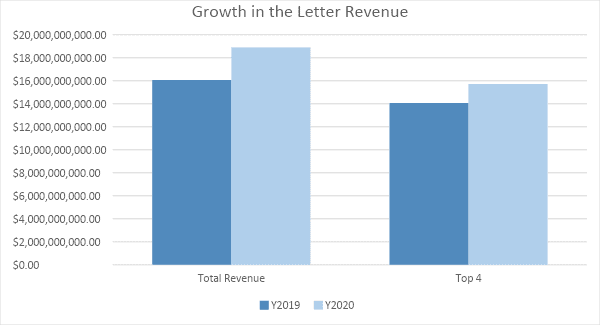
When imagining the Security Letter as the “S&P” of the Security industry, we can see a good indication of how the market has grown, changed, and evolved. In December of 2019, we saw the total revenue of the group hover near $17B. This year we are looking at an overall revenue figure of just under $19B, which is 18% up from 2019. The top 6 companies on this list still hold the majority of the revenue with nearly 90%.
What does this tell us? Often, these revenue figures represent a combination of growth and acquisition. With the acquisition of SOS last year, Allied added over $500 million in revenue to their business. The data also fluctuates as new companies join the list. As this report is voluntary, the overall numbers change with the number of reporting companies.
In reviewing the top 4 companies, we can see how they maintained top positions from 2019 to 2020, indicating that their movement is in line with the market. The top four had a 12% increase from 2019 to 2020, which is a combination of M&A, expansion of services, and continued growth of the industry.
The 2020 Security Letter at a Glance
| Finding | What the 2020 letter showed |
|---|---|
| Total reported revenue | Just under $19 billion, up from near $17 billion in December 2019 |
| Reported growth | 18%, from a mix of organic growth, acquisitions and new participants |
| New companies | 7 new names, including Constellis, Paladin and Prosegur |
| List size | 4 more slots than the 2019 letter |
| Share held by the top 6 | Nearly 90% of reported revenue |
| Growth of the top 4 | 12% from 2019 to 2020 |
| Notable exit | SOS Security, acquired by Allied Universal |
Positive Indications with Cautious Optimism
The 2020 Security Letter data shows positive movement in the industry. Revenues are moving in the right direction and there are more participants on the list reflecting movement in the industry. What we await to see is the impact the global crisis has had on our industry. Although the general unemployment numbers were low at the time the letter was drafted, we still see an abundance of resources and clients as they were before. Now, despite some industries having completely shut down, there are others that have thrived in the new normal.
Just like the S&P 500, indications from the experts say the economy will bounce back from this artificially induced recession. We too hope the security market will come back stronger than ever. Regardless of the current situation, it is important to have benchmarks such as Dr. McCrie’s Letter that give us a snapshot into the evolving world of Physical Security.
What Has Happened Since the 2020 Letter
Several of the trends the 2020 letter pointed to have only accelerated:
- Consolidation continued. Allied Universal completed its acquisition of G4S in 2021, and Securitas acquired Stanley Security in 2022, further concentrating the top of the market.
- Staffing became the defining challenge. In Trackforce research, 42% of security leaders named high turnover as their number one challenge, echoing the long-running problem of too many contracts and not enough guards.
- Technology adoption grew, but unevenly. Only about half of security companies report using AI or automation, as covered in the AI adoption paradox.
For a current, data-driven view of the market, see the Physical Security Operations Benchmark Report, a study of more than 300 contract security providers and enterprise security teams.
What the Rankings Mean for Growing Security Firms
When a handful of companies hold most of the revenue, growing security firms win by being better, not bigger. Here is where to focus:
- Compete on proof, not size. Clients compare evidence. GPS-verified tours, time-stamped incident reports and client-ready reporting show the value you deliver on every site.
- Protect margin as you grow. Overtime and unbilled hours erode profit quietly. TrackTik Margin Insight shows each contract’s projected margin while the period is still open. Read more on how to increase profit margins at your security company.
- Build systems that scale. Acquisitions and new contracts only pay off if scheduling, payroll and billing can absorb them. TrackTik security company management software connects them in one flow.
- Use data the way the largest firms do. TrackTik business intelligence turns daily operations into dashboards you can use in client reviews and growth planning.
Ready to compete with the largest security companies on service and efficiency? Book a TrackTik demo.
Frequently Asked Questions
Latest Articles





Featured Resources





See Trackforce in action
Book a walkthrough with our team and see how it fits your operation.