The AI Adoption Paradox: Security Leaders Want It, But Only Half Are Using It

Trackforce
March 7, 2026 · 6 min read

The AI Adoption Paradox: Security Leaders Want It, But Only Half Are Using It
Key takeaways
- Just over half have started.
53% of security companies use AI or automation in operations today, which leaves a very large minority still running entirely on manual process. - The non-adopters are not resistant.
55% of those not yet using it say they are actively exploring, so the blocker is execution rather than belief. - Leaders already know where they want it.
Real-time incident detection and predictive scheduling are named most often, because both remove work rather than add it. - Cost, integration and unclear ROI are the brakes.
Not scepticism about the technology, but uncertainty about what it costs to run and whether it will connect to what is already in place. - Trackforce ships AI inside the platform teams already use.
ReportPro AI structures incident reports at the point of capture and the same record feeds scheduling and analytics, so adoption does not mean adding another system.
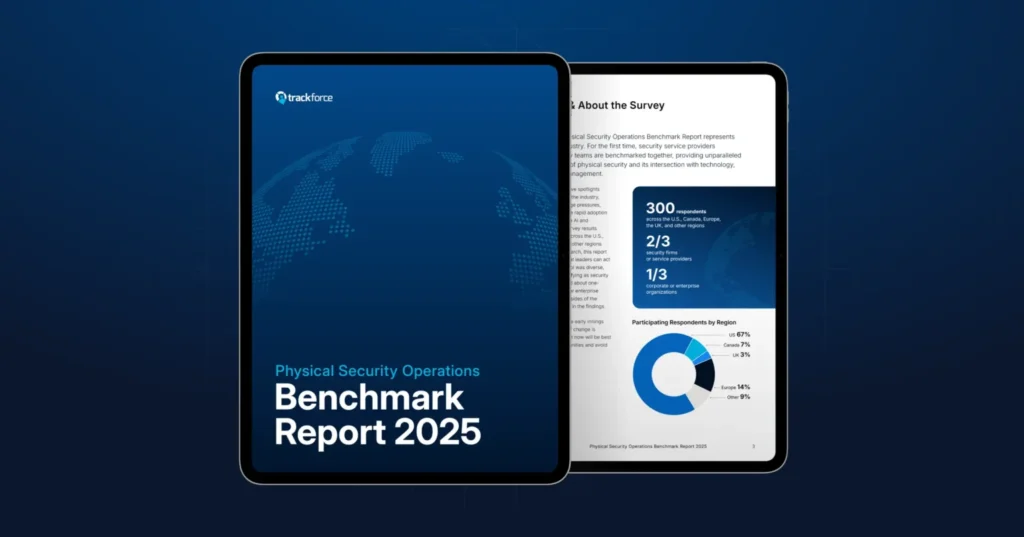
The Trackforce Physical Security Operations Benchmark Report reveals surprising numbers relating to AI. Only 53% of companies currently use AI or automation in their operations, despite widespread recognition of its value. Among those not yet on board, more than half (55%) are actively exploring how to bring these tools on board.
This highlights a gap between interest and execution: while enthusiasm for AI is high, implementation remains a challenge. Security leaders clearly see value- especially in features like real-time incident detection and predictive scheduling, which promise to boost efficiency and reduce risk. Yet barriers such as cost, integration complexity, and uncertainty about ROI are slowing progress.
The stakes couldn’t be higher. Security teams are under constant pressure to do more with less, making automation more than just a “nice to have” – it’s become a competitive necessity. Bridging the divide between interest and adoption will determine which organizations can stay ahead in an increasingly complex environment.
Where security leaders want AI first
The two capabilities that come up most often are real-time incident detection and predictive scheduling. That is not a coincidence. Both target work that is already happening manually and already costing time, which makes the business case easier to write than it is for more speculative applications.
Incident detection appeals because the alternative is a person watching feeds or reading reports after the fact. Predictive scheduling appeals because filling a last-minute call-off is one of the most repetitive, highest-friction tasks in the operation. In both cases the value shows up in hours saved and response times rather than in abstract capability.
Why interest stalls before implementation
The barriers reported are consistent: cost, integration complexity, and uncertainty about return. Worth noting what is not on that list. Leaders are not questioning whether the technology works. They are questioning whether it will fit what they already run, and whether they can defend the spend.
That distinction points to a different kind of answer. If the obstacle were confidence in AI, the fix would be evidence. Because the obstacle is integration and cost certainty, the fix is architectural: adopt AI inside a platform the team already uses, rather than bolting on a separate tool that needs its own budget line, its own training and its own integration project.
Moving from exploring to deployed
For the 55% actively exploring, the practical question is where to start. A sequence that tends to work:
- Pick the most repetitive process, not the most impressive one. Report writing and shift filling beat predictive analytics as a first project because the before and after is obvious.
- Measure the manual baseline first. If you do not know what report completion currently costs in supervisor hours, you cannot prove what automating it saved.
- Start where the data already lives. AI applied to a system that already holds your patrol, incident and scheduling records sidesteps the integration problem entirely.
- Keep humans on the judgment. The adoption that sticks automates the administrative layer and leaves decisions with officers and supervisors.
Trackforce is built for that path. ReportPro AI structures an incident report at the moment of capture rather than hours later from memory, and because it runs inside the same platform as scheduling, patrol verification and analytics, there is no separate system to integrate or fund. For the fuller argument on why the sector lags and what early adopters gain, see why most security providers are still under-adopting automation.
Frequently asked questions
Latest Articles





Featured Resources
See Trackforce in action
Book a walkthrough with our team and see how it fits your operation.