How to Increase Profit Margins at Your Security Company

Trackforce
October 13, 2026 · 13 min read

Running a security company means managing a business where nearly every dollar of revenue is tied to an officer’s hour on post. You win a contract, set a bill rate, staff the schedule and hope the math holds. Most months it does. But when it doesn’t, the reason usually isn’t visible until payroll has run and the invoices have gone out, when it’s too late to change anything.
That timing problem is why so many security firm owners feel busy and profitable on paper, yet end the quarter with less money than expected. The contracts are full, the posts are covered and the clients are happy. Meanwhile, overtime the bill rate never accounted for and hours paid but never invoiced quietly take a share of every period’s profit.
This guide explains how profit margins work in the security guard business, where the money typically goes, why it’s so hard to see in time and what you can do about it. You’ll find practical steps you can start this week, whether you run five contracts or five hundred.
Key takeaways
- Security company margins are thin, so small labor overruns have an outsized effect on profit.
- Two leaks drive most avoidable margin loss: non-billable overtime and hours paid but never billed.
- Most firms only see margin after payroll closes, when the loss is already locked in.
- Reviewing margin by contract, every week, while the period is still open gives you time to fix problems.
What is a good profit margin for a security guard company?
Gross margins for security guard companies commonly fall between the mid-teens and the low twenties, and operating margins often land near 10%. Where your firm sits in that range depends on your mix of contracts, your local wage market and how tightly you manage labor.
Gross margin vs. operating margin
These two numbers answer different questions, and it helps to track both.
Gross margin is what’s left of a contract’s revenue after you pay for the labor that delivered it. In a guarding business, that means officer wages plus the costs that come with every paid hour, such as payroll taxes, workers’ compensation and benefits. Gross margin tells you whether a contract is priced and staffed well.
Operating margin is what’s left after you also cover the cost of running the company: sales, management, back-office staff, software, insurance and facilities. It tells you whether the business as a whole is healthy.
A contract can look fine on revenue alone and still lose money once its true labor cost is counted. That’s why gross margin by contract is the number to watch most closely.
Why thin margins raise the stakes
When operating margins sit near 10%, there is very little room for error. A contract that slips a few points on labor can move from profitable to break-even without anyone noticing, and a handful of those contracts can erase the profit from your best accounts.
The upside is that the reverse is also true. Every dollar you protect on an existing contract goes straight to your bottom line, with no sales cost or new hiring attached. For many firms, protecting margin on current contracts is one of the fastest ways to make more money.
Why labor costs decide security company profitability
Labor is the biggest cost in private security, reaching up to 65% of total cost. That makes a security company’s profit, above all, a question of how its labor hours line up with what it bills.
The challenge is that the two sides of that equation are set at different times. Your bill rate is agreed when the contract is signed, often for a year or more. Your labor cost is decided shift by shift, as officers call off, posts need extra coverage and schedules change. When the schedule drifts, the cost moves and the bill rate stays where it was.
The two biggest margin leaks in security guard contracts
Most avoidable margin loss comes from two leaks. They look similar on a payroll report, but they happen for different reasons and need different people to fix them.
Non-billable overtime
Non-billable overtime (NBOT) is overtime you pay on hours the client is billed at the standard rate. The hour itself is billed, but the overtime premium on it comes out of your margin.
It usually starts with a coverage gap. An officer calls off, and the fastest fix is asking someone already on site, or already near 40 hours for the week, to cover. The post stays covered and the client never notices. But you’ve paid time and a half for an hour you sold at the regular rate. Common triggers include call-offs, turnover, training shifts and last-minute schedule changes.
Trackforce estimates unbilled overtime can cost security companies 6 to 10% of profit, against operating margins near 10%.
Paid, never billed
The second leak is hours an officer is paid for that never make it onto an invoice at all. Here the entire wage is lost, which makes these hours more costly per hour than overtime.
These hours usually point to a scheduling or coverage issue, such as overlapping shifts, early starts or a post running longer than the contract covers. Because each instance is small, they’re easy to miss unless someone is looking for them.
Why each leak needs its own owner
Non-billable overtime is a pricing and contract question, so it belongs to the account manager, who can revisit rates, contract terms and overtime approval. Paid-not-billed hours are a scheduling question, so they belong to the scheduler, who can fix the coverage pattern behind them.
Combining the two into one overtime or labor number makes both harder to act on. Tracking them separately, contract by contract, lets each owner see exactly what’s theirs to fix.
Why you can’t see your margin until after payroll closes
If both leaks are fixable, why do they keep happening? For most security companies, the answer is timing.
The three steps that stand between you and your margin
A period’s financial picture only exists after three things happen in order: every shift is approved, payroll runs and invoices go out. Each step waits on the one before it, and none can be rushed by working harder on the previous step. Until all three are done, nobody accountable for the account has a margin figure to look at.
The blind window
That creates what we call a blind window. For the whole period, while a manager could still adjust the schedule, add a floater or push back on unplanned overtime, the numbers that decide whether the contract makes money are out of sight.
The common workaround is a spreadsheet built after close. It explains what went wrong last period, but it arrives too late to change this one. And because it takes time to build, it’s often done monthly or quarterly, which means the same problem can repeat several times before anyone sees it.
Example: how one call-off erases a shift’s profit
To see how quickly a single leak adds up, here’s a simple illustration using round, made-up numbers.
A post bills at $30 an hour and the officer earns $20 an hour, so each regular hour leaves $10 of gross margin. An officer calls off an eight-hour shift. The replacement has already worked 40 hours that week, so the shift is paid at time and a half: $30 an hour.
|
Regular shift |
Covered in overtime |
|
|---|---|---|
|
Billed (8 hours at $30) |
$240 |
$240 |
|
Paid |
$160 |
$240 |
|
Gross margin |
$80 |
$0 |
The client sees no difference. The shift was covered and billed as usual. But the profit on it is gone, and a handful of call-offs in a month can push a contract toward break-even. Multiply that across dozens of contracts and it’s easy to see how a firm can stay busy and still miss its profit targets.
7 ways to increase profit margins at your security company
None of these steps require new contracts or new headcount. Each one helps you catch margin loss earlier or prevent it from starting.
1. Track margin by contract, every week
A strong month overall can hide one or two accounts that lose money every period. Review gross margin contract by contract, and do it weekly while the period is still open. The goal is to spot a contract drifting in week two, while you can still change the schedule.
2. Set an overtime threshold for each contract
Decide what share of hours can run in overtime before a contract needs attention. The right number varies by site, so set it for each contract. When a contract crosses its threshold, that’s the signal to look at coverage before the next shift.
3. Build a call-off plan that doesn’t default to overtime
Much non-billable overtime starts with a call-off covered by whoever is closest. A bench of part-time or floating officers who are under 40 hours for the week lets you cover short-notice shifts at regular rates. Track who is available and how close each officer is to overtime before you make the call.
4. Audit paid-not-billed hours by scheduler
Review hours that were paid but never billed, grouped by the scheduler responsible. Patterns like recurring overlaps or early starts usually trace back to a specific site or schedule template. A short weekly review keeps small gaps from piling up.
5. Price new contracts on real overtime history
Before you bid, look at the actual overtime history of similar sites you already run. If a type of site regularly needs coverage after call-offs, build that cost into the bill rate from the start.
6. Protect your bill rate floor
Know the lowest average bill rate each contract can carry and still make money once labor costs are counted. Flag any work that falls below it, including add-on hours or special events billed at a discount.
7. Add overtime and escalation terms at renewal
Contract language that addresses client-driven overtime, holiday coverage and wage increases gives you a way to recover costs you can’t avoid. Renewal is the natural time to raise it, backed by the margin history of that account.
How to grow your security business without growing your losses
Growth is the natural next goal once margins are under control, but it multiplies whatever your contracts already do. If a type of site loses money to overtime today, winning ten more like it multiplies the loss.
A few habits help firms grow profitably:
- Know your most profitable contract types. Use margin by contract to see which sites, industries and schedules perform best, and focus new business there.
- Staff for coverage from day one. Build call-off coverage into the staffing plan for every new contract before it starts.
- Watch new contracts closely. Review margin weekly in the first few periods, when a pricing or staffing problem is still cheap to fix.
The firms that grow profitably treat margin as something they manage every week, while there is still time to act.
How TrackTik Margin Insight helps security firms protect profit
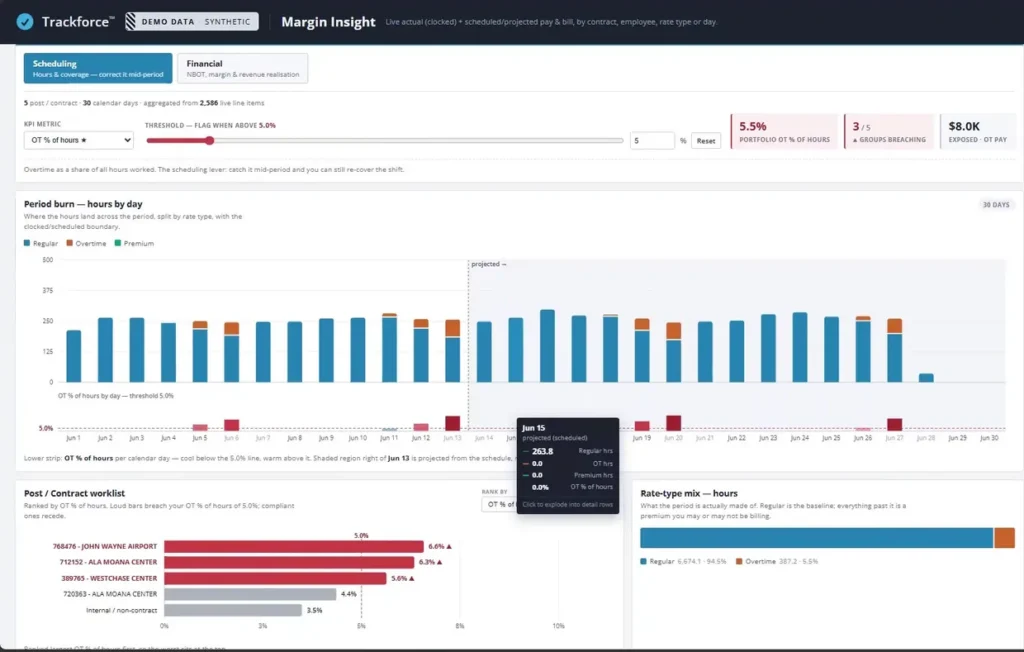
Most of the steps in this guide get easier when you can see margin while the period is still open. Margin Insight brings that view into the TrackTik platform.
It combines the hours your officers have already worked with the hours still on the schedule, so you can see how each contract is tracking before payroll runs. You set the threshold that matters to your role, such as estimated non-billable overtime or paid-not-billed hours, and Margin Insight ranks your contracts against it, shows the dollars exposed and points to the account, day or scheduler to act on first.
Non-billable overtime and paid-not-billed hours are tracked separately for every contract, so account managers and schedulers each see what’s theirs to fix. And every figure exports alongside the records behind it, ready for a finance review or a client conversation.
Frequently asked questions
Conclusion: protect profit while there’s still time to act
Security company profit is decided shift by shift, long before the payroll report arrives. The firms that protect their margins are the ones that can see a contract slipping while the period is still open, and that know who on the team should fix it.
Start small. Pick your five largest contracts, review their margin every week this month and track non-billable overtime and paid-not-billed hours separately. You’ll quickly see where your profit is going and which fixes will matter most.
Ready to see where your profit is going? Book a demo to see Margin Insight on a period from your own book of business.
Latest Articles





Featured Resources





See Trackforce in action
Book a walkthrough with our team and see how it fits your operation.
The Margin Blind Spot
Live TrackTik webinar, Oct 28 at 1 pm ET: see how security firms catch unbilled overtime and coverage gaps mid-period, before payroll and invoicing close.