Healthcare Security Management After Hours: Proving Coverage in Your Highest-Risk Areas

Trackforce
September 14, 2026 · 6 min read
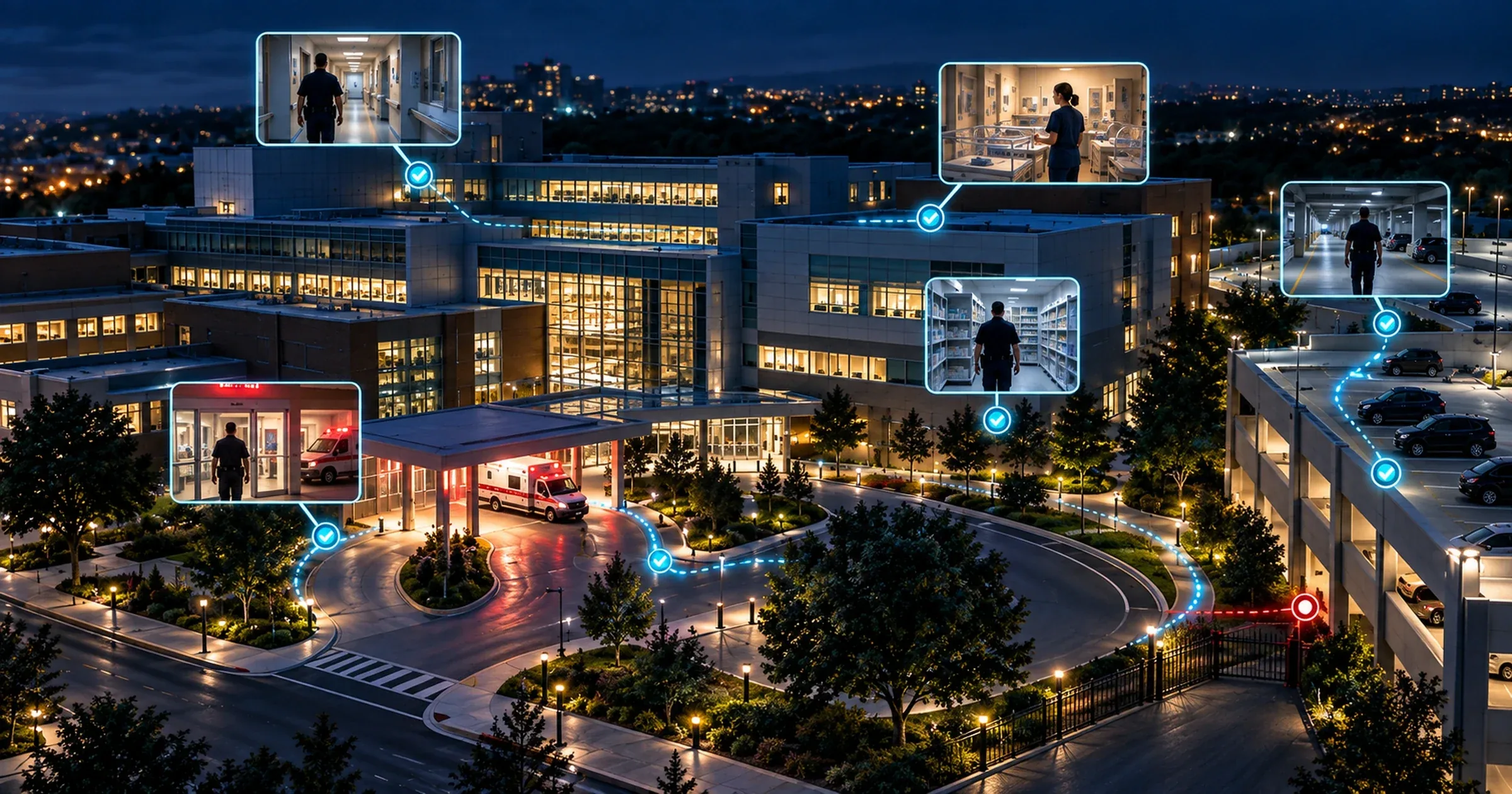
A hospital operates around the clock, and its highest-risk areas carry that same requirement. The emergency department, the behavioral health unit, the pharmacy, the infant unit, and the parking structure each have distinct security needs, and each requires consistent coverage across every shift.
The challenge most security leaders face isn’t scheduling that coverage. It’s verifying that it happened as planned. Without a system built to confirm patrols, access events, and response times in real time, that verification typically only happens after an incident occurs, when a security or risk team is reconstructing what took place from memory, radio logs, or handwritten notes.
Closing that gap between scheduled coverage and verified coverage is where healthcare security technology has advanced the most in recent years.
The Emergency Room After Midnight
Emergency departments carry a disproportionate share of healthcare’s security incidents, and the risk doesn’t taper off after visiting hours end. Staffing thins overnight, patients and families are under stress, and a patrol that’s supposed to happen every 30 minutes can quietly slip.
Real-time, GPS-verified patrols and live location tracking close that gap by giving supervisors a way to see coverage as it happens, not reconstruct it the next morning. A missed round shows up immediately, as a gap on a dashboard, instead of showing up later, as a line in an incident report explaining why no one was nearby.
Securing Behavioral Health and Pharmacy Around the Clock
These two areas share a common requirement: access has to be controlled, and it has to stay controlled, every hour of every day. A behavioral health unit or a pharmacy that’s secure on paper but inconsistently enforced in practice is a liability waiting for the wrong moment.
Controlled access paired with coordinated, facility-wide lockdown capability means a breach in either area triggers a response and a record in the same instant. Security doesn’t have to reconstruct who badged in and when after the fact. The system already knows.
When Seconds Matter in the Infant Unit
Few areas carry lower tolerance for delay than a maternity or infant unit. A Code Pink response has to be immediate, and it has to be documented well enough to hold up under review, not rebuilt afterward from memory and radio traffic.
Timestamped dispatch and response records give that unit exactly that: a record of who responded, when, and what was done, captured the moment it happens rather than pieced together afterward.
Closing the Gap on Perimeter and Lot Coverage
Perimeter and lot coverage is the classic blind spot between shifts. It’s easy to prioritize the units with patients in them and let the parking structure slide to “checked when we have time.” The same GPS-verified patrol data that proves ED coverage proves lot coverage, on the same dashboard, so it stops being an afterthought.
One System, Every Site
For a single hospital, all of this closes the visibility gap between shifts. For a multi-site health system, it does something more.
The real differentiator for a security leader running several facilities isn’t that one hospital can prove its coverage. It’s that every hospital in the network reports the same way. Standardized incident, patrol, and access data across every site means a corporate security team can compare hospital A against hospital B using the same record, instead of reconciling five different formats first to figure out which site actually has a problem.
Coverage You Can Prove
The theme underneath every one of these areas is the same: scheduling coverage isn’t the hard part. Verifying it is, especially when a board, a risk team, or a Joint Commission surveyor asks for proof on the spot.
A platform built to close that gap doesn’t just make the security program run better day to day. It gives every high-risk area in the building, and every hospital in the network, a record that holds up under audit or legal review, whenever it’s asked for.
[CTA: See how TrackTik closes the coverage gap, book a walkthrough with our team]
FAQs
What is healthcare security management?
Healthcare security management is the set of processes, staffing, and technology a hospital or health system uses to protect patients, staff, and visitors across every area of a facility, including high-risk zones like emergency departments, behavioral health units, pharmacies, and parking structures. It covers patrol coverage, access control, incident response, and the reporting needed to demonstrate the program is working.
How can hospitals verify that security patrols actually happened?
GPS-verified patrol technology allows supervisors to confirm coverage in real time rather than relying on a guard’s report after the fact. Each patrol is logged with location and timestamp data, so a missed round is visible immediately instead of surfacing only after an incident.
What are the Joint Commission’s physical security requirements for hospitals?
As of the current National Performance Goals, NPG 11 requires hospitals to identify and manage security risks, control access to sensitive areas, monitor and investigate incidents, and maintain emergency back-up systems. Meeting this standard depends on being able to produce documentation, not just describe a policy.
How do multi-site health systems standardize security reporting across facilities?
A shared reporting structure across every hospital in a network means incident, patrol, and access data are captured the same way at every site. That lets a corporate security team compare facilities directly and identify an underperforming site without reconciling different formats first.
What technology helps secure high-risk hospital areas like behavioral health units and pharmacies?
Controlled access paired with coordinated lockdown capability secures these areas continuously. A breach or unauthorized access attempt triggers both a response and a timestamped record in the same moment, rather than requiring investigation after the fact.
Why does incident documentation matter for hospital security programs?
Timestamped dispatch and response records give a security program a defensible account of what happened during an incident, who responded, and how quickly. That record is what supports internal review, board reporting, and Joint Commission survey readiness.

Featured Resources
See Trackforce in action
Book a walkthrough with our team and see how it fits your operation.