Healthcare & Pharma Security Compliance at Scale: How to Prove Every Site Meets the Standard
Security leaders who can pull the same quality of evidence from every hospital, clinic and pharmacy site walk into surveys and audits ready, whichever location gets the visit. That consistency is what compliance at scale looks like in practice.

Trackforce
October 15, 2026 · 9 min read
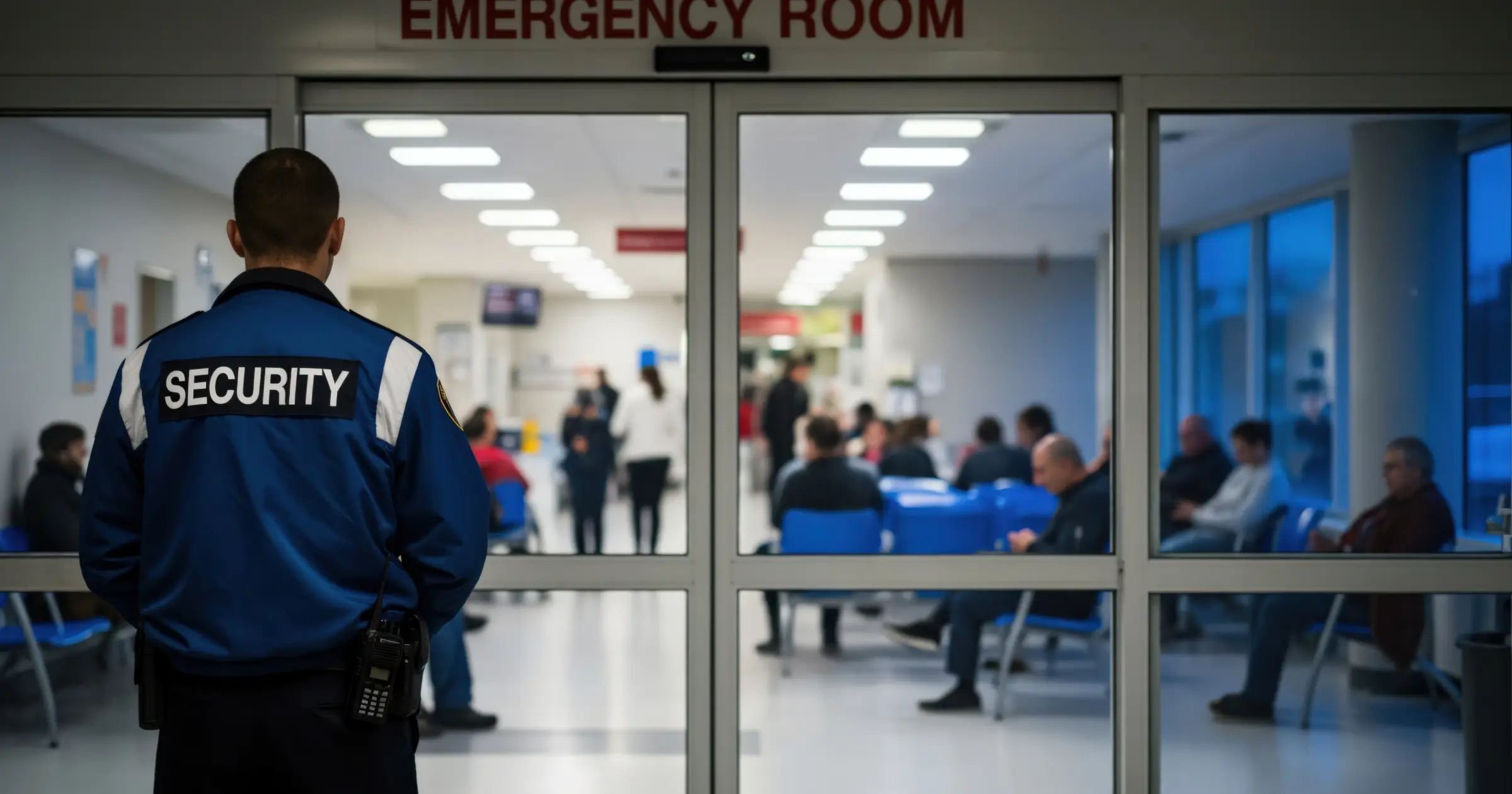
Healthcare security compliance is the documented proof that an organization prevents, responds to and learns from security incidents in line with accreditation standards and regulations. For a single hospital, that proof can live in one security office. For a health system or pharma operator running dozens of sites, it has to look the same everywhere.
Key takeaways
- Surveyors and auditors judge an organization on the site they visit, so security evidence needs to be consistent at every facility.
- Joint Commission NPG 2a (workplace violence prevention) and NPG 11 (secure physical environment) took effect January 1, 2026, and both call for documented, ongoing evidence.
- Proving a workplace violence prevention program works means trending incident volume, response times, follow-up and training completion by site over time.
- Standardized digital incident reports, patrol records and post orders give leaders one view across in-house officers and contracted guard teams.
- Pharma manufacturing, distribution and research sites face parallel demands, and the same standardized evidence approach applies.
What does healthcare security compliance mean?
The Joint Commission’s National Performance Goals raised the bar for security documentation. NPG 2a covers workplace violence prevention, and NPG 11 covers a secure physical environment. Both took effect January 1, 2026.
Under NPG 2a, hospitals need a documented, multidisciplinary workplace violence prevention program that includes trend analysis, corrective action and reporting to the governing body. NPG 11 extends the focus to how the physical environment is secured, from access to sensitive areas to how security incidents are handled.
The practical result for security teams is a shift from having a plan to showing the plan is working. Our Hospital Workplace Violence Prevention: 2026 Evidence Brief breaks down what the standards ask for in more detail.
Why compliance gets harder as a health system grows
Every new facility adds its own way of documenting security. One hospital files incident reports on paper, another uses a guard contractor’s app, and a newly acquired clinic logs events in a shared spreadsheet. Incident categories differ, patrol records live in different places, and post orders drift from site to site.
That variance shows up at the worst moment. When a surveyor asks how a site trends workplace violence incidents, the answer depends on which site they are standing in. System leaders also lose the ability to compare locations, spot hot spots or show the governing body a single picture of program performance.
A single incident also rarely stays inside security. A workplace violence event in the emergency department can reach Employee Health, HR, Nursing, Risk and Compliance within hours. The Cross-Functional Incident Workbook for Hospitals helps teams map those handoffs department by department, with RACI grids built around NPG 2a and NPG 11.
How can hospitals demonstrate compliance with Joint Commission NPG 2a and NPG 11?
Hospitals demonstrate compliance by keeping consistent, time-stamped records of how they prevent, respond to and follow up on security events, organized by site and easy to retrieve on survey day. The strongest programs capture this evidence as part of daily operations, so nothing has to be rebuilt before a survey.
The evidence most security teams rely on:
| Evidence type | What it shows | Supports |
|---|---|---|
| Incident reports | What happened, where, who responded and what followed | NPG 2a, NPG 11 |
| Patrol and tour logs | Verified coverage of wards, entrances, parking and sensitive areas | NPG 11 |
| Post orders | Documented procedures officers follow at each post | NPG 11 |
| Corrective action records | Changes made after an incident and whether they closed | NPG 2a |
| Training records | Officer de-escalation and response training completion | NPG 2a |
| Trend reports | Incident patterns by site, unit and time period | NPG 2a |
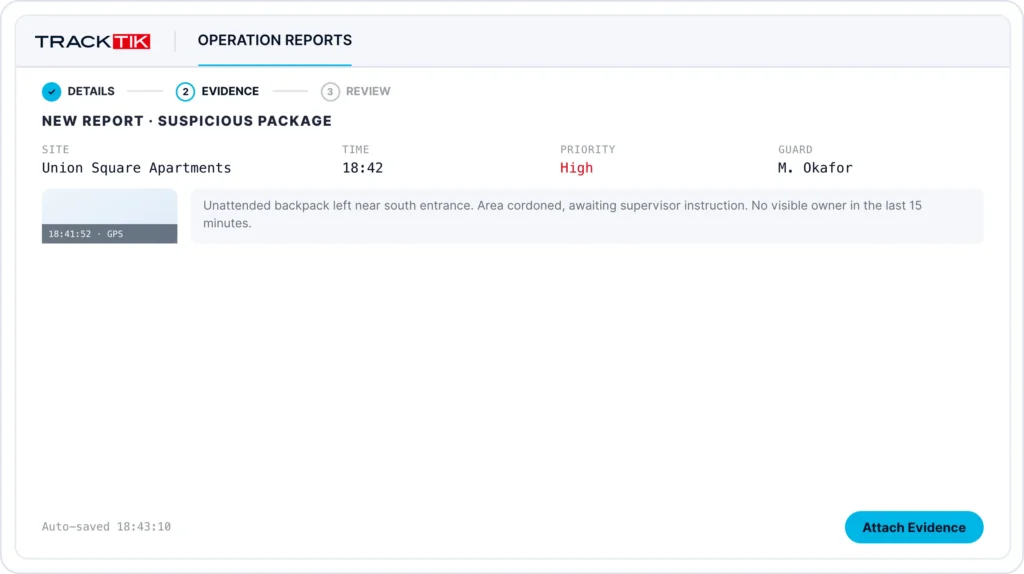
Officer response matters as much as the record of it. Guided de-escalation workflows help officers follow the right steps during a volatile encounter and leave a complete report behind. With TrackTik incident reporting, every patrol, incident and response is logged as it happens and can be exported for Joint Commission and CMS surveys. TrackTik supports your documentation; accreditation decisions remain with the Joint Commission.
How do hospital security teams prove a workplace violence prevention program is working?
Security teams prove results by trending the same measures over time, at every site, and showing what changed after each intervention. Trend lines give leaders and surveyors a clear view of whether the program is moving the numbers.
Measures worth tracking by site and unit:
- Incident volume and severity, broken out by type, so leaders can see whether serious events are rising or falling.
- High-risk locations, such as emergency departments and behavioral health units, where targeted staffing or patrols can be adjusted.
- Response times from report to officer arrival.
- Follow-up closure, meaning how many incidents led to a documented corrective action and how many of those were completed.
- Training completion for officers and frontline staff.
These measures only compare well across sites when every location collects them the same way. Standardized incident forms and categories make a report from one hospital comparable to a report from another, and security analytics roll them up into the system-level view a governing body expects.
We cover this question in more depth in Hospitals Need Proof Their Violence Prevention Programs Are Actually Working. For prevention tactics on the floor, see 4 Ways Security Can Reduce Workplace Violence in Healthcare and Mitigating Potential Healthcare Violence with Training, Visitor Management, and Workforce Management Tools.
Where pharma security compliance follows the same pattern
Pharmaceutical manufacturers, distributors and research operators face a different rulebook with the same core challenge: proving that every site controls access and responds to incidents consistently.
Common security evidence at pharma sites includes:
- Patrol and access records for controlled-substance storage, vaults and restricted production areas
- Visitor and contractor logs for manufacturing and lab facilities
- Incident reports for theft, diversion attempts, unauthorized access and safety events
- Supply chain and shipping-area security records, including C-TPAT documentation where the company participates in the program
The approach that works for health systems carries over directly. Standard post orders, consistent incident categories and verified guard tour records give a pharma security leader one evidence trail across plants, warehouses and labs. Organizations that run both hospitals and pharmacy or distribution operations can manage all of it in one system.
What to look for in hospital security incident reporting software
The best hospital security incident reporting software makes consistent evidence the default at every site. Use this checklist when evaluating options:
- Standardized forms and categories that apply across every facility, with room for site-specific fields
- Mobile reporting so officers can file from the scene with photos, witness details and automatic time and location stamps
- Guided workflows for de-escalation, escalation and notifications to other departments
- Verified patrols for wards, entrances, parking structures and sensitive areas like infant units and pharmacies
- One view across in-house and contract officers, so a site staffed by a guard company still feeds the same compliance record
- Dashboards and trend reports by site, unit and time period
- Survey-ready exports that pull defensible logs in minutes
- Security controls that support HIPAA obligations when incident records touch patient information
Many health systems already run clinical risk or patient-safety reporting tools. Security operations software complements them by capturing the physical security record: officer patrols, response times and incident handling. TrackTik is built for that layer, for enterprise security teams managing many sites at once.
Custom demo
See TrackTik in your healthcare facility
Book a custom demo built around your sites, your incident categories and the evidence your surveyors ask for.
Frequently Asked Questions
Map every handoff before the next incident
A single workplace violence event can reach as many as seven hospital departments. The free Cross-Functional Incident Workbook for Hospitals gives you worksheets and RACI grids to map who owns each step, built around NPG 2a and NPG 11, so your documentation is ready across every site.
Latest Articles




Featured Resources





See Trackforce in action
Book a walkthrough with our team and see how it fits your operation.