Hospitals Need Proof Their Violence Prevention Programs Are Actually Working

Trackforce
August 20, 2026 · 8 min read

Healthcare workers spend their careers protecting patients and each other, often in moments when people are at their most vulnerable. Increasingly, they’re the ones who need protecting too.
The numbers make the case. Healthcare workers make up roughly 10 percent of the U.S. workforce but account for close to half of all nonfatal workplace violence injuries. NIOSH data puts the nonfatal violence rate for healthcare and social assistance workers at more than four times the rate for private industry overall. In a 2026 survey, more than a quarter of nurses reported being physically assaulted at work in the prior year, and most never formally reported it.
Underreporting is its own finding worth sitting with. A separate 2025-26 survey of over 1,200 RNs found that only about 4 in 10 nurses said their employer gives them a clear way to report an incident, and fewer than 1 in 5 said they’re included in violence risk assessments at all. When people who experience violence don’t trust the reporting process, the data a health system relies on for staffing, training, and budget decisions is incomplete before it’s even collected.
Regulators are moving, if slowly. There is still no federal OSHA standard specifically for workplace violence prevention in healthcare, though a rule has been in development for years. The Joint Commission already requires accredited hospitals to have a workplace violence prevention program. California’s SB 553 now requires a written plan for all employers in the state. Health systems will increasingly need to prove their prevention programs work, not just that they exist on paper.
Key takeaways
- The exposure is documented. The proof usually is not.
Healthcare workers are roughly 10 percent of the U.S. workforce but account for close to half of all nonfatal workplace violence injuries, and the harder question for a security leader is showing that prevention work actually happened. - The data is incomplete before it is collected.
Only about 4 in 10 nurses say their employer gives them a clear way to report an incident, and fewer than 1 in 5 are included in violence risk assessments at all. - Requirements are tightening without a federal standard.
The Joint Commission already requires accredited hospitals to run a prevention program, and California’s SB 553 requires a written plan, so existing on paper is no longer the bar. - Visibility changes behavior before an incident occurs.
Verified patrols and immediate logging reviewed by leadership make operators measurably more diligent, which is a far more defensible claim than saying software prevents violence. - Workplace violence needs its own incident category.
Separated from the general security log and reported through Trackforce, the trend is clean enough to bring into an Environment of Care meeting or a board review without anyone questioning the numbers.
Most of the conversation is about alerts. Security leaders keep asking about proof.
Most published content on this topic centers on the moment something goes wrong: panic buttons, duress badges, mass notification. Those tools matter. In conversations with security leaders across hospital systems, though, a quieter problem comes up just as often. They struggle to show that the prevention work happening before an incident is actually happening at all.
That request tends to sound similar across health systems. A security leader inheriting a paper-based logging process wants it centralized so incident and patrol data is trustworthy enough to act on. A newer security director wants reporting built to hold the program accountable. A hospital wants workplace violence tracked as its own incident category, separate from general security logs, so trends in that specific risk are visible.
The common thread is a CSO who needs to walk into an Environment of Care meeting or a board review and show, with real data, where patrols are happening, where they aren’t, and whether the pattern is improving over time.
Accountability data changes behavior before an incident happens
Guard tours, GPS-verified patrols, and checkpoint scanning do more than document what happened after the fact. They create a record that someone is checking, and that record changes how the work gets done.
Andrew Smittie, Chief/Director at Lutheran Health Network, described this in practice. TrackTik data is shared monthly in Environment of Care meetings, with an annual report tracking security trends across the organization and supporting resourcing decisions. That’s a health system treating patrol and incident data as a standing input to compliance and safety governance, not an after-the-fact log pulled out only when something goes wrong.
Likith Kolla, a dispatcher at Lakeridge Health, pointed to the real-time version of the same capability. Being able to see guard location and activity is what matters most during an actual emergency, when leadership needs to know where coverage is without waiting for a radio call.
A facilities operations lead at a large enterprise health care company described the underlying mechanism plainly. Logging issues immediately, with that visibility reviewed by leadership, has made facility operators noticeably more diligent about performing their duties properly and on time. Visibility drives behavior. That’s a more defensible claim than saying a platform prevents violence directly, and it holds up under scrutiny.
Where TrackTik Fits in the Prevention Program
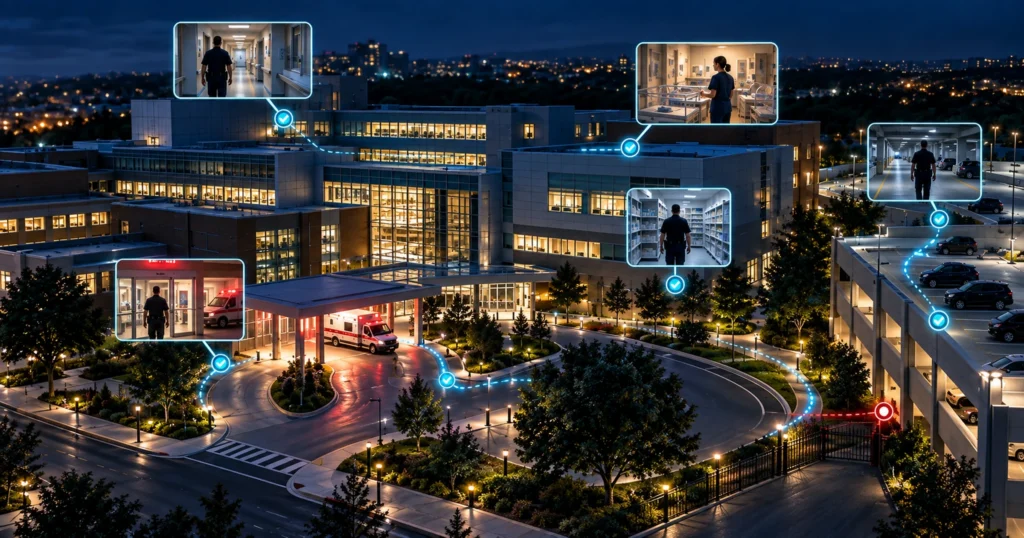
TrackTik supports the operational backbone underneath a violence prevention program. Verified patrols in the areas that carry the most risk. A workplace-violence-specific incident category instead of a general catch-all. Reporting clean enough to bring into a compliance meeting without anyone questioning whether the numbers can be trusted.
For a security leader trying to answer whether a prevention program is actually working, that’s the question that matters most. Not whether an alarm sounded, but whether there’s data to prove the work meant to prevent the incident in the first place is actually getting done.
Frequently Asked Questions
Latest Articles



Featured Resources
See Trackforce in action
Book a walkthrough with our team and see how it fits your operation.