What do You Need to Know to Ensure Your Team is Ready to Face Any Critical Event? Training Highlights for Risk Mitigation

Trackforce
June 17, 2020 · 12 min read
What This New Normal Means for Enterprise Security Operations
Moving forward, especially in this new normal, will be a challenge. Unlike any other business move, for most, joining the restart of the economy after an unprecedented closure due to a health crisis requires determining the best response appropriate for enterprise security solutions and your overall business continuity plan.
After determining what you need during a critical event, what is the next move? First, gathering insights from your team will help you establish what they know, what they don’t, and where improvements can be made. Here are a few things corporate security management must keep in mind.
Key takeaways
- Readiness is a capability question, not a document question.
A contingency plan nobody has rehearsed is a filing achievement. What matters is whether your team can locate people, communicate and record decisions while the event is still running. - Visibility is the first thing you lose.
In the opening minutes of a critical event, knowing who is on site, where they are and which posts are uncovered is worth more than any procedure in the binder. - Train on scenarios, not slides.
Officers retain what they have rehearsed under mild pressure. Tabletop and walkthrough drills expose gaps that a completed training module never will. - Communication fails in predictable ways.
Ambiguous authority, too many channels and verbal instructions nobody logged are the three failures that show up in almost every after-action review. - The record is what turns an incident into improved training.
With TrackTik, the timeline of who was notified, who responded and what they did is captured as the event unfolds, so your post-incident review starts from evidence instead of recollection.
Resource Diversion and Full Site Coverage
Like any other critical event recovery, visibility is key. Not only during a critical emergency but afterwards as well. In recovery mode, there are three things to consider:
- Assess corporate security management needs and prioritize response
- Shift essential resources to recover from perceived losses and to mitigate threats
- Gain insights on identified risk points and your team’s response
Ensuring Team Accountability and Risk Mitigation with a Modified Contingency Plan
“What if” scenarios are most impactful once you and your team have had a snapshot of a critical event. Planning and evaluating for the worst case scenario is part of any risk management plan and is one your team can utilize for enhanced training methods.
Contingency Plan and Security Team Compliance
In taking what insights gained after having gone through a health crisis, there are no guarantees when the next wave may hit, how impactful it will be, or if it will be worse than the first. Adapting training methods to combat the best “worst-case” scenario is key. Here’s what works:
- Disaster Specific Training. Such as: maintaining guard health, recognizing COVID-19 symptoms, and protecting against departmental exposure to security personnel.
- Visitor and Vendor Management. Person-to-person handling, including: people management and crowd control, de escalation tactics, and front-desk package procurement.
- People Management or “Soft Skills”. These include : Communication tactics to maintain clarity and sense of public security and visitor visibility in knowing which 3rd party vendors may be in the building, when, and where.
Physical Security Operations Benchmark Report
Download the report
Four Capabilities a Team Needs Before the Next Critical Event
Whatever the event turns out to be, the same four capabilities decide whether your response holds together. Assess your operation honestly against the third column, because that is what the after-action review will find.
|
Capability |
What it looks like in practice |
What goes wrong without it |
|---|---|---|
|
Live accountability |
You can name every officer on site, their post and their last known position within a minute |
Supervisors spend the first critical minutes phoning around to build a headcount |
|
One channel with clear authority |
Everyone knows who is directing the response and where instructions will come from |
Conflicting instructions arrive by radio, phone and text, and officers pick whichever they heard last |
|
Contemporaneous recording |
Decisions, notifications and actions are logged as they happen, not written up afterwards |
The timeline is reconstructed from memory weeks later, when it matters most and is least reliable |
|
Surge coverage |
You can redeploy officers between posts and sites without losing track of what is now uncovered |
Responding to the incident quietly creates a second gap somewhere nobody is watching |
Build the Training Around Scenarios, Not Slides
Completion rates on a training module tell you who clicked through it. They tell you very little about who will perform. Rehearsal under mild pressure is what moves knowledge into behavior, and it does not require a budget. Run these as 30-minute tabletop or walkthrough exercises.
Debrief each drill in writing while it is fresh and feed the gaps back into the programme. For the fundamentals underneath all of this, see our guidance on running a successful and engaging officer training program.
Maximizing Security Team Coverage for Scalability
Once training methods are adapted, the next step is to prepare these methods to be amplified on a large scale. What does this mean? To make the best use case of your contingency plan, it’s essential to allow for scalability. This can be combated with a few tools that support clear communication among your team, accountability for in-house or contracted security, and lightning-fast reporting captured in real-time.
Mitigate Harmful Team Miscommunication
When it comes to preventing miscommunication among your security team, it’s important to use the best mode of communication to deliver clear and concise information. There are two methods to follow:
- Reinforcing Top Down Orders Between Executives, Supervisors, and Guards
- Creating Connection and Visibility Alongside Your Communication – Plus a Touch of Automation
In approaching communication capabilities, Push-to-Talk (PTT) has been the north star for most in-house security teams. Verbal communication via a PTT direct channel allows for swift control over any situation and will help prevent miscommunication before it can take shape. Read more about building a culture of communication in physical security.
What Changes During an Incident When Operations Are Centralised
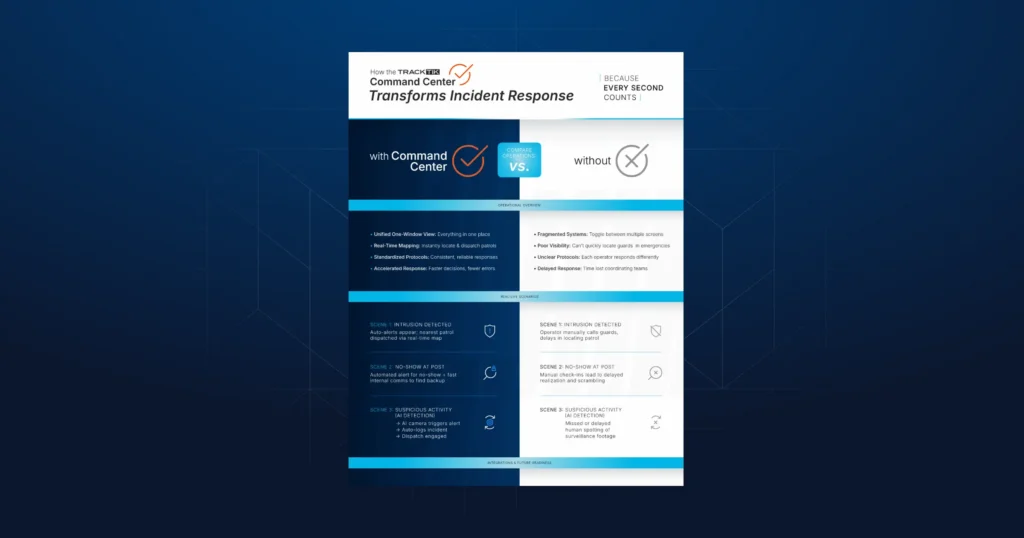
The difference between a controlled response and a chaotic one is rarely the quality of the officers. It is whether the people directing them can see what is happening without asking. When posts, tours, alarms and reports all report into one place, the supervisor stops assembling a picture and starts making decisions.
That is the role the TrackTik command center plays during a critical event. Live post status and officer positions answer the accountability question immediately, alarms and incidents surface in one queue rather than across three systems, and every notification carries a time stamp you can rely on afterwards.
Redeployment is where most responses quietly create a second problem. Pulling two officers toward an incident leaves posts uncovered, and in the moment nobody is tracking which ones. Handling that through dispatch keeps the coverage picture honest while you surge, so the gap you created is visible rather than discovered later.
Recording matters just as much as responding. Entries filed through incident reporting as the event unfolds carry their own time and location data, which is what makes the eventual account defensible. Afterwards, business intelligence turns that timeline into something you can actually analyse, rather than a folder of narrative documents.
Run a Post-Incident Review That Improves the Training
Most after-action reviews produce a document and no change. The fix is to tie every finding to a specific training or configuration change with an owner and a date. Work through it in this order.
- Rebuild the timeline from the record first. Start from logged entries and notifications rather than from anyone’s account, then ask people to fill the gaps. Memory reshapes itself around outcomes.
- Mark every decision point. Identify each moment someone chose between options, and what information they had at that moment. Decisions look obvious in hindsight and were not.
- Separate information failures from judgment failures. An officer who acted sensibly on bad information needs a better data flow, not retraining. Conflating the two damages morale and fixes nothing.
- Convert each finding into one concrete change. A revised escalation rule, an added report field, a new drill. If a finding cannot become a change, it is an observation and should be recorded as one.
- Re-drill the scenario within 60 days. This is the step almost everyone skips, and it is the only one that proves the change worked.
If your incidents routinely involve facilities, HR or legal, it is worth structuring the review across functions rather than inside the security team alone. Our cross-functional incident workbook lays out that format.
Final thoughts
Proper team training will improve communications and avoid mishaps during any critical event. When technology is added, your team will excel in ensuring that your risk management plan is followed to a “T”.
Are you a physical security professional looking for enterprise security solutions?
You’ve come to the right spot. At Trackforce, we specialize in enterprise security solutions made to enhance holistic security methods across all departments. Our corporate security software is made for security by security professionals. Take a look at how we may help your organization succeed.
Frequently Asked Questions
Latest Articles

Featured Resources
See Trackforce in action
Book a walkthrough with our team and see how it fits your operation.