Incident Response Is Never Just One Department’s Job

Trackforce
September 24, 2026 · 13 min read

Every guarding contract produces incident reports. Far fewer produce incident records that hold up when a client disputes an invoice, an insurer asks for the file, or opposing counsel reads them six months later.
Security incident reporting software is what closes that gap. It replaces handwritten logs, radio recaps, and emailed PDFs with structured digital reports carrying timestamps, GPS coordinates, and evidence captured at the moment of the event. For a contract security firm, the report is a deliverable, not paperwork. The hard part isn’t documenting an incident. It’s proving it.
Key takeaways
- It is a system of record, not a form.
The platform captures the event, routes it for action, and stores a timestamped record that can be searched, analyzed, and defended. - Capture method decides whether the record holds up.
Evidence attached as the report is written is more defensible than a document reconstructed after shift end. - The report is a client deliverable.
Accounts renew on evidence of coverage and response, and billing disputes are settled by the record, so client-facing visibility is a buying criterion rather than a bonus. - Physical security reporting is not IT incident management.
The two categories share vocabulary and almost nothing else, and buying the wrong one means re-keying reports for billing and client reporting. - Trackforce connects reporting to the rest of the operation.
In-tour capture, ReportPro AI, Command Center, dispatch, and Data Lab run on one record rather than five systems.
What is security incident reporting software?
It is a platform that lets field officers capture and submit incidents digitally, routes those reports to the people who must act on them, and stores them as a searchable, auditable record.
A capable system does four things: it captures the event through guided mobile forms, attaches evidence as the report is written, escalates by rule instead of waiting for a shift handover, and rolls individual reports into trend data by type, severity, location, and time. That last one is what turns a compliance obligation into a risk tool.
It sits inside security operations software, alongside scheduling, guard management, and guard tour systems. Buying reporting in isolation is common and usually a mistake, because incidents are found during tours and resolved through dispatch.
What information should a security incident report include?
A defensible incident report answers six questions: what happened, when, where, who was involved, who responded, and what action was taken. Most contract disputes turn on the last two.
Beyond the narrative, the fields that hold up under review are:
- Timestamp of the event and timestamp of the report, recorded separately
- Exact location, ideally GPS coordinates rather than a site name
- Incident type and severity, drawn from a fixed list rather than free text
- Names and roles of officers, witnesses, and third parties such as police or EMS
- Attached evidence: photos, video, audio, and written statements
- Actions taken, escalations made, and the resolution or handover
- The reporting officer’s identity and an audit trail of every later edit
Free-text-only reports fail on the fixed-list fields. That’s what makes them impossible to analyze later and easy to challenge.
Why do paper and email incident reports fail?
Manual reporting fails in four predictable ways, and each shows up later as cost or credibility.
Delay. A report written at shift end is written hours after the event, when detail has faded. If it then sits in an inbox overnight, the window to act has closed.
Inconsistency. Without a guided form, two officers documenting the same incident type produce two different documents, and the fields that matter to a claim are the ones most often missing.
Weak evidence. Photos taken on a personal phone and emailed separately are hard to tie to a specific report, time, and location. That gap is where a record gets challenged.
No trend visibility. Documents can’t be analyzed. One loading dock generating eleven incidents in a quarter stays invisible, and so does the case for changing coverage there. That’s the argument for pairing reporting with security business intelligence.
Is security incident reporting the same as IT incident management?
No, and the confusion costs buyers time. IT incident management platforms, the service desk and on-call tools, track outages, tickets, and service restoration. Security incident reporting software tracks physical events on a site: trespass, theft, assault, medical response, property damage, and policy breaches.
The two categories share vocabulary and almost nothing else. Physical security reporting needs mobile capture from officers in the field, GPS and checkpoint context, photo and video evidence, post orders that differ by contract, and a chain of custody that holds up in a claim. A generic incident tool built for IT tickets has none of that, and a guarding firm that buys one ends up re-keying reports into a second system for billing and client reporting.
What features should security incident reporting software have?
Eight capabilities separate a genuine incident reporting platform from a digital form builder.
- Guided, in-tour capture. Officers file mid-shift without leaving the tour, because reporting that interrupts the workflow gets deferred, and deferred reports get thinner.
- Forms configurable per contract. Required fields, severity levels, and mandatory reports vary by site, and the operator should set them without a vendor change request.
- Multimedia evidence with provenance. Photo, video, audio, GPS, and text attached to the report itself, timestamped.
- Automatic escalation. Rules that push an incident to a supervisor, a client, or a third party without anyone remembering to forward it.
- Dispatch integration. Closest-available-officer matching, live ETA, and SLA timers on every response.
- Analytics and data portability. Categorization by type, severity, location, and outcome, and replication into the operator’s own BI tools.
- Device flexibility. Android and iOS, on issued or personal devices.
- Security posture. SOC 2 Type II, ISO 27001, and documented data residency.
What changes for in-house enterprise teams?
Everything above assumes a contract guarding firm, where the report is a deliverable and disputes are settled by the record. For an in-house corporate team the report is risk data instead, and the challenge shifts from client visibility to standardization across sites, vendors, and countries so leadership sees one number instead of nine formats. Enterprise security teams weight vendor-independent data ownership, one taxonomy everywhere, permissions that segregate vendor data, and multi-site aggregation a board will accept.
A shared taxonomy also makes the next conversation easier: showing what an incident means for the departments that absorb it. HR, legal, facilities, and communications each carry part of the aftermath, and a security leader who can map that impact with them builds a stronger case for program investment and a better-prepared crisis team. Trackforce’s Cross-Functional Incident Impact Workbook gives those teams a structured way to work through it together.
TrackTik: Reporting connected to the record
TrackTik by Trackforce is built for the physical security operation rather than the IT ticket queue, and treats the incident report as the connective tissue of that operation. TrackTik security incident reporting gives officers guided, in-tour reporting with timestamped photo, video, audio, GPS, and text evidence, configurable to any contract’s specifications, on Android or iOS and on issued or personal devices.
Four capabilities extend that foundation.
1. ReportPro AI turns rough field notes into compliance-ready documentation and generates executive summaries for supervisors triaging volume. Every AI-assisted change is audit-logged with the original preserved beside it, and sensitive client data is never used to train AI models.
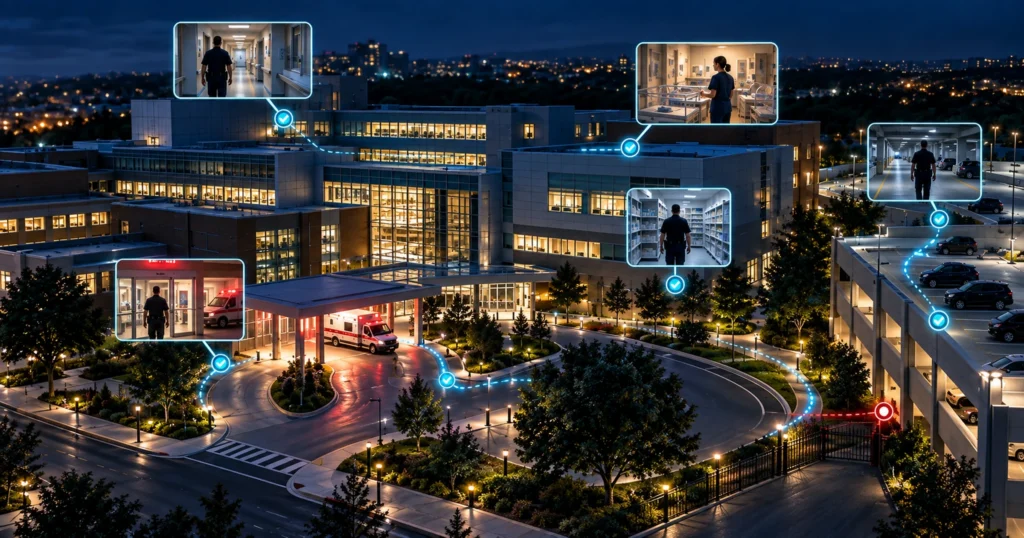
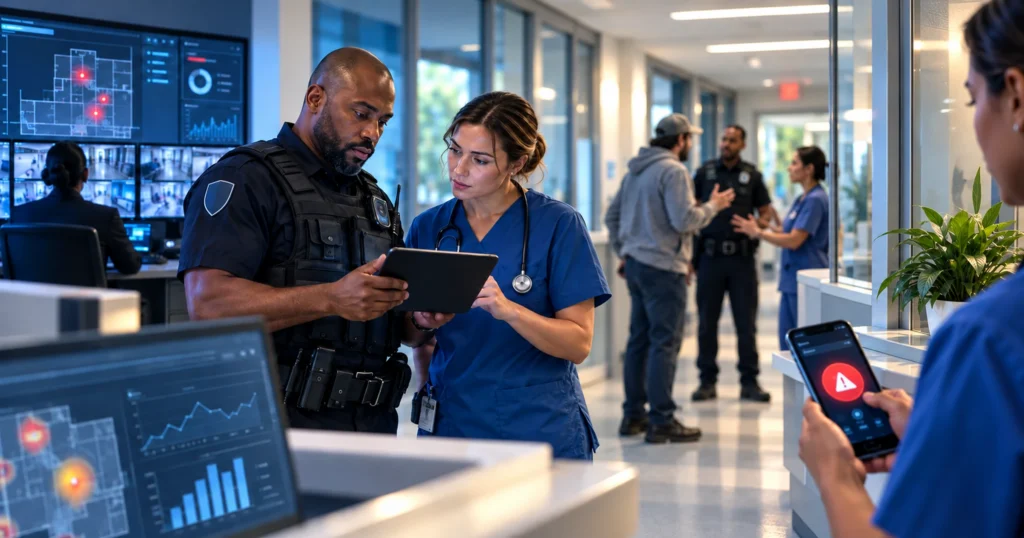
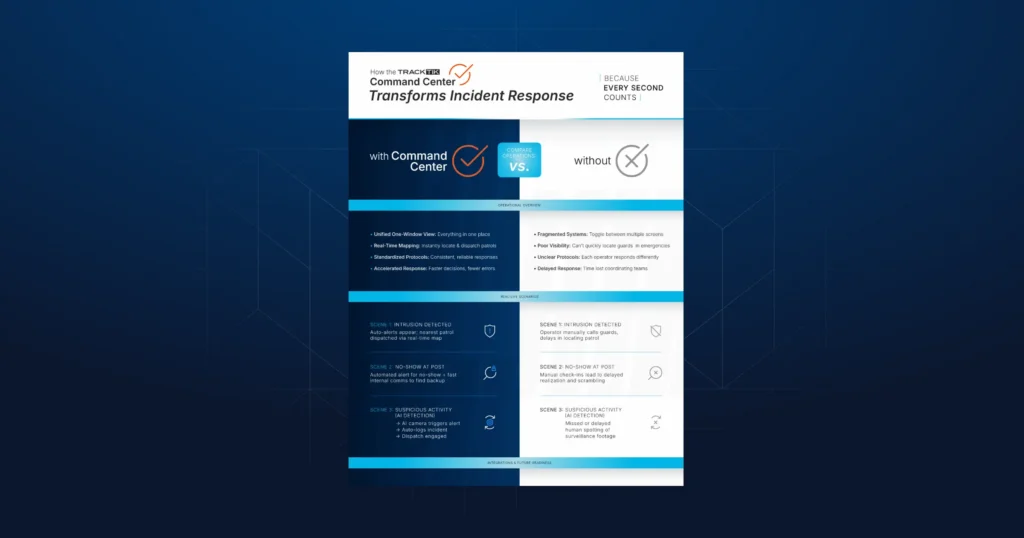
2. Command Center unifies alarm monitoring, video surveillance access, and guard dispatch in one workspace, with call-to-action protocols, full incident timelines, geographic heat maps, and categorization by type, severity, location, and outcome.
3. Service Dispatch matches the closest available officer on live status and ETA and tracks SLA timers on every response.
4. Business intelligence and Data Lab provide drag-and-drop dashboards and automated replication into Tableau, Power BI, or Looker Studio, so the data stays with the operator.
The rest of the operation runs on the same record: guard tour tracking with GPS, NFC, QR, and barcode checkpoints, the security guard app, mobile patrol management, and an open integrations layer for cameras, access control, and alarms.
How should a security firm evaluate incident reporting vendors?
Feature tables flatten everything to a checkbox. These eight questions separate platforms that look similar on paper.
|
Question |
Why it matters |
|---|---|
|
Can officers file a report without leaving the tour? |
Reporting that interrupts patrol gets deferred, and deferred reports lose detail. |
|
Is evidence attached to the report at capture, with its own timestamp and GPS? |
Evidence tied to the record at the moment of the event is what holds up in a dispute or claim. |
|
Is every edit logged, including AI-assisted changes? |
A complete audit trail protects the report when its accuracy is questioned. |
|
Can escalation rules route by severity, site, and client? |
Rule-based routing gets incidents to the right person without relying on a shift handover. |
|
Does a report trigger dispatch in the same system? |
Response times and SLA tracking stay attached to the incident they belong to. |
|
Can each client see its own reports and nothing else? |
Client-facing visibility supports renewals, and segregated permissions protect every other account. |
|
Does it work offline and on personal devices? |
Basements, parking structures, and remote sites are where connectivity fails and incidents still happen. |
|
Which certifications does the vendor hold, and where is data stored? |
SOC 2 Type II, ISO 27001, and documented data residency are baseline requirements for most enterprise clients. |
Trackforce publishes its certifications and data residency positions on its trust and compliance page, and TrackTik pricing is custom-built to each deployment.
Three more questions separate a real evaluation from a feature tour.
What does migration look like? Historical reports are evidence. Ask how many years transfer, in what format, and whether attachments travel with the records.
What happens at renewal if you decide to switch? Export options and scheduled replication into the operator’s own environment decide whether the next move is a project or a negotiation.
What does a realistic rollout look like?
Adoption, not installation, decides whether an incident reporting project works. Officers who find the form slow keep a paper notebook.
The sequence that holds up: standardize the incident taxonomy first, pilot on the hardest two or three sites, configure forms against real post orders, and train supervisors on triage before officers on capture. Data migration and configuration are where timelines slip, which is what professional services exist to absorb with the Trackforce team.
Coverage You Can Prove
Nearly every system captures an incident. Far fewer produce a record complete enough to defend, fast enough to act on, and structured enough to analyze, which is what matters when a client, a risk team, or opposing counsel asks for proof.
Book a walkthrough with our team and see how the TrackTik platform fits your sites and contracts.
Frequently asked questions
Latest Articles


Featured Resources
See Trackforce in action
Book a walkthrough with our team and see how it fits your operation.
The Cross-Functional Incident Workbook
Six worksheets and RACI grids that map how one security incident reaches HR, IT, Legal, Risk, Facilities, and Health & Safety, so every handoff has a named owner before it happens for real.