What Works and What Doesn’t – Highlights on Guard Tour Training and How You Can Leverage Technology

Trackforce
June 10, 2020 · 12 min read
When security firm owners adopt new strategies to keep people safe, how do they work out what will actually hold up in the field and what will not? Here are three ways technology helps you tell the difference, and a straight comparison of the approaches that work against the ones that quietly do not.
Key takeaways
- A completed tour does not prove a trained officer.
A checkpoint scan shows presence. It says nothing about whether the officer knew what to do once they were standing there. - Printed post orders are out of date the day they are printed.
Instructions have to live where the officer already looks, which is the phone in their hand. - Training you cannot evidence does not count.
If you cannot show a client or an insurer who completed what and when, the programme exists but the protection does not. - Attendance is the wrong measure.
Judge training by what changes in the field afterwards: report quality, incident handling, repeat issues at the same site. - Tours and training work best welded together.
Tasks attached to checkpoints in a guard tour system mean the tour itself carries the instruction.
1. Training basics: how training adapts to changing times and needs
Security guards need to be trained on procedures for emergency situations such as an attack, machinery malfunction, fires and natural disasters. Each of these events requires precise training to mitigate, or better yet avoid, the worst-case scenario.
It is essential that guards understand the shifting threats and risks they may face while on duty. For that reason, guard training must be highly customizable, timely, well documented for review, and tracked for accountability. Keeping completion and certification records against the officer in people management is what makes the last two possible.
What works
During a large-scale emergency, officers diverted to where they are needed most have to be ready for crowd control and de-escalation, alongside any event-specific training the situation demands. The COVID-19 period was the clearest recent example: firms that could push new health and safety procedures to the field within days coped, and firms relying on scheduled classroom sessions did not. The lesson outlasted the pandemic. There is more on building that foundation in our piece on training guards to be officers, and on handling violence risk in healthcare settings.
Some sectors need surge guarding at short notice, supermarkets and hospitals among them. When demand spikes, sites that were low-risk last quarter become high-risk this week, and the officers covering them are often new to the location.
This is where de-escalation training earns its place. Officers have to help keep the peace and reduce the chance of violence, and they can only do that if they were trained for escalation before they met it. In healthcare environments in particular, that training is the difference between a contained incident and an injury.
2. Guard tour basics: technology reduces tour discrepancies and improves accountability
How do you know guards are properly trained? And how can training be updated at a moment’s notice during a fast-moving critical event?
What works
Although it may seem obvious, there are three essentials your team must be trained on for proper response:
- Post order management
- Reporting best practices
- Supervisory communication
Post order management
Depending on your post order protocols, it is a bad look when guards do not understand their tasks during a tour, and the client usually notices before you do.
Digital post orders distribute workforce instructions as they change, so guards always have current procedures rather than whatever was printed last quarter. Delivered through the guard mobile app, an update made at head office is on the officer’s phone for their next shift.
Reporting best practices
Guard activities and incidents have to be logged and tracked, and not just for attendance and accountability. It is an essential part of compliance and overall risk mitigation.
Customizable guard reports are what streamline communication between you and your supervisors. That means training officers on exactly what you want documented, including time-stamped photos, audio, GPS location and notes.
Supervisory communication
Supervisors need training on how to follow up incidents reported by guards. Scrambling to piece an incident together after the fact is avoided when reports are automatically routed to an assignee the moment a guard completes them.
3. How guard tours and training work better together
Here are two reasons guard tours and training are best applied together:
Teams can reduce violence, conflict and harmful miscommunication
Situational awareness requires real vigilance in monitoring risks to both the business and the operational environment, and that gets harder the more distributed your team is.
When choosing how to communicate, use the mode best suited to getting a clear message to the field. Most firms end up with a mix: written communication in digital form, such as mass notifications and messaging, and verbal mobile communication, such as a phone call or Push-to-Talk. Where an incident needs a live response rather than a message, that is a dispatch decision rather than a communication one.
Push-to-Talk remains one of the most effective ways supervisors can reach guards in the field immediately.
Guards become more accountable for their actions
When communication works across the operation, orders are understood, acknowledged and completed accurately. Guards on sites that require physical supervision for contractual or location reasons must adhere to state, federal and contractual requirements.
To know your guards are being accountable, proper tour tracking during shifts tells you whether duties are being completed safely, whether tours are incomplete, and when an incident occurs. That is the core of guard management, and it is also what gives you something to train against.
What works and what doesn’t, side by side
Most training programmes fail for predictable reasons rather than exotic ones. Here is the honest comparison:
|
What doesn’t work |
Why it fails |
What works instead |
|---|---|---|
|
Annual classroom training, then nothing |
Officers forget it, and it cannot respond to a threat that emerged last month |
Short, frequent modules tied to the sites and risks an officer actually covers |
|
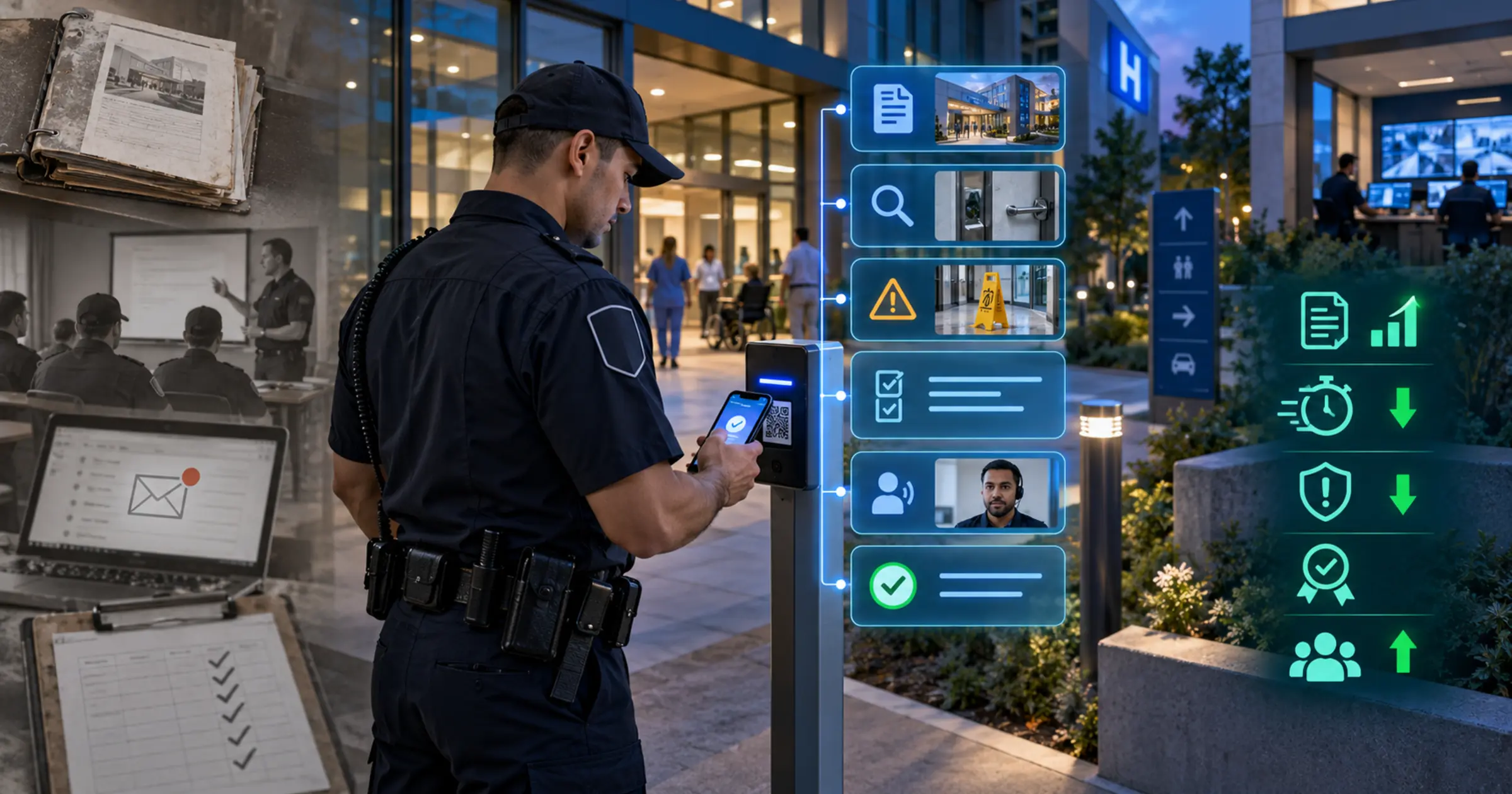
Printed post orders in a binder at the desk |
They go out of date the day they are printed, and nobody reprints them |
Digital post orders on the phone, updated centrally and visible on the next shift |
|
Training with no record of who completed it |
You cannot prove competency to a client, an insurer or a regulator |
Completion tracked per officer, with certification expiry visible before it lapses |
|
Assuming a completed tour means a trained officer |
Scanning a checkpoint proves presence, not understanding of what to do there |
Tasks attached to checkpoints, so the tour itself carries the instruction |
|
Judging training by attendance |
Attendance measures compliance with the session, not change in the field |
Look at incident quality, report completeness and repeat issues per site after training |
|
One programme for every site |
A hospital lobby and a remote industrial yard need different competencies |
Site-specific briefs layered on a common core |
|
Rolling out changes by email |
Field officers rarely read work email, and you cannot tell who saw it |
Push the change into the app and require acknowledgement |
The pattern across that right-hand column is the same idea repeated: put the instruction where the work happens, and measure the outcome rather than the activity. If your current setup cannot do either, that is usually one of the signs it is time to upgrade your guard tour system.
How to tell whether training actually worked
This is the part most firms skip, because attendance is easy to count and behaviour change is not. These are the measures worth watching in the 60 days after a training push:
- Report completeness. Are required fields being filled without a supervisor chasing them? The clearest single indicator that reporting training landed.
- Time from observation to escalation. Trained officers escalate sooner, because they recognise sooner. This number should fall.
- Repeat incidents at the same site. If the same issue keeps recurring at one location, either the training or the post orders for that site are wrong.
- Tour completion at the difficult posts. Improvement at your easy sites proves little. Watch the awkward ones.
- Supervisor follow-up time. Training supervisors matters as much as training officers, and this is where it shows.
- Client escalations. The lagging indicator, but the one that decides renewals.
A 30-day plan to tie training to tours
- Days 1 to 7: audit what officers can actually see on shift. Open the app as an officer at three sites. If the post orders there are wrong, out of date or absent, that is your first fix and it costs nothing.
- Days 1 to 7: check certification expiry across the roster. Most firms find someone working on a lapsed certification. Better you find it than a client or a regulator does.
- Days 8 to 14: attach tasks to checkpoints at one site. Turn the tour into the training delivery mechanism rather than a separate thing officers do.
- Days 15 to 21: set your baseline before you train. Record report completeness and escalation times now, or you will have no way to judge the outcome afterwards.
- Days 22 to 30: train, then re-measure at 60 days. Compare against the baseline and change one thing based on what you find. A programme that is never reviewed drifts back within a quarter.
One thing is clear: when guards are trained properly, your team avoids miscommunication mishaps and the hardships that follow. Coupled with what technology offers, officers stay current on the problem-solving techniques public safety and security actually demand.
If you are building or rebuilding a programme, our piece on keys to an engaging security officer training program covers the design side, and configurable training modules covers keeping compliance evidenced. To see how tours, post orders and training records sit together in one place, book a TrackTik demo.
Frequently Asked Questions
Latest Articles


Featured Resources
See Trackforce in action
Book a walkthrough with our team and see how it fits your operation.