The Purpose & Benefits of a Security Operations Center

Trackforce
July 19, 2018 · 9 min read
It doesn’t matter if your organization is local, regional or even global, at some point real-time security information and data will be indispensable to the operational continuity of any organization.
Multinational organizations create a Global Security Operations Center (GSOC) while national organizations just call it a Security Operations Center (SOC). For both, the objectives are the same; ensure assets and people are secure and safe at all times.
For simplicity, we’ll use the term SOC since not all companies have a global footprint. The concept of a Security Operations Center is not new by any means, but its value became more recognized recently among organizations managing security operations at multiple sites (i.e., national/multinational corporate security teams, security companies).
A traditional SOC is a costly endeavor and requires careful planning to maximize the return on investment. For example, just building a conventional SOC for a global company with let’s say 10+ locations (a GSOC in this case) can range between $200K-$500K, and that doesn’t include the cost of staffing and the recurring expenses it takes to run it.
Key takeaways
- A security operations center is your organization’s central nervous system for security.
It is where alerts arrive, officers are dispatched and incidents are tracked to resolution across every site. - SOC and GSOC share one purpose.
A GSOC simply covers a global footprint; both exist to keep people and assets safe around the clock. - Awareness, readiness and proactivity are the three jobs.
Know what is happening, be prepared to respond, and get ahead of threats before they escalate. - Both enterprise teams and security firms benefit.
Corporate teams gain one operating picture; security firms gain a service they can sell and prove. - You no longer need a costly build to run one.
TrackTik Command Center brings alarm monitoring, video surveillance access and guard dispatch into a single cloud workspace.
Let’s start with the purpose of a SOC and to keep this brief; we’ll focus on the physical security aspects only and exclude cybersecurity, and break it down into three areas of focus:
Always Be Aware
A SOC is a centralized location where all the security resources are known and can be deployed quickly. From alerts of unwanted intruders to damaged fire extinguishers and failure of completing post orders, the timely awareness of the situation and dispatch of resources are vital to keeping personnel and assets protected. Ultimately this is what ensures the operational continuity of an organization.
Ready at All Times
Taking the plunge and committing to a SOC is a clear signal that an organization is dedicated to 24/7 readiness. When done correctly, the real-time data coupled with business, artificial intelligence tools, and proper operator training all come together in a powerful and centralized location, ensuring the highest level of readiness. In short, preventing the worst-case scenario with preparedness is the objective of any SOC.
Stay Proactive
The DNA of the SOC is to be the organization’s alert system. Its purpose is to provide a proactive information flow of the security situation ensuring a knowledgeable operation of trust. Apart from responding to incidents, the SOC can also offer critical communication to keep staff safe in situations such as riots and terror attacks or less critical cases like traffic jams and severe weather.
How a Modern SOC Handles an Incident
Whatever its size, a SOC follows the same basic cycle every time an alert comes in. The faster and more consistently each step happens, the less an incident costs.
- Detect. Alarms, video analytics, access control events and officer reports all feed into one view.
- Verify. Operators confirm what is happening, often by checking live video, before committing resources.
- Dispatch. The closest available officer is assigned, and the response is tracked against the service-level agreement.
- Respond and document. The officer handles the situation and files a report with photos and time stamps.
- Escalate and notify. Managers, clients or emergency services are informed according to the site’s protocol.
- Review. Incident data is analyzed for trends so patrols and post orders can be adjusted.
TrackTik Command Center runs this cycle in a single workspace, consolidating alarm monitoring, video surveillance access and guard dispatch so operators are not switching between disconnected screens.
The Benefits of a Security Operations Center
The SOC is not only a valuable tool to corporate security teams but also firms that offer security services to third parties. The operational and cost savings benefits of a well-executed security operations center are vast from centralized reporting, verified guard patrols to lone worker monitoring and mass notifications in emergency situations. However, the road to an effective security command center can be lined with many pitfalls and a high price tag.
Here at Trackforce, we have been building technology to improve security officer operations for almost two decades and our solutions have been deployed at over 20,000 organizations worldwide. Trackforce customers have access to a built-in security operations center without the hassle and the investment. Contact us to learn more or request a demo.
Who Needs a Security Operations Center?
Corporate and enterprise security teams
Organizations protecting people and facilities across many sites use a SOC or GSOC to see risk across the whole portfolio, standardize how incidents are handled and give leadership one operating picture. Airbus, for example, replaced a patchwork of security reporting systems across its European sites with a single Trackforce platform, so agents, supervisors and management now work from the same view.
Security firms
For contract security companies, a SOC is both a service-quality tool and a revenue line. Remote monitoring, alarm response and dispatch let a firm protect more sites with the same team, and the data a SOC captures proves the value of the service to every client.
Building a SOC Without the Traditional Price Tag
A traditional SOC starts with a room full of hardware. A modern one starts with software. Cloud-based platforms let you stand up a SOC in an existing office, connect the systems you already own and scale as you add sites.
What you need to get started
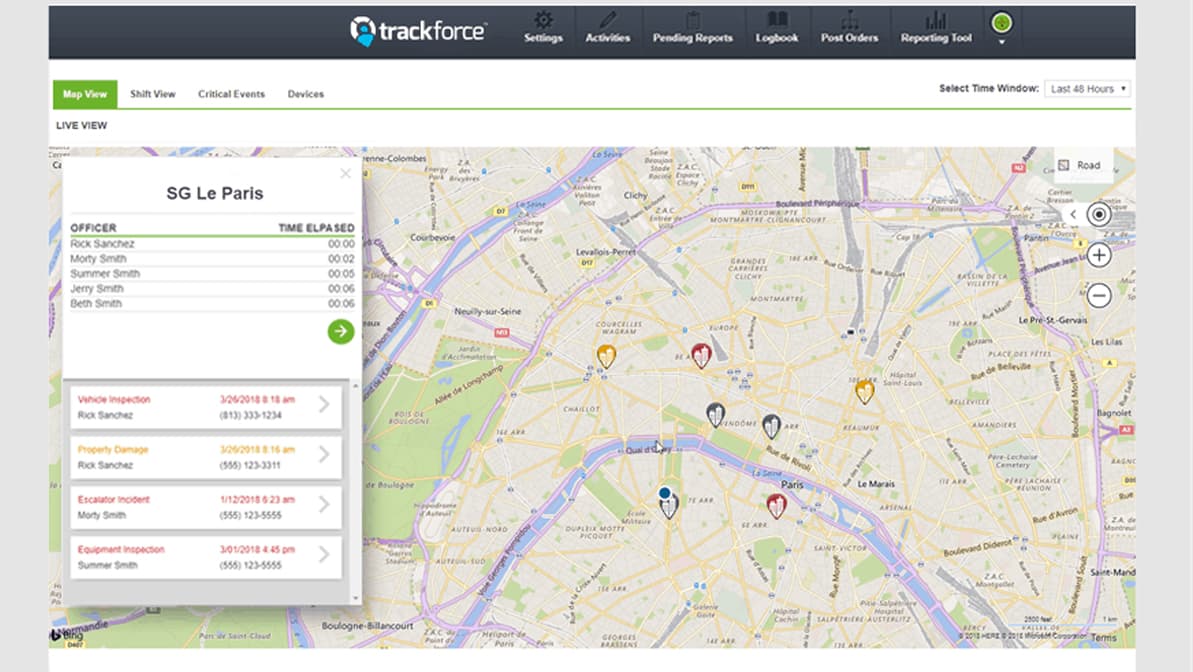
- One platform that brings alerts, officer locations, patrols and dispatch into a single view.
- Integrations with your existing video, alarm and access control systems.
- Standardized response protocols, so every operator handles the same alert the same way.
- Trained operators, with clear escalation paths for each site and client.
- KPIs such as time to dispatch, time to scene and SLA compliance, tracked automatically.
- Reporting that turns incident data into insight for leadership and clients.
For more ways to run a leaner operation, see these security operations center best practices.
Run your SOC on TrackTik
TrackTik Command Center consolidates alarm monitoring, video surveillance access and guard dispatch into one operational platform. It integrates with video, access and alarm systems, standardizes response with structured protocols, and assigns the closest available officer while tracking SLA times end to end.
Calidad Services handles all incident reporting for its SOC directly in TrackTik and connects alarms, video, access control and patrol activity through Immix. For one district client, its SOC was logging roughly 300 incidents a month, and incident volume dropped sharply within 90 days of going live. Read the Calidad Services story.
Frequently Asked Questions
Latest Articles





Featured Resources





See Trackforce in action
Book a walkthrough with our team and see how it fits your operation.