Using Guard Activity Management Across Different Industries: A Use Case Overview

Trackforce
January 14, 2021 · 9 min read

Using Guard Activity Management Across Different Industries: A Use Case Overview
Not every security guard company casts a wide net or works across industries. Some focus on specific sectors, while others specialize their training and skills to win key contracts in healthcare, education or retail. Recent years made one lesson clear: flexibility is the cornerstone of growth, and the companies that adapt fastest win new markets.
Across every industry, guard activity management comes down to two core KPIs: guard tours and reporting. To effectively manage guard activities, supervisors use technology to track and monitor officer task completion and status, including open reports and outstanding or incomplete guard tour checkpoints.
When you expand guard activity management into new industries, two baseline considerations matter most: shifts in guard training and market needs. Tracking guard tours and reporting will always be essential, but the subtle, industry-specific nuances can make or break a security guard company, especially one expanding into a new sector.
Key takeaways
- Guard tours and reporting are the core KPIs.
No matter the industry, supervisors need to know checkpoints were completed and every report is closed out. - Each industry adds its own priorities.
Healthcare needs rapid, coordinated response. Facility management needs visitor control, task verification and asset oversight. - Training has to keep pace.
Client and regulatory requirements shift, so training programs need regular review for every industry you serve. - Configurable technology makes expansion possible.
Post orders, tours and report templates you can tailor by site let one team serve many industries well. - One platform, many industries.
TrackTik brings command center operations, guard tours, reporting, visitor management and lone worker protection together, so you can grow into new sectors without adding new systems.
The Guard Activity KPIs That Matter in Every Industry
Whatever sector you serve, these measures show whether guard activity is on track:
- Checkpoint completion rate by site, tour and officer
- Missed or late checkpoints and how quickly they are addressed
- Open reports and the time it takes to close them
- Report completeness, including required photos, notes and signatures
- Incident response time from first alert to resolution
Changes in Guard Training
Training is perhaps the most essential part of a security guard company’s ability to deliver great service. Reviewing what makes up your training program, including the requirements set by your clients, should happen regularly. Skipping those reviews invites inconsistencies, miscommunication and costly mistakes. In industries such as healthcare, facility management and hospitality, required knowledge can change at a moment’s notice.
Healthcare shows how quickly that can happen. During the pandemic, many contracts with corporate security managers required third-party security officers to take on specialized screening duties, such as temperature screening, monitoring protective equipment and physical distancing, managing building occupancy and controlling crowd surges.
As requirements shifted, technology became essential to keep training current. Security leaders, including Drew Levine, then president of G4S Secure Solutions, pointed to on-demand video training and live virtual sessions as two formats that scale well for distributed teams.
Changes in Market Needs
The pandemic changed how security guard companies adapted from sector to sector, often supplementing depleted in-house security teams. Robert Perry’s COVID-19 and the Contract Security Industry report predicted that contract officers would continue filling in-house security roles long after the pandemic slowed, and that trend has shaped the market since.
That opens the door for security guard companies to enter sectors that were once hard to break into, whether because of limited contract availability, the need to expand a company’s specialty or state-specific training requirements.
Guard Activity Needs by Industry
Each industry puts its own emphasis on guard activity management. Use this overview to plan the capabilities you need before bidding on a new contract.
| Industry | Top priorities | TrackTik capabilities that help |
|---|---|---|
| Healthcare | Emergency procedures, disruptive patients or visitors, coordination with first responders | Command Center, incident reporting, post orders |
| Higher education | Large open campuses, events, student safety and after-hours patrols | Guard tours, lone worker protection, dispatch |
| Retail | Loss prevention, customer-facing officers, peak season staffing | Incident reporting, scheduling, dashboards |
| Manufacturing | Perimeter control, contractor access, safety compliance | Guard tours, visitor management, asset tracking |
| Property management | Resident and tenant safety, amenity checks, visitor control | Mobile patrol, visitor management, client reporting |
| Hospitality | Guest experience, event security, incident discretion | Post orders, incident reporting, real-time communication |
Taking the Next Step into New Industries
For security guard companies ready to grow into new sectors, there are a few areas where technology is a must and where flexibility is key to getting the most from your efforts. Let’s look more closely at two industries: healthcare and facility management.
Healthcare
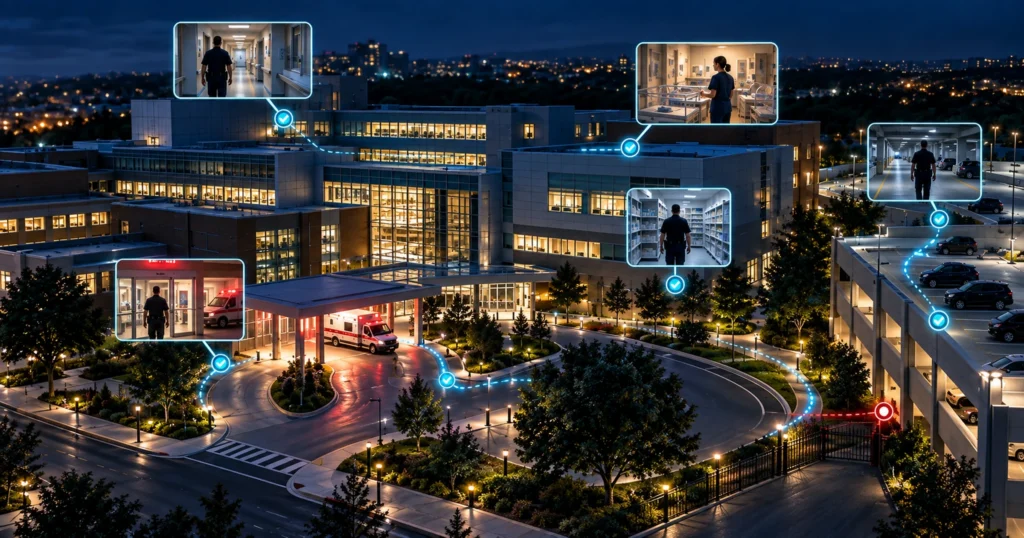
Whether it’s making sure officers follow proper emergency procedures, securing buildings and outdoor spaces, or responding to disruptions among patients or staff, hospital security relies on the right tools to reduce these risks.
Supervisors need to communicate with local law enforcement as well as other emergency services while also helping their guards maintain a safe and operable healthcare facility.
One capability stands out: centralized visibility and command.
A security operations center, also known as a GSOC or command center, manages more than critical events. A full command center also handles everyday incidents, guard activity and location tracking, and specialized communications in one system, so operators never switch between disconnected screens.
Must-have capabilities for healthcare:
- Command Center (GSOC) for alerts, patrols and dispatch in one workspace
- Incident reporting with time-stamped photo, video and GPS evidence
- Digital post orders officers must acknowledge, with emergency procedures attached
- Guard tour activity tracking with missed checkpoint alerts
Facility Management
From managing site visitors to confirming that maintenance and janitorial work is completed as expected, facility contracts require close coordination between technology and a well-trained security team.
In-house security managers need excellent incident and daily activity reporting to keep facilities in good condition and to make sure visitors entering the grounds, or using tools and assets owned by the facility, are properly vetted. Digital reporting makes that possible.
Digital reporting allows for flexibility when updating procedures and process-handling. These procedures would already be established by the in-house security manager, so it’s essential that adequate reporting procedures start with proper training and standardization in all reporting requirements. This includes establishing what guards are to report and how, ensuring all evidentiary support is attached (such as photos, videos, and additional notes), and setting up procedures for supervisory follow-up.
Must-have capabilities for facility management:
- Lone worker protection with panic alarm and fall detection
- Guard tour activity tracking with checkpoint verification
- Incident and daily activity reporting with configurable templates
- Visitor management with visitor lists, pre-registration and badge printing
- Asset tracking for equipment, keys and facility-owned tools
A Checklist for Expanding into a New Industry
- Research the sector. Learn the regulations, licensing and common risks for the industry.
- Map the client’s KPIs. Agree on what success looks like, from checkpoint coverage to response times.
- Build industry-specific post orders and tours. Tailor instructions and checkpoints to each site.
- Train for the new environment. Cover industry procedures before officers take their first shift.
- Configure report templates. Capture the details this client and industry care about most.
- Pilot, review and adjust. Review the first 30 to 90 days of data with the client and refine the program.
Adaptability and Flexibility: The Way Forward in Efficient Guard Activity Management
Recent years showed how quickly security requirements can change, and one thing is clear: the cornerstones of business growth are adaptability and flexibility.
To keep processes smooth and guard activity management top-notch, security companies need technology that supports their business and allows for configuration, adaptability and flexibility. Book a TrackTik demo to see how one platform supports every industry you serve.
Frequently Asked Questions
Latest Articles


Featured Resources
See Trackforce in action
Book a walkthrough with our team and see how it fits your operation.