Top Challenges for Guard Firms: How 2020 Has Shaped Security

Trackforce
August 20, 2020 · 8 min read
Top Challenges for Guard Firms: How 2020 Has Shaped Security
Key takeaways
- Hiring and turnover topped the list.
It was already the industry’s biggest challenge before 2020, and the pandemic compounded it. - Safety protocols and compliance got harder.
Firms had to enforce changing health guidelines, train new officers under social distancing and track rules like FFCRA and the CARES Act. - Clients paid slower.
Shutdowns and reduced operations raised client turnover and delayed receivables, pushing some guard firms to rely on credit. - Larger firms pivoted to expanded services.
Empty offices shifted demand toward video monitoring, command centers and other remote tools. - TrackTik addresses all five challenges today.
People management, post orders, ACA reporting, invoicing tied to operational data and Command Center help guard firms stay resilient.
The events of 2020 have forever shaped the landscape of society. The entire world has been impacted by a pandemic, socially, economically and physically, and is now facing a “new normal” in daily life. Focusing specifically on the physical security industry, this new normal has created a unique impact and has changed processes, people, and technology, effectively changing the way security services are offered permanently.
In 2020, we surveyed security professionals and compiled a comprehensive report that analyzes quantitative data from the physical security industry to determine specifically how the events of 2020 changed the landscape of the industry.
It also covers the top challenges facing the industry that year, as well as how technology is playing a larger role in helping create safer, more effective security operations.
The report addresses common operational challenges for physical security and seeks to understand the challenges that are a result of the climate of operations in 2020.
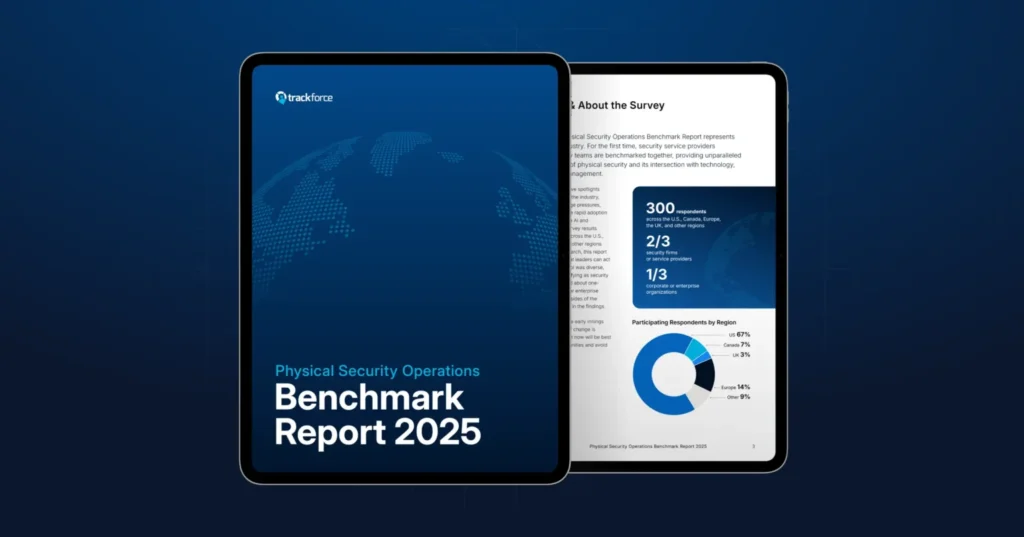
Below are the five challenges the survey identified, followed by how each one looks today. For current data, see our latest Physical Security Operations Benchmark Report, built from 300+ responses across North America and Europe.
The top 5 challenges guard firms faced in 2020
Challenge 1: Hiring and turnover
Despite challenges felt across the board, the most significant were hiring and turnover. As we know, hiring and turnover has been a major challenge for guard firms even before the pandemic. Not only is it hard to find good talent and retain those employees, there are competitive wage rates in other industries that are less strenuous on the individual.
With record unemployment and economic downturn at the time, this challenge was compounded exponentially. Later in this article, we look at how firms are addressing it today.
Challenge 2: New health and safety protocol enforcement
With so many changes to processes and guidelines for safe operation within a business, companies are struggling to not only keep up with the guidelines, but also effectively implement procedures and training for their team on enforcing them.
Beyond the actual processes themselves is the ability to operate effectively while maintaining a paperless and contactless operation. Many are looking to technology to aid in this.
“It has not been easy to get proper training for new guards due to social distancing and mobilizing crowds.”
Challenge 3: Compliance risk and liability
With the pandemic creating a certain degree of FUD (fear, uncertainty and doubt), employees working in the field are concerned about safety and health, and certainly there are some concerns about wage and labor issues, sick leave, hazard pay and more.
Guard firms are especially concerned with worker safety and want to make sure they are compliant with these regulations, but these are exceptional times. Having proper documentation, traceability and protocol to ensure compliance is a key component of the “new normal”.
Another compliance challenge focuses on the government assistance reports, such as the Paycheck Protection Program (PPP) and the CARES Act. Ensuring proper compliance was another key theme in 2020.
“We have been challenged to keep track of changing rules and laws in regards to FFCRA and CARES, and enforcing COVID-19 guidelines and regulations within our staff.”
Challenge 4: The client and vendor dynamic
Client retention has always been a challenge, but as businesses continue to remain shut down or reduce operations, there is higher turnover in the physical security industry than ever before.
Even with clients that keep their security contracts, payments have often been delayed in order to support core business operations first. Clients are delaying payment to their security provider to pay their own employees or vendors who provide them with critical goods (e.g. toilet paper, sanitizer, etc.).
Guard firms were dealing with slow receivables and relying on credit to keep up with business operations.
“The biggest opportunity has been to reinvent yourself and use technology as an ally for any business.”
Challenge 5: Remaining competitive through expanded services
The last challenge affects larger guard firms over smaller ones. Within companies with over 100 guards, this was the second highest challenge after hiring and turnover. Many firms are seeing a reduction in on-site guards, replaced with more remote operations.
Many companies, especially those in corporate America, are seeing a shift to work from home, and there are a lot of empty corporate offices.
Guard firms are looking to supplement on-site resources with technology, such as video monitoring, mobile command centers and other tools, that will help to continue proper vigilance while requiring less on-site resources.
How the 2020 challenges look today
Most of these challenges didn’t end with the pandemic. They became permanent features of running a guard firm. Here is how each one has evolved and where technology now helps.
| Challenge | What changed after 2020 | How TrackTik helps |
|---|---|---|
| Hiring and turnover | Labor stayed tight, and retention became a core business metric | Skill and certification matching, lone-worker check-ins and one record from onboarding to every shift |
| Health and safety protocols | Site rules and procedures change more often | Post order management and lone worker protection in the officer app |
| Compliance risk and liability | Documentation and audit trails are expected, not optional | ACA reporting and filing, plus leave and break management |
| Client and vendor dynamic | Clients scrutinize every invoice and expect proof of service | Invoicing tied directly to operational data |
| Expanded services | Remote monitoring and hybrid guarding became standard offerings | Command Center consolidates alarms, video and dispatch |
Lessons from 2020 that still apply
- Treat retention as a revenue issue. Every officer who leaves costs recruiting, training and overtime. Protect your best people first.
- Digitize procedures. When rules change, updates should reach every officer at once, not wait for the next site visit.
- Keep documentation audit-ready. Consistent records protect you when regulations, clients or courts ask questions.
- Tie billing to proof of service. Accurate invoices backed by operational data get paid faster and disputed less.
- Build services beyond the on-site post. Remote monitoring, mobile patrol and alarm response make your firm harder to replace.
How TrackTik helps guard firms stay resilient
- People and shifts. TrackTik people management matches skills and certifications to assignments, prevents overtime with live labor-cost tracking and adds lone-worker check-ins and emergency alerts.
- One back-office flow. TrackTik business administration connects scheduling, time capture, billing and payroll into one automated flow.
- Faster, cleaner billing. TrackTik contracts and invoicing automates invoicing tied directly to operational data and forecasts revenue by billing period.
- Compliance without the headache. TrackTik ACA reporting prepares, generates and files required 1094-C and 1095-C forms.
- Services beyond the post. The TrackTik Command Center consolidates alarm monitoring, video surveillance access and guard dispatch into a single operational platform.
Build a guard firm ready for the next disruption
2020 showed how quickly the ground can shift. The security firms that came through strongest were the ones with connected operations, clean data and services clients couldn’t easily replace.
Book a TrackTik demo to see how one platform helps you manage people, compliance, billing and services from a single record.
Frequently Asked Questions
Latest Articles





Featured Resources
See Trackforce in action
Book a walkthrough with our team and see how it fits your operation.