How to Keep Security Guards Safe: Technology, Training & Best Practices

Trackforce
June 17, 2025 · 13 min read

Security guards are increasingly on the front lines of danger, facing escalating workplace violence across all sectors from retail to healthcare. Recent Bureau of Labor Statistics data shows service occupations including security guards experienced over 25,000 workplace violence incidents requiring days away from work in just a two-year period, with an incidence rate of 7.4 cases per 10,000 workers. Research reveals that 39% of security guards face verbal aggression at least monthly, while 19% experience threats of assault and 15% encounter physical violence.
The growing demand for security personnel has created a concerning paradox: as we rely more heavily on security guards to protect our communities, workplaces, and events, their own safety becomes increasingly compromised. With verbal threats accounting for 45% of workplace violence incidents and physical assaults making up 25%, security professionals face daily risks that extend beyond traditional safety concerns to include cyber threats, drone surveillance, and hybrid attacks that blur physical and digital boundaries.
They’re protecting us, but who’s protecting them?
Key takeaways
- Security guards face real and rising risk.
Verbal aggression, physical assault and lone working are everyday hazards, especially in public-facing posts. - Safety is also a business decision.
Fewer injuries mean lower workers’ compensation costs, less overtime to cover absences and better insurance rates. - Technology keeps officers connected.
GPS tracking, panic alarms, fall detection and automated check-ins make sure no officer is truly alone on shift. - Training and routine matter as much as tools.
De-escalation, situational awareness, varied patrol routes and pre-shift equipment checks prevent many incidents before they start. - TrackTik brings officer safety into one platform.
Lone worker protection, real-time incident reporting and dispatch work together, so supervisors can see a problem and send help fast.
The biggest safety risks security guards face
Every post carries its own hazards, but most guard injuries trace back to a handful of common risks. Here is where they show up and how to reduce them:
| Risk | Where it shows up | How to reduce it |
|---|---|---|
| Verbal aggression and threats | Retail, healthcare and other public-facing posts | De-escalation training, clear escalation paths and body-worn cameras |
| Physical assault | Loss prevention, trespass removals and night shifts | Two-officer rules for high-risk tasks, panic alarms and fast dispatch |
| Lone working | Overnight sites and remote facilities | Scheduled check-ins, lone worker monitoring and missed check-in alerts |
| Slips, trips and site hazards | Patrols in poorly lit or unfamiliar areas | Site walkthroughs, hazard reporting and danger-zone timers |
| Vehicle and traffic incidents | Mobile patrol and parking enforcement | Pre-shift vehicle checks, route planning and GPS monitoring |
| Fatigue | Long shifts and overtime-heavy schedules | Fair scheduling, overtime alerts and planned rest breaks |
Regulatory environment for security guards
The regulatory environment takes into account all the rules and laws that dictate how security guards can operate. It’s a constantly changing area that directly affects how security companies do business and how we keep our guards safe.
Current laws on security guard safety
Security guard safety is governed by a mix of federal and state laws. Federally, OSHA sets workplace safety standards that apply to guards, covering everything from personal protective equipment to hazard communication. However, specific licensing, training hours, and use-of-force protocols for security guards vary from state to state.
Compliance requirements for security companies
For security companies, compliance means conducting background checks and making sure team members are properly licensed according to their state’s rules. They also need to follow training standards, which often include education on legal limitations, de-escalation tactics, and emergency procedures. That’s not all. Beyond personnel, companies are responsible for maintaining fair labor practices, providing necessary safety equipment, and documenting all incidents for both legal and operational needs.
Potential upcoming legislation and policy changes
Looking ahead, we may see an argument for more standardized requirements across states, possibly in cybersecurity awareness and active shooter response. There’s also growing legislative interest in private security use of force, which could lead to more strict regulations and accountability measures. Plus, as the industry becomes more technologically advanced, there may be a need for new (and ethical) policies on AI, drones, and the collection of digital data by security operations.
Economic impact
Of course, there’s also the cost of security guard injuries, which go beyond medical bills. Consider the lost productivity, the expense of temporarily staffing the position or paying for overtime from other guards, as well as potential legal fees if there’s a lawsuit. Plus, there are indirect costs like lower employee morale and damage to your company name.
Investing in safety measures, and getting a return on that investment, is important. Training, modern safety equipment, and management systems lead to fewer injuries. Not only does this provide the protection your team needs, but it also saves on workers’ compensation claims and its associated expenses. Of course, making your team as safe as possible is the right thing to do, plus the economically smart thing to do.
The safety of your security guards also affects insurance and premiums. Insurers view companies with a strong safety record as lower risk, which can lead to better workers’ compensation and insurance rates. Safety steps like using a comprehensive security workforce management platform can show insurance companies you’re committed to reducing risk, which can lead to savings on premiums over time. See more on Security insurance: Challenges, trends, and strategies for today’s businesses.
Technologies designed to improve guard safety
Wearable devices, like smart badges or body cameras, can offer real-time location tracking and provide evidence during incidents. There’s also the possibility of providing panic buttons for immediate assistance. Plus, advanced communication tools and lone worker safety apps help with instant alerts and check-ins, so guards are always connected to dispatch and each other.
Integrating technology with existing security systems
Safety technologies can often integrate with existing security infrastructure. By linking wearable devices, lone worker apps, and communication tools with central command centers, security companies can work from one main unit. This integration helps with faster response times, dispatching, and better awareness for people monitoring multiple sites.
Potential innovations in the field
Companies can expect more widespread use of AI-powered analytics to predict potential threats and identify high-risk areas. Plus, advancements in robotics and autonomous patrolling systems could reduce exposure to dangerous situations, while augmented reality tools might provide real-time data to improve performance during patrols.
5 tips for keeping security guards safe
There are several precautions you can take to create the safest working conditions possible for your security guards. Let’s look at the top five.
1. Vary routing
Security officers are often assigned to regular routes where they use their mobile phones to inspect checkpoints. It’s important to vary routes regularly as criminals often monitor an officer’s movements to commit a crime when an officer is out of sight. So be unpredictable on patrols and vary arrival and departure times if possible.
2. Get familiar with security measures
It’s important to be familiar with security measures to help deal with incidents as they occur. Make sure officers know what procedures to follow in the event of an injury, a fire, or a break-in. Make sure officers know what to do if they have to apprehend or detain a suspect. Of course, even though some situations are rare, make sure they’re prepared to deal with worst-case scenarios.
3. Know the environment
Introduce teams to potential problem areas. Ask them to walk routes to learn where all the stairwells, doors, and exits are located. Warn them to make wide turns around corners to prevent being ambushed or harmed. Similarly, ask them to report any burnt-out lightbulbs, broken locks, or gaps in fencing.
4. Use security equipment
It’s important to have reliable equipment in good working order at all times. Radios, CCTV, and alarm systems are only useful if they’re on and functioning. Ask teams to make sure phones and earbuds work at the beginning of shifts. If there are patrol vehicles involved, ask teams to go through a checklist to make sure they’re in working order before every shift.
5. Invest in your team’s safety
And the most important … security service companies should also invest in a solid security workforce management solution that includes safeguards to help protect security officers’ safety. Look for a solution that includes officer safety tools like real-time incident reporting, and other tools like a panic button, notifications, and security for lone workers.
Security guard safety checklist
Use this checklist to build safety into every shift:
Before the shift
- Confirm the radio, phone and guard app are charged and working
- Review post orders, site alerts and any recent incidents
- Check the vehicle before starting a mobile patrol
- Confirm who to contact and how to escalate in an emergency
- Make sure lone worker check-in times are set
During the shift
- Vary patrol routes and timing
- Complete check-ins on schedule
- Report hazards such as broken locks or failed lighting as soon as they are found
- Use the panic alarm without hesitation when threatened
- Tell a supervisor before entering a high-risk area
After an incident
- Get to safety and request medical help if needed
- File a detailed incident report with photos while the details are fresh
- Debrief with a supervisor
- Update post orders, tours or staffing to prevent a repeat
Safety training every security guard needs
Technology works best when officers know how to use it and when to act. Build these topics into onboarding and refresher training:
- De-escalation and conflict management: calming tense situations before they turn physical.
- Situational awareness: spotting warning signs early and positioning safely.
- Emergency response: fires, medical emergencies, active threats and evacuations, practiced through critical event training.
- Use of force and legal limits: what officers can and cannot do under state law and client contracts.
- First aid and CPR: caring for themselves, colleagues and the public until help arrives.
- Incident reporting: documenting events clearly, accurately and quickly.
- Lone worker procedures: check-ins, panic alarms and escalation when working alone.
Training sticks when it is practical and ongoing. See our keys to a successful and engaging security officer training program.
How TrackTik protects security guards
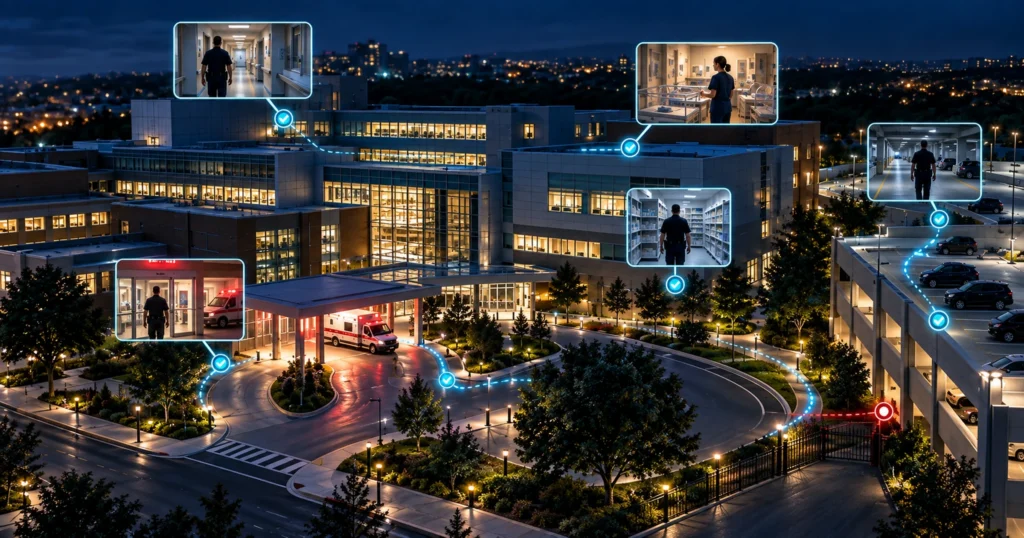
With workplace violence incidents affecting thousands of security professionals annually, TrackTik, from Trackforce, provides critical safety infrastructure that transforms how security teams protect their personnel. Our real-time monitoring and emergency response capabilities ensure guards are never truly alone, even in the most isolated assignments.
Essential safety features
- Instant emergency response: real-time GPS tracking lets supervisors monitor officer locations across multiple sites and deploy help immediately when threats emerge. Combined with panic alarms, help arrives faster when every second counts.
- Lone worker protection: a manual panic alarm, true fall detection, phone-tilt detection and a danger-zone timer keep solo officers covered, even when they cannot call for help themselves.
- Smart incident documentation: officers file GPS-stamped incident reports instantly from their mobile devices, creating a digital trail that supports both safety and legal protection.
- Automated safety check-ins: scheduled mandatory reports keep regular contact with isolated officers, and missed check-ins trigger automatic alerts to supervisors.
- Enhanced communication: integrated messaging and alerts keep officers connected to dispatch and supervisors for coordinated emergency response.
- Audit-ready documentation: from healthcare settings to industry-specific safety regulations, TrackTik keeps detailed, time-stamped records that protect both officers and organizations.
When security guards face increasing workplace violence, TrackTik provides the technology backbone that transforms reactive security management into proactive guard protection. Because those who protect others deserve protection themselves.
Ready to strengthen your guard safety protocols? Book a TrackTik demo to see these safety features with your own sites.
Frequently Asked Questions
Latest Articles



Featured Resources
See Trackforce in action
Book a walkthrough with our team and see how it fits your operation.
Make sure no officer is truly alone
Book a demo to see how TrackTik lone worker protection, GPS tracking, incident reporting and dispatch keep your officers safe on every shift.