How Corporate Security Teams Can Leverage the Physical Security Ecosystem

Trackforce
June 4, 2021 · 10 min read
Finding the right alignment of people, processes and technology is a challenge for any security organization. For corporate security leaders, assuming that operations are in good shape can quietly turn into a serious risk: officers following different procedures at different sites, data spread across tools that do not talk to each other, and contract security partners working from their own systems. The physical security ecosystem is a way to see and fix that.
The physical security ecosystem is a method for aligning people, processes and technology against day-to-day security operations. Combined with a sound risk management strategy, it shows how corporate security leaders can establish a central source of truth. This article explains the model, how to assess where you stand, how to keep contract security partners inside the ecosystem, and how TrackTik security workforce software from Trackforce serves as the technology at its center.
Key takeaways
- The ecosystem aligns three elements.
People, processes and technology, each connected to the others like interlocking puzzle pieces. - At its center is a single source of truth.
One operational record that every team, site and partner works from. - The goal is visibility and control.
Those are the two capabilities most security operations are missing or have only in part. - Contract security can break the circle.
When partners use their own tools, the organization loses visibility and ownership of its own security data. - Owning the technology keeps the ecosystem whole.
Requiring in-house teams and contract partners to work in one platform such as TrackTik keeps the record complete.
The Central Source of Truth Is the Heart of the Ecosystem
Unlike other frameworks for aligning processes, the physical security ecosystem breaks visibility and control, two areas that are often missing or limited, into an actionable set of processes. People, processes and technology together drive that control.
The phrase “single source of truth” gets used to explain almost anything involving technology. Its real meaning is that truth comes from unified processes: operational convergence that allows streamlined operations and communication. Without it, corporate leaders get only partial information, which limits visibility, and they put the value of their operations at risk, which means giving up control. This is the same problem behind why fragmented tools undermine enterprise risk strategy.
How the Physical Security Ecosystem Fits Together
The ecosystem establishes the central source of truth by letting each element connect to the others. Like puzzle pieces, they interlock, and the source of truth sits at the core.
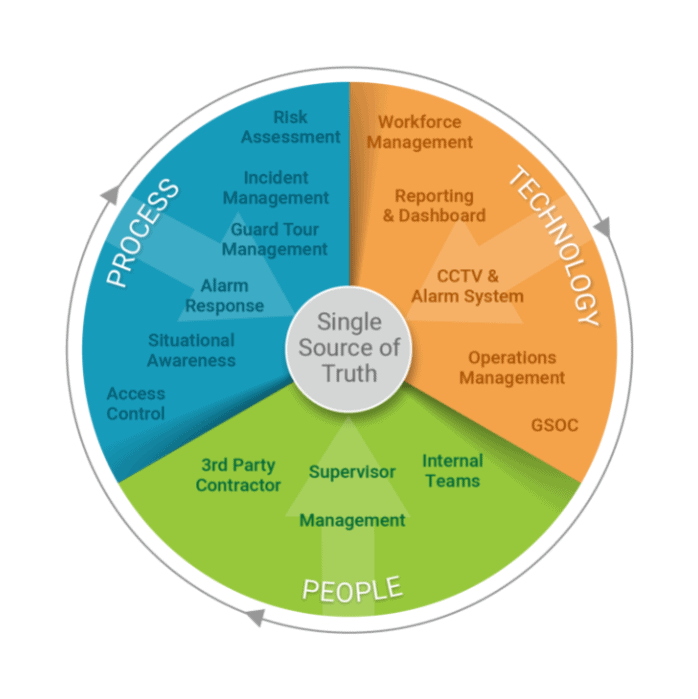
The Three Elements That Define the Physical Security Ecosystem
- Aligning people. Making sure the safety and security of internal and external teams, organizational staff and operations always remains the priority.
- Aligning processes. Putting the right processes in place so people can achieve the most visibility and control possible, and operational excellence with it.
- Aligning technology. Using technology for the automation, collaboration and integration of processes and people that make the operation efficient.
The table shows what each element looks like when it is out of alignment, what alignment looks like, and where the technology layer supports it.
| Element | Out of alignment | Aligned | Where TrackTik supports it |
|---|---|---|---|
| People | Officers, supervisors and contract staff working to different expectations; training records scattered | Everyone working to the same post orders, with training and credentials visible | People management, digital post orders, training records |
| Processes | Each site reports and escalates its own way | Standard tours, reporting templates and escalation paths across every site | Guard tours, configurable reports, site tasks, dispatch |
| Technology | Separate tools for tours, incidents, scheduling and reporting, plus partners’ own systems | One platform holding the operational record, integrated with alarms and video | The TrackTik platform, Command Center and integrations |
| Source of truth | Leaders assemble reports by hand and cannot fully trust them | Live dashboards built from the same data the field creates | Business intelligence and reporting |
Getting Started: A Two-Step Approach
1. Reassess the overall health of your operations
Recent years exposed inconsistencies in many corporate security operations: in team communication, in how sites run, and in how well leaders could see what was happening. Many security leaders responded by reassessing their operations and revamping their risk management plans. A structured way to start is the Security Operations Maturity Index, which scores where your program stands today, and Trackforce’s Physical Security Operations Benchmark Report shows how peers compare.
2. Enhance your team’s training and education
The ecosystem holds together only when everyone understands how each element works. Proper training unifies the team on the processes and makes the technology simple to use, so each element is actually followed. That includes:
- Better communication practices that build trust between security personnel and operational staff.
- Education on operational processes and a clear definition of the role security plays in reducing risk.
- An understanding of how technology, used properly, reduces miscommunication, eliminates silos and provides a central view of operations.
Tracking that training in TrackTik people management closes the loop, and integrated tools help eliminate training gaps across in-house and contract teams.
A Quick Ecosystem Self-Assessment
Answer yes or no. Every “no” marks a gap in visibility or control.
- Can you see, right now, which sites are fully staffed and which tours are on schedule?
- Do in-house and contract officers follow the same post orders and reporting templates?
- Does every incident, at every site, land in the same system within the shift?
- Could you produce last quarter’s incident and patrol trends without asking anyone to build a spreadsheet?
- If you changed contract security providers tomorrow, would you keep all of your historical data?
- Are alarms, video alerts and officer dispatch handled in one operator view?
Avoiding Third-Party Disruption to the Ecosystem
Supplementing in-house officers with contract security is common and growing, but it can seriously affect a leader’s visibility. If contract security providers use their own technology and insist on their own tools and processes to meet their obligations, a gap opens in the ecosystem. There is no longer a single source of truth, which increases risk and the potential exposure of proprietary information.
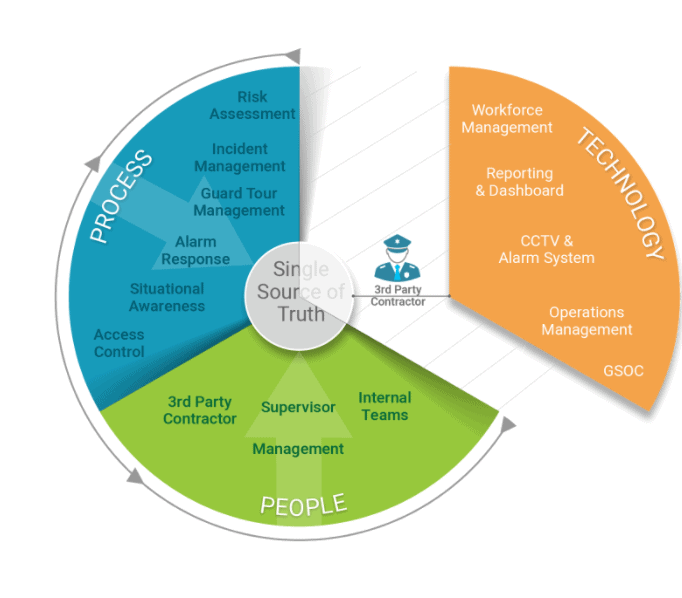
Corporate leaders keep control of their organization’s information, and the ecosystem intact, by owning the technology. As part of any long-term security strategy, they can require security firms to use the tools and processes in the organization’s security plan. That matters most at the moment you change providers, which is exactly when who really owns your security data becomes an urgent question.
What to require from contract security partners
- Work in your platform. Contract officers use your TrackTik environment for tours, post orders and reports, so their work lands in your record.
- Follow your templates and escalation paths. Same incident categories, same required fields, same escalation contacts as your in-house team.
- Keep data ownership with you. Write it into the contract: incident, patrol and visitor data belongs to the organization and stays with it at the end of the engagement.
- Report from the same dashboards. Review partner performance with the data in TrackTik business intelligence, not a separate monthly PDF.
The Technology at the Center of the Ecosystem
TrackTik is built to be the single operational record for enterprise security teams. Guard management holds post orders, tours and site tasks; security operations tools cover incidents and dispatch; the Command Center gives operators one view of alarms, alerts and officers, with integrations bringing in access control, video and other systems; and business intelligence turns the whole record into the dashboards leaders need. In-house and contract officers work in the same platform, which is what keeps the circle closed.
Establishing the Full Circle
At its core, the physical security ecosystem rests on a familiar principle: unifying the process is the only way to achieve real visibility and operational control. Using the ecosystem method, corporate security leaders can run their operations with confidence that the whole team, in-house and contracted, is working from one holistic view of security. Book a TrackTik demo to see how a single platform becomes the source of truth for your security operation.
Frequently Asked Questions
Latest Articles




Featured Resources
See Trackforce in action
Book a walkthrough with our team and see how it fits your operation.