The Future of Remote Guarding: Physical & Digital Unite

Trackforce
May 30, 2025 · 13 min read
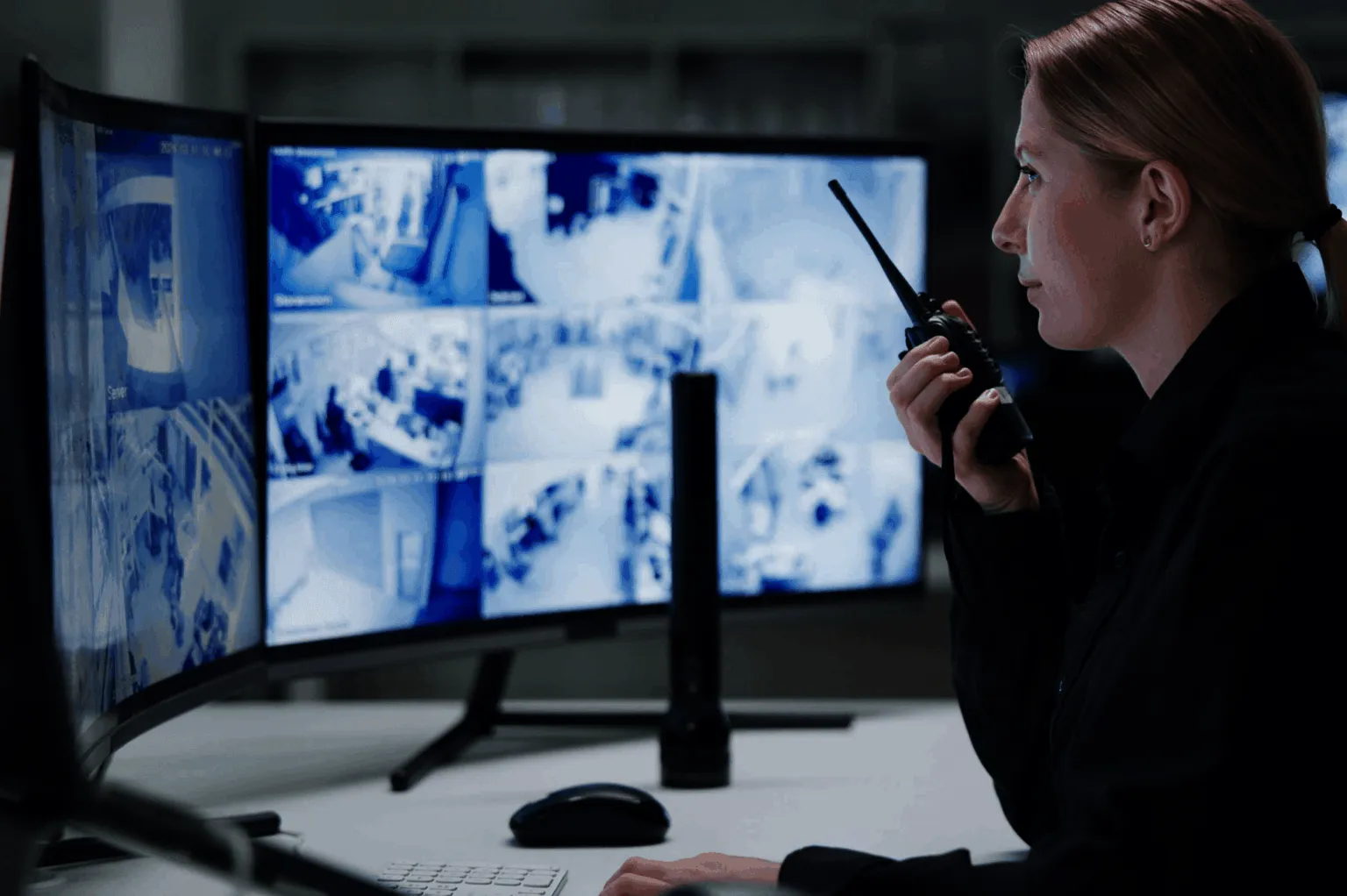
Unlike us, remote guarding never sleeps. Plus, AI helps outsmart threats that people might not otherwise notice. Put them together? You’ve got a significantly stronger security framework.
This guide explains how AI remote guarding works, how it compares with on-site and hybrid security, and how the Immix and TrackTik integration connects remote monitoring to officers in the field.
Key takeaways
- Remote guarding watches every site, all the time.
Trained operators monitor live video and intervene in real time, without an officer on every post. - AI cuts through the noise.
Video analytics filter out false alarms so operators can focus on genuine threats. - The biggest gap is between detection and response.
Without integration, escalating an event from the monitoring center to field officers is slow and manual. - Immix and TrackTik close that gap.
Verified events dispatch the nearest officer through the TrackTik Command Center, and every step is documented and billable. - Hybrid models win.
Combining remote guarding with on-site and mobile officers lets security firms right-size coverage and add a new revenue stream.
What is AI remote guarding?
AI remote guarding combines technology with human expertise to protect at a distance. It uses high-definition video surveillance systems, often with artificial intelligence and analytics capabilities, to monitor 24/7. Remote guards can observe live video feeds from a central monitoring station and respond to potential security threats in real-time.
Benefits of remote guarding
Remote guarding addresses many of the challenges faced by traditional security methods. This modern security solution offers numerous advantages, making it an attractive option for organizations of all sizes.
Let’s explore the key benefits of remote guarding:
- It allows for constant surveillance without needing people to be physically present. Not only is this helpful for more coverage with fewer people, but it can also deter criminal activity, as the presence of cameras, sensors, and other monitoring devices is a visible reminder that the area is under constant surveillance.
- Remote guards can interact with intruders through two-way audio systems, which increases their reach. If needed, they can also issue warnings and alert local law enforcement.
- The service can be customized to specific site requirements. By tailoring the remote guarding solution to the unique needs of each location, companies can avoid overinvesting in unnecessary features or personnel. Additionally, the scalability of remote guarding allows businesses to adjust their security coverage as needed, potentially reducing costs during off-peak hours or seasons without compromising overall protection.
Remote guarding has a variety of benefits for security operations. First, businesses can take advantage of the cost reduction benefits by decreasing the overhead of traditional on-site personnel.
Need someone around the clock? Remote guarding means monitoring happens 24/7, so there are fewer gaps in security. This is also a way to respond faster, since remote guarding gives trained professionals the ability to assess situations and quickly begin a response. Not only that, but integrating AI often leads to reduced false alarms, since AI can help tell an accident from a genuine threat.
Finally, this option also helps keep security personnel safer. People are removed from potentially dangerous situations altogether when security guard duties are done from a remote location.
Remote guarding vs. on-site guards vs. a hybrid model
Remote guarding works best as part of a coverage plan, not as a blanket replacement for officers. Here is how the three models compare:
| Factor | On-site officers | Remote guarding | Hybrid model |
|---|---|---|---|
| Coverage | One post, one set of eyes | Many cameras and sites at once, 24/7 | Continuous video coverage, with officers dispatched when needed |
| Physical response | Immediate, on site | Audio warnings and police notification, no physical presence | Verified events trigger dispatch of the nearest officer |
| Cost profile | Highest per site, billed by the hour | Lower per site, depending on camera infrastructure | Lower than full-time posts, with response capacity built in |
| Customer-facing duties | Access control, escorts and customer service | Limited | Officers focus on on-site duties where they add the most value |
| Best for | High-traffic sites that need a constant visible presence | After-hours, vacant or low-traffic sites with good camera coverage | Multi-site portfolios and clients who need both |
The hybrid approach is where many security firms are heading. Calidad Services, for example, pairs officers with Immix video and Scylla AI on TrackTik, sizing the mix for each client, and nearly halved the security spend on one account.
Integrating Immix and Trackforce
Immix enhances security event management through its user-friendly integration platform. By incorporating Immix into the TrackTik Command Center, organizations seamlessly connect remote monitoring, alarm/video response, and field security guard management in one comprehensive view. This integration empowers businesses to prevent threats more effectively, respond to incidents faster, and reduce costs while ensuring compliance. Additionally, it opens up new revenue opportunities through remote guarding services. Learn more about the Immix and Trackforce partnership.
How do Trackforce and Immix work together? By combining these two advanced systems, we’ve created a comprehensive security solution that tackles many of the challenges faced by today’s security teams:
- Unified command and control: Now, there’s a way to centrally manage all security events on a single platform, including alarms, video, access control, and patrols.
- Closed-loop automation: Reduce the need for manual intervention while speeding up response times. With this feature, organizations get automated incident escalation and dispatch from the SOC to the field.
- AI-driven event processing: Make the most of your time and resources. With AI and analytics, security teams can filter out false positives and prioritize real threats.
- Comprehensive reporting and compliance: No need to worry, and no need for paper. The platform provides an audit trail for regulatory compliance, and detailed reports of all security events. Plus, billing and invoicing are integrated.
Addressing pain points through the power of integration
Security operations often struggle with manual processes, especially when escalating incidents from the Security Operations Center (SOC) to field teams. This approach slows things down and introduces errors, making challenging situations even trickier to handle. False alarms are another pitfall. Without AI verification, security teams waste time and resources chasing down non-existent threats.
Fragmented systems make it hard to manage incidents from start to finish, while the lack of integrated billing and reporting keeps companies from offering profitable remote guarding services.
Automation and streamlined practices aren’t just nice-to-haves in this environment. They’re essential. That’s where the integration of Trackforce and Immix comes in, offering a solution that tackles these pain points head-on. We explore this detection-to-response gap in more depth in Solving Physical Security’s Last Mile Problem.
How a remote guarding event flows through TrackTik
Here is what happens from the moment a camera spots activity to the moment the response is billed:
- Detect. Camera analytics or an alarm flags activity at the site.
- Verify. Immix and AI threat detection filter out false alarms, so operators only see events that need attention.
- Intervene. The remote operator issues a two-way audio warning and, if needed, contacts local police.
- Dispatch. If a physical response is required, the TrackTik Command Center sends the nearest available officer with the situational context.
- Document. The officer’s actions, photos and resolution are captured in a single incident record linked to the original alert.
- Report and bill. The response is included in client reporting and invoicing automatically.
How security firms can add remote guarding
To leverage the benefits of this integration and tackle these challenges head-on, security firms should consider adding remote guarding to their service offerings. Here’s how to get started:
- Evaluate your readiness: Assess your current technology and personnel. Are your systems compatible with remote guarding solutions? Is your staff prepared for this new approach?
- Invest in training: Ensure your team is fully prepared for the technical aspects of remote guarding. This investment in your staff is crucial for successful implementation.
- Implement the right software: Choose solutions that not only meet your needs now but will evolve with you as your business grows. TrackTik connects remote monitoring, field response, reporting and billing in one platform.
- Develop new service models: To offer remote guarding profitably, create new service packages and pricing models. This allows you to cater to diverse customer needs while maintaining profitability.
The Immix + Trackforce integration in action: Key use cases
The integration between Immix and Trackforce isn’t just a technical merger. It’s a game-changer for security operations. By combining these powerful platforms, security firms can streamline their processes, enhance response times, and unlock new revenue streams.
Let’s explore three key use cases that demonstrate the transformative power of this integration:
- Automated incident escalation: When Immix detects a verified alarm or video event, it automatically dispatches the nearest available security guard via the TrackTik Command Center, complete with situational context. See how TrackTik security guard dispatch works.
- Integrated incident lifecycle reporting: Every step, from camera alert to field resolution, is documented in a single platform. Professional and audit-ready incident reports are at your fingertips.
- Remote guarding monetization: Security providers can bill for remote guarding responses, combining static, mobile, and remote services in a single invoice. This allows for new service models and possible higher margins.
Remote guarding for the enterprise
There are a variety of benefits when enterprise security teams choose remote guarding:
- Security across multi-site businesses
Remote guarding is a benefit for multi-site businesses. Remote guarding creates a layer of security across all locations, no matter where they are located. With remote monitoring, enterprises can have comprehensive security coverage without needing multiple on-site people at each site. - Centralized monitoring and management
An advantage of remote guarding for enterprises is the ability to monitor all locations from a single, central hub. This gives people a unified view of security events, which helps with a quicker and coordinated response. - Standardization of security protocols across regions
Remote guarding means uniform security protocols can be set and followed across all enterprise locations. This standardization means that there will be consistent security responses and a predictable level of protection. This can help minimize risk and improve the organization’s efficiency. - Cost savings and improved efficiency
People are the most valuable resource…and the most expensive. Remote guarding can save costs compared to relying only on traditional on-site security personnel at every location. This way, there is continuous monitoring without the overhead of multiple on-site guards, so that organizations can use a more economical security model.
Overcoming challenges in remote guarding
With remote work, there’s always a concern about keeping everything private. To address these privacy issues, organizations need data handling policies, plus a way to securely store data. Reliable connectivity is another must-have since organizations must ensure no interruption in their monitoring options. Plus, there needs to be a balance between automation and real humans, since technology will never entirely replace security teams. We need honest people’s decision-making skills to successfully manage AI integration.
Finally, there’s the issue of regulatory compliance across different regions, which is complex but manageable. As technology progresses, so will the ability to work across geographies.
Remote guarding in the future
Most of us still remember before AI became mainstream. AI and machine learning advancements will change the future of remote guarding, which will help with even more accurate threat detection and automated responses. Plus, there’s even more room for integration. Remote guarding will become even more integrated with other intelligent building systems, as they get smarter in the future.
Predictive security measures will change as technology advances, since data will help remote guards anticipate and prevent security threats. Due to its efficiency and potential, remote guarding technology will likely expand into new industries and applications beyond traditional security.
The new integration from Immix and Trackforce is creating more innovative security practices across the industry. This integration solves common pain points and helps organizations respond faster, cut costs, and use compliant remote guarding services that are ready for future advancements.
Ready to connect remote monitoring with your officers in the field? Book a TrackTik demo to see the Command Center and Immix integration in action.
Frequently Asked Questions
Latest Articles





Featured Resources





See Trackforce in action
Book a walkthrough with our team and see how it fits your operation.