Your Front Office Got Smart. Your Back Office Is Still Running on Spreadsheets.

Trackforce
September 9, 2026 · 15 min read
Walk the floor at GSX and you’ll see how far the frontline has come. Guard tracking, patrol verification, GPS clock-ins, client-facing dashboards. Security firms have spent a decade wiring up the field.
Walk into most of those same firms’ back offices and you’ll find a different story. Shifts filled by text message and phone call. Verified hours re-entered by hand into billing. Payroll reconciled against spreadsheets. Invoices built one line at a time from approved timesheets.
That gap, between what the field can do and what the office actually runs on, was the subject of our panel session at GSX 2026: The AI-Powered Back Office for Security Firms. Here’s the thinking behind it, and what we brought to Atlanta.
Key takeaways
- The field modernised, the office did not.
A decade of investment went into patrol verification and GPS clock-ins while scheduling, payroll and invoicing stayed on spreadsheets and phone calls. - Five pressure points account for most of the loss.
Scheduling fragmentation, payroll complexity, billing reconciliation, missing real-time visibility, and no automated handoff between field and back office. - Re-entering verified data is where margin goes.
Hours that were already accurate in the field get retyped into billing, which introduces errors into data that was correct the first time. - AI needs a trustworthy system of record, not a mess to sit on top of.
AGS Pro built agents only where judgment adds something a fixed rule cannot, and held every agent to a 90 percent match against a seasoned scheduler before it went live. - Closing the gap turns a cost center into a selling point.
When operational and financial data live in the same business administration layer, a firm can price, scale and compete on more than headcount.
Five places security firms lose time, margin, and competitive ground
Most inefficiency in a security firm’s back office traces back to five recurring pressure points:
- Scheduling fragmentation. Coverage decisions get made manually, on incomplete information, under time pressure, usually right as a shift is about to go uncovered. Qualification and availability data usually exists already inside guard management, it just is not reaching the person filling the gap.
- Payroll complexity. Multi-tier pay rates, overtime rules, and compliance requirements get processed by hand, shift after shift, site after site. Payroll and compliance rules are deterministic, which makes them exactly the wrong thing to run manually.
- Billing reconciliation. Hours that were already verified in the field get re-entered into a separate billing system, introducing errors into data that was accurate the first time. Connecting verified time straight through to contracts and invoicing removes the re-entry step rather than auditing it.
- Lack of real-time visibility. Leaders make decisions on yesterday’s numbers, or no numbers at all, because the operational data and the financial data live in different places.
- Front-to-back disconnect. Field activity and administrative workflows run in separate systems with no automated handoff between them, so every handoff becomes a manual one. A single security operations platform is what removes the handoff entirely.
Individually, each of these is a known headache. Together, they’re the reason the back office has stayed a cost center while the frontline became a selling point.
The handoff chain, step by step
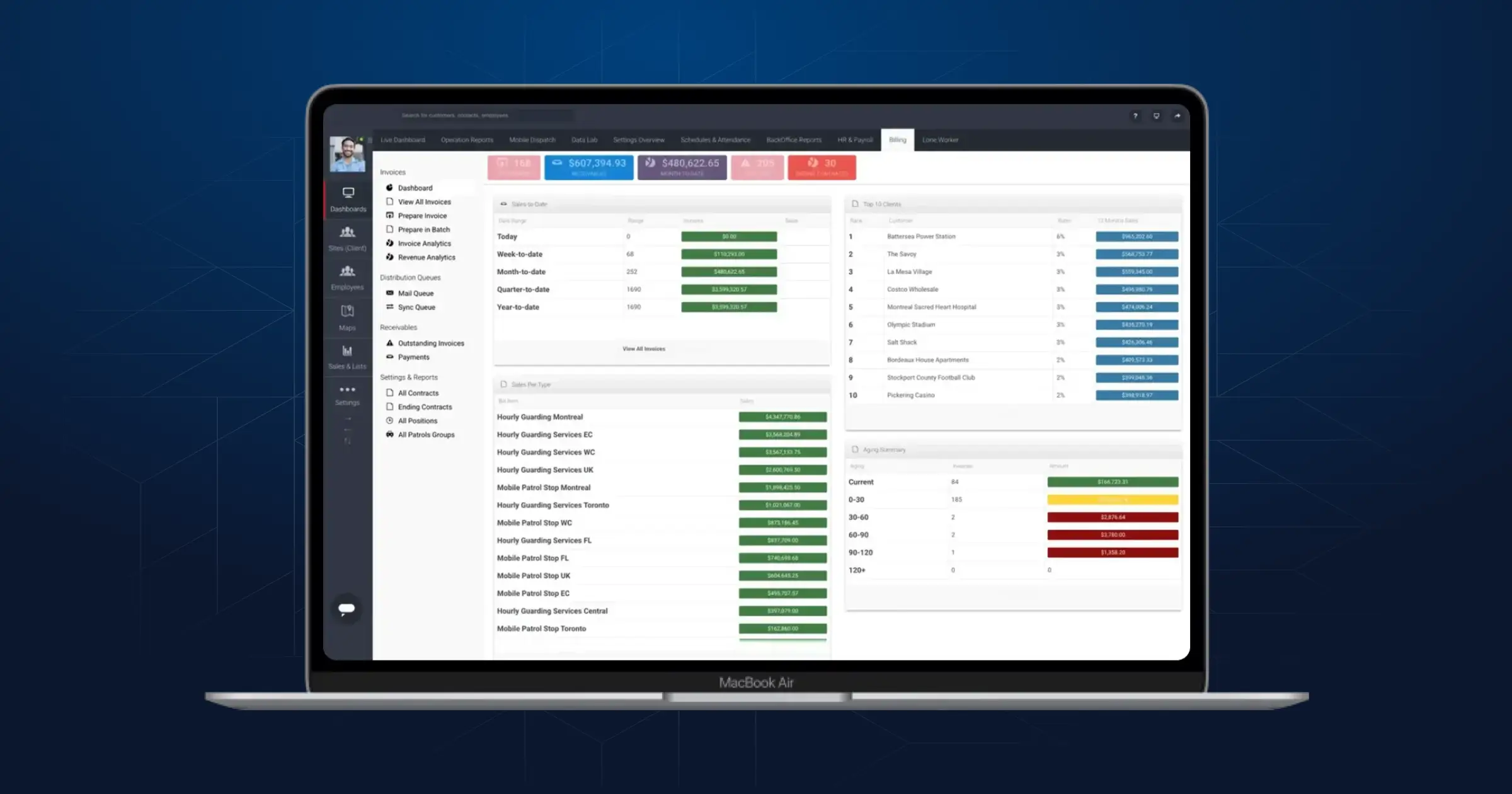
Those five pressure points are easier to act on when you follow a single shift all the way through, from the moment it needs filling to the moment somebody asks whether the contract made money. Every row below is the same shift, one step later:
|
Step in the chain |
Done by hand today |
Connected in TrackTik |
|---|---|---|
|
A shift needs filling |
Phone calls and texts down a list, based on whoever the scheduler remembers |
Availability and qualifications matched against the roster, with the open shift posted automatically |
|
The officer works the shift |
Times noted on paper, or in a spreadsheet after the fact |
Time and attendance captured in the field, with the tour record attached to it |
|
Hours get verified |
A supervisor checks a timesheet against memory and a phone call |
Checked against actual checkpoint scans and attendance data |
|
Payroll is calculated |
Multi-tier rates and overtime rules applied by hand, shift by shift, site by site |
Rules applied automatically to hours that were already verified |
|
The invoice is raised |
Verified hours re-entered into a separate billing system |
The same verified hours carry through to the invoice, with no re-entry step |
|
The client asks what happened |
Someone rebuilds a report from two or three systems and a spreadsheet |
Assembled from the operational record the team already created |
|
Margin is reviewed |
A month-end spreadsheet, if anyone gets to it |
Contract-level profitability visible while the month is still running |
The middle column is the whole problem in one view. Not one of those steps is security work, and every one of them is a place where accurate data gets degraded by being moved by hand.
Signs your back office is the bottleneck
Most firms know something is wrong before they can name it. These are the symptoms that show up first:
- Someone re-types data that already exists. The single clearest signal. If a number is keyed in twice, the second entry adds risk and nothing else.
- Invoicing waits on a person rather than a date. When billing slips because one person was on leave, the process is a person, not a system.
- Margin problems surface at month end. By then the overtime has been worked and the hours are unbillable. The information arrived too late to be useful.
- Coverage decisions are made from memory. A scheduler who knows which officers are reliable is valuable. A scheduler who is the only place that knowledge lives is a risk.
- No client question can be answered from one screen. If confirming a shift was covered and correctly billed takes three systems, your clients feel that delay too.
- Your best scheduler cannot take a holiday. Single points of failure in the back office are usually accepted rather than noticed.
What changes when AI works with the data you already have
The case for AI here isn’t about generating new data. It’s about putting the operational data security firms already collect, shift patterns, attendance history, billing cycles, guard qualifications, client requirements, to work.
That shift shows up most concretely in AGS Pro’s experience building AI agents on top of TrackTik, which Founder & CEO Lee Andrews walked through in a recent case study. AGS didn’t set out to replace schedulers and dispatchers. The goal was narrower: take the repetitive decisions off their plates so they could spend time on the ones that actually needed a person.
The first agent AGS built handles coverage recovery when an officer calls out or no-shows. Before it touched a live schedule, the team ran it in shadow mode for two weeks and tested it against a simple bar: would the agent make the same call a seasoned scheduler would? At first, it matched their team’s decisions only 30 to 50 percent of the time. Rather than scrap it, AGS rewrote the reasoning behind the agent, how it weighed skills, proximity, cost, and overtime risk, until it cleared 90 percent. That became the threshold every agent had to hit before going live.
The results reached beyond scheduling. An audit agent AGS pointed at a new contract compared how the account was configured in TrackTik against the signed agreement itself. It caught a position with contracted billable overtime that hadn’t been billed across multiple weeks, and separately, an estimate that was about to go out roughly $3,000 underbilled because a full day of shifts had been missed. In another case, a security council agent reviewing three months of dispatch data at one property found that 36 percent of overnight dispatches were going to a single stairwell where people were smoking. The fix was one camera.
None of this works without a trustworthy system of record underneath it. As Lee put it, TrackTik already handles the deterministic work, the rules, the alerts, the open-shift posts, so AGS built agents only where judgment adds something a fixed rule can’t. That’s the model our GSX session was built around: AI that reads and acts on operational data that’s already accurate, rather than AI layered on top of a mess. The same principle applies to reporting, which is why ReportPro AI drafts from what officers actually logged rather than inventing a narrative.
What makes an AI agent trustworthy enough to act
The AGS Pro experience is worth generalising, because the interesting part is not the AI. It is the discipline around it. Six things separate an agent you can let touch a live schedule from a demo:
- A system of record it can trust. An agent reasoning over inconsistent data will produce confident nonsense faster than a human could.
- One narrow, named job. Coverage recovery when an officer calls out is a job. Improving operations is not.
- Shadow mode before it acts. Run it alongside the humans and compare, with nothing at stake, for long enough to see edge cases.
- A measured bar to clear. AGS held every agent to matching a seasoned scheduler 90 percent of the time before it went live, which turns the decision into evidence rather than a feeling.
- Reasoning you can rewrite. The first version matched only 30 to 50 percent. The fix was rewriting how it weighed skills, proximity, cost and overtime risk, so the reasoning had to be inspectable.
- A clear line to a human. Deterministic work belongs to the platform, judgment calls belong to agents, and anything outside both should escalate rather than guess.
From cost center to competitive advantage
Reframed that way, the back office stops being a place where reports get built after the fact and decisions get made on lagging data. It becomes a source of real-time operational insight, predictive scheduling, and proactive risk surfacing, the kind of foundation that lets a firm price, scale, and compete on more than headcount.
That’s also where the workforce story lives. Qualification-matched scheduling means guards work posts they’re actually equipped for, which is a people management problem before it is a scheduling one. Automated shift offers and confirmations replace last-minute phone calls. Accurate, on-time pay removes one of the more common sources of guard turnover. None of it reads as flashy AI. All of it changes whether a guard sticks around.
Where to start when you cannot replace everything at once
Nobody rebuilds a back office in one quarter, and the order matters more than the pace. Each step below makes the next one cheaper, because each one removes a manual handoff that the next step would otherwise inherit:
- Get verified time first. Everything downstream depends on hours you can stand behind. Until time and attendance is captured in the field rather than reconstructed, automating payroll or billing just moves bad data faster.
- Connect verified time to payroll. Rates and overtime rules are deterministic, so this is the highest-volume manual work with the lowest judgment content. It is the easiest large win available.
- Connect the same hours to invoicing. This is where the re-entry step disappears and billing disputes start to fall away, because the hours worked and the hours billed come from one record.
- Turn the record into client reporting. Once the data is trustworthy, reporting is a by-product rather than a project, and it becomes something you can lead with at renewal.
- Only then look at agents. Automation on top of an accurate record compounds. Automation on top of a mess industrialises the mess.
What we showed at GSX 2026
GSX 2026, the Global Security Exchange, ran September 14 to 16 at the Georgia World Congress Center in Atlanta, where we hosted Booth #3305 and meeting room B218 above the exhibit hall.
Physical security is at an inflection point. Labor is tightening, clients expect more transparency, and the gap between early and late adopters is widening fast. At the booth we showed the complete field-to-back-office workflow end to end for the first time: patrol verified, incident reported, payroll calculated, invoice generated, all in one platform. Visitors also saw how programs like Lear Corp, Paladin, and Airbus use Trackforce to own their security data across hundreds of sites, the kind of scale an enterprise security team has to plan for, and what an agentic back office actually looks like when scheduling gaps fill themselves and billing disputes disappear before they start.
See the AI-powered
back office running live
Patrol verified, incident reported, payroll calculated, invoice generated, all in one platform. Book a walkthrough against your own sites and site list, and see the whole field-to-back-office workflow end to end.
If you missed us in Atlanta, everything on the booth screen is the same workflow we can walk through with you directly, using your own sites rather than a demo dataset. It is also the workflow most security firms already have half of, in the field, and are still rebuilding by hand in the office.
Frequently Asked Questions
Latest Articles





Featured Resources

See Trackforce in action
Book a walkthrough with our team and see how it fits your operation.