Why Security Guards No-Call, No-Show

Trackforce
October 14, 2016 · 11 min read
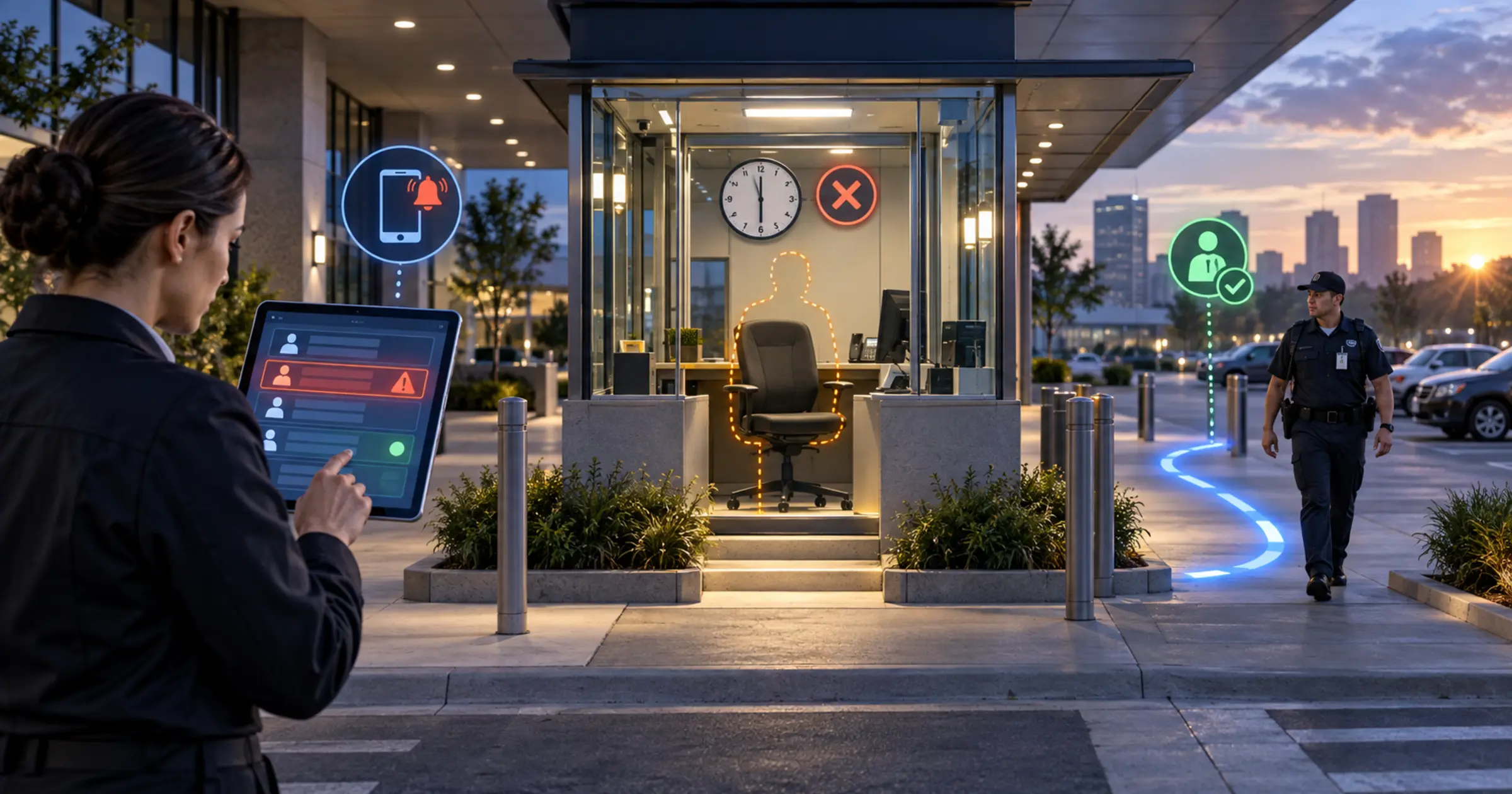
In the security services industry, it is common knowledge that security guards’ rates of no-call, no-show incidents are far higher than in most other lines of work, especially given the difficulties many security firms have in recruiting good guards. This problem is no minor inconvenience, but constitutes a threat to the morale and efficiency of your entire company.
Below, we address 7 common causes for security guard no-call, no-shows (aside from instances of genuine emergencies where calling in was impossible).
Key takeaways
- Most no-shows are process failures, not character failures.
An availability request that never reached the schedule looks identical to an officer who simply did not turn up, and only one of those is the officer’s fault. - If a verbal approval never changes the schedule, the schedule is wrong.
Time-off requests that live in a supervisor’s memory are the single most common root cause on this list. - Inconsistent enforcement teaches the wrong lesson faster than any policy document.
Officers calibrate to what actually happens, which means exceptions have to be recorded and defensible. - You cannot manage what you never categorised.
Absences logged as a blank gap tell you nothing. Absences logged with a reason code become a pattern you can act on. - Detection speed decides the client outcome.
The client rarely cares that someone missed a shift. They care whether the post was covered, and how quickly. That is a guard management question.
1. Poor communication concerning availability
In some cases, companies may not have a streamlined system in place whereby guards request time off or indicate a lack of availability ahead of time. Guards may say something to their immediate supervisor, but their request may never get answered or a verbal approval may not always translate into an actual scheduling change. When availability lives in people management alongside the roster, an approved request updates the schedule itself rather than someone’s intention to update it.
2. Lack of understanding of company policies
A no-show may also occur because new hires were not properly orientated to company policy in regards to asking for time off or scheduling changes. There should also be periodic review of the rules with existing employees and an organized way of indicating rule changes. Guards should understand what to do if a last-minute sickness should strike, know who is responsible for finding a replacement, and be fully aware of the consequences of a no-show.
3. Inconsistent enforcement of the rules
Rules concerning no-shows must be enforced consistently to be taken seriously, and to show your employees that you are not arbitrarily making exceptions for some guards but not for others. This will require full record keeping on infractions and a refusal to bend the rules when put under pressure. Consistency is far easier to defend when the record is in the system rather than in a supervisor’s notebook, which also matters if an absence ever becomes a disciplinary or employment dispute.
4. Scheduling problems and conflicts
Often, guards miss days without calling in first because they truly could not be there and yet feared that calling in would be futile, knowing that the schedule was virtually inflexible once set. Don’t fail to get feedback from no-show guards to see what caused the incident, and do your best to get everyone scheduled only for time slots they are willing and able to fill. A schedule that can absorb a swap is a schedule officers will engage with, and connecting it to the back office means a change does not create a payroll problem downstream.
5. Work-life balance
Not only do guards no-show more frequently than others, but they also have a higher incidence of quitting. Turnover in the security industry runs far above most sectors, and the same pressures drive both outcomes. Dissatisfaction with work-life balance is one of the largest, and a lack of quality family time is among the most commonly cited reasons for both missing days and leaving altogether. Our own research found that 42% of security leaders rank high turnover as their single biggest challenge, which puts a no-show in its proper context: it is usually an early symptom of the same problem.
6. Management-employee relations issues
All five of these above problems can be summed up as a breakdown in management-employee relations. But, beyond what has been mentioned, employees may become resentful if they feel mistreated; on the other hand, they may become overly relaxed if they feel there are no clear boundaries. There are practical strategies for improving engagement that address this directly, and most of them cost less than replacing an officer.
7. Not using security industry scheduling software
By using modern security scheduling software, managers can know in real time when guards do not show up as scheduled and, thus, respond quickly to fill vacated posts. TrackTik, for example, uses GPS and mobile check-in from the guard app to give managers instant alerts of no-shows. It also handles complex, ever-changing schedules and helps ensure every post is filled by a guard with sufficient experience and current certifications, rather than whoever answers the phone first.
No-show response: the first hour
Understanding the causes matters, but on the morning it happens you need a sequence rather than a theory. The difference between a no-show that damages a client relationship and one the client never notices is usually measured in minutes:
|
When |
What needs to happen |
Where it happens in TrackTik |
|---|---|---|
|
Shift start passes with no clock-in |
You find out, rather than the client telling you |
An automatic alert fires from the schedule instead of waiting for a call |
|
First 10 minutes |
Reach the scheduled officer |
Contact details and the shift record sit together, so nobody hunts for a phone number |
|
10 to 20 minutes |
Work out who can genuinely cover |
Availability, qualifications and proximity filter together, so the offer only goes to someone eligible |
|
20 to 30 minutes |
Send a replacement, and notify the client if the contract requires it |
Dispatch routes the nearest available officer and the record shows when they arrived |
|
End of shift |
Categorise the absence, do not just note the gap |
A reason code is attached to the absence so it can be counted later |
|
Next review cycle |
Find the pattern behind the incidents |
Reporting shows whether no-shows cluster by site, shift, day of week or supervisor |
Notice that only the first row is about detection. Everything after it is about whether the information reaches a person who can act, which is why a phone tree and a spreadsheet struggle here even when the people using them are excellent.
Leading indicators that predict a no-show
No-shows are more predictable than they feel. These are the signals worth watching, most of which are already sitting in your scheduling data:
- A shift assigned without a confirmed availability response. The clearest single predictor, and the easiest to fix.
- Repeated late clock-ins at the same post. Lateness usually precedes absence at the same site, often because of travel or parking rather than attitude.
- A first shift at an unfamiliar site. Officers who have never been to a site are markedly more likely to miss it. A site brief and a named contact removes most of that risk.
- Short turnarounds between shifts. A late finish followed by an early start is a no-show waiting to happen, and it is visible in the roster before it happens.
- Overtime concentrated on a handful of officers. Your most reliable people absorb the gaps until they stop being reliable. Reporting on overtime distribution catches this early.
- One supervisor’s posts accounting for a disproportionate share. When absence clusters under one manager, the cause is rarely the officers.
A 30-day plan to cut no-shows
- Days 1 to 7: start measuring properly. Add reason codes to every absence so that next month you have categories rather than gaps. You cannot fix a number you are not collecting.
- Days 1 to 7: close the availability loop. Make time-off requests something an officer submits and receives a recorded answer to. A verbal yes that never reaches the roster is the defect behind cause one.
- Days 8 to 14: get the policy onto one page. What to do when sick, who finds the cover, how much notice, and what the consequences are. Then confirm every current officer has actually seen it, not just every new hire.
- Days 15 to 21: build a coverage bench. Identify who is qualified and willing to pick up extra shifts per site, before you need them at 6am. Cover is a roster problem solved in advance, not a phone problem solved in the moment.
- Days 22 to 30: read the data and act on one thing. Break absences down by site, shift, day and supervisor, then change the single biggest contributor. Connect it through to billing as well, since unfilled posts and the hours you invoice need to agree.
See how TrackTik can help make sure you always have a guard where you need one, and a record of it afterwards. Book a demo today.
Frequently Asked Questions
Latest Articles


Featured Resources

See Trackforce in action
Book a walkthrough with our team and see how it fits your operation.