Winning The Best Security Contracts In A Growing Industry

Trackforce
July 18, 2019 · 15 min read
The physical security industry keeps expanding, and so do both the competition and the number of potential clients. As competition increases, security buyers can be more particular with which guard companies they choose to deploy on their properties. As a result, greater evaluation of your brand’s image, standards and perceived value of service can lead to a larger market share.
A well-executed security sales and marketing plan has always been important in acquiring new security contracts, but it is no longer enough. Clients now choose which security companies they contract by evaluating their overall industry knowledge and experience, customer referrals, licensing, price, and their technology stack. Because of this, it is essential for security firms to evaluate each of these components of their own company to create a compelling image that conveys quality.
Key takeaways
- Buyers no longer buy the pitch, they buy the proof.
Experience, referrals, licensing, price and technology are all assessed, and the firms that win are the ones who can show evidence for each instead of asserting it. - The lowest bid is a weak position.
Undercutting signals that your own service is worth less. Price at market and prove the value instead. - Licensing is a state-level question.
Requirements differ by jurisdiction, so confirm them with your own regulator rather than assuming one state’s rules apply everywhere. - Technology is now part of the offer, not the back office.
A buyer asking how they will see the work is asking a product question. Showing a live security operations view answers it in seconds. - Winning the contract and keeping it are the same skill.
The operational record that wins a bid is the same record that defends a renewal and justifies a rate increase.
What Security Buyers Actually Evaluate
Most losing bids are not lost on price. They are lost because the buyer asked a question and the answer was a promise instead of a document. It helps to separate what a buyer says they are evaluating from what they are actually trying to find out, and to decide in advance what you will put in front of them.
|
What buyers evaluate |
What they are really asking |
What to put in front of them |
|---|---|---|
|
Track record |
Have you done this at our scale, in our sector? |
Two references from the same sector, plus a case study with numbers in it |
|
Price |
Is this rate credible, or are you buying the contract? |
A rate built from wage, burden, supervision and margin, with the assumptions shown |
|
Licensing and insurance |
Will you expose us to liability? |
Current state licence numbers, a certificate of insurance, and the certifications held per post |
|
Officer quality |
Who exactly will be on our site, and are they trained? |
A post-specific training matrix and a named site supervisor |
|
Technology |
Will we actually be able to see the work? |
A live portal view, one sample tour report and one sample incident report |
|
Escalation |
What happens at 2am when something goes wrong? |
A written escalation path with response times and a sample monthly review pack |
The pattern in that last column is worth noticing. Almost everything a buyer wants is a record of work that already happened, which means the bid is won or lost by how well you were running the sites you already have.
Industry Experience and Referrals
One of the first things your potential business clients will research is your credibility and history in the security industry. Reviews and previous customer feedback are key factors in which you will be evaluated for security contract bids. A solid way to prove you have what they need is through referrals from previous clients. Having these referrals handy, like on your website, will strengthen your company image. It is one thing to tell a potential customer about the quality of your services. But having a relatable buyer who you have impressed assures they will have a positive experience utilizing your services and will make a much stronger impact on the lead.
Another easy way to get a leg up on the competition and show possible clients that you are a driving force in the security market is through customer reviews. There are dozens of platforms online where people can share reviews of business interactions, including Yelp, Google, and even Facebook. Try asking any of your former, happy clients to write you a review, and share those reviews across your website, on social media, and with prospective clients during the sales process.
Make the reference concrete. A sector match beats a logo, and a number beats an adjective. Instead of saying retention improved, say which site, over what period, and by how much. Armour Security grew from three officers to over 1,250 on an operating record they could show clients, which is the kind of reference that survives a procurement committee.
The Right Price
Intuition would tell you that the lowest price will attract the most customers, but this does not always hold true. Undercutting another security company’s prices may undercut the perceived value of your own services. Do not worry about being cheaper than your competition, as this may put your value in question. Instead, focus on setting your pricing at similar rates and market yourself as the premium option. As long as you can prove your value, people are happy to pay more.
Additionally, be willing to create flexible pricing options for your prospects. Tailoring your services to your potential customers’ budget will prove that you understand the needs of their business, and will only increase your chances of winning the bid.
Flexibility only works if you know your own floor. Build the bill rate from the bottom up rather than reverse engineering it from a competitor’s number, and keep the components visible so you can flex one without giving away the others:
- Base wage for the post, at the rate that will actually retain an officer in that market.
- Burden, covering payroll taxes, insurance, paid time off, uniforms and equipment.
- Supervision and overhead, including the field supervision the contract genuinely needs rather than the minimum you can defend.
- Training and compliance specific to the site, which is often what separates two otherwise identical bids.
- Margin, stated as a number you will defend rather than whatever is left over.
Margin leaks after the contract is signed, not during the bid. Unbilled overtime, missed shifts, and hours that never make it onto an invoice are where the profit goes. Tying scheduling to billing through contracts and invoicing and a connected back office means the hours worked and the hours billed are the same hours, so the rate you won stays the rate you earn.
Training and Licensing
Licensing is handled at state level, so the exact authority depends on where you operate. In California, for example, it runs through the Bureau of Security and Investigative Services, and a Private Patrol Operator licence carries its own list of requirements. Most other states run an equivalent board with its own rules, so confirm the requirements with your own state regulator before you bid rather than assuming one state’s process applies everywhere.
One requirement is close to universal: liability insurance, which can be obtained from a number of different firms. Research your options, and choose what is best for your company. With proper licensing and insurance, you can put potential clients at ease by proving the lawfulness of your operation.
Training your security officers to be well prepared, as well as testing them rigorously, is another great way to increase customer satisfaction. On-the-job training and third party programs are both good ways to make sure your officers are qualified. Up-to-date certifications and training throughout your company is a must for any growing firm, and it is the first step in assuring quality to future customers.
The practical risk is not the training itself, it is proving it held. Certifications expire, officers move between posts, and a buyer will ask whether the person on their site tonight is currently qualified for it. Holding certifications, expiry dates and post assignments against each officer in people management turns that from a filing exercise into a question you can answer in the meeting.
Technology
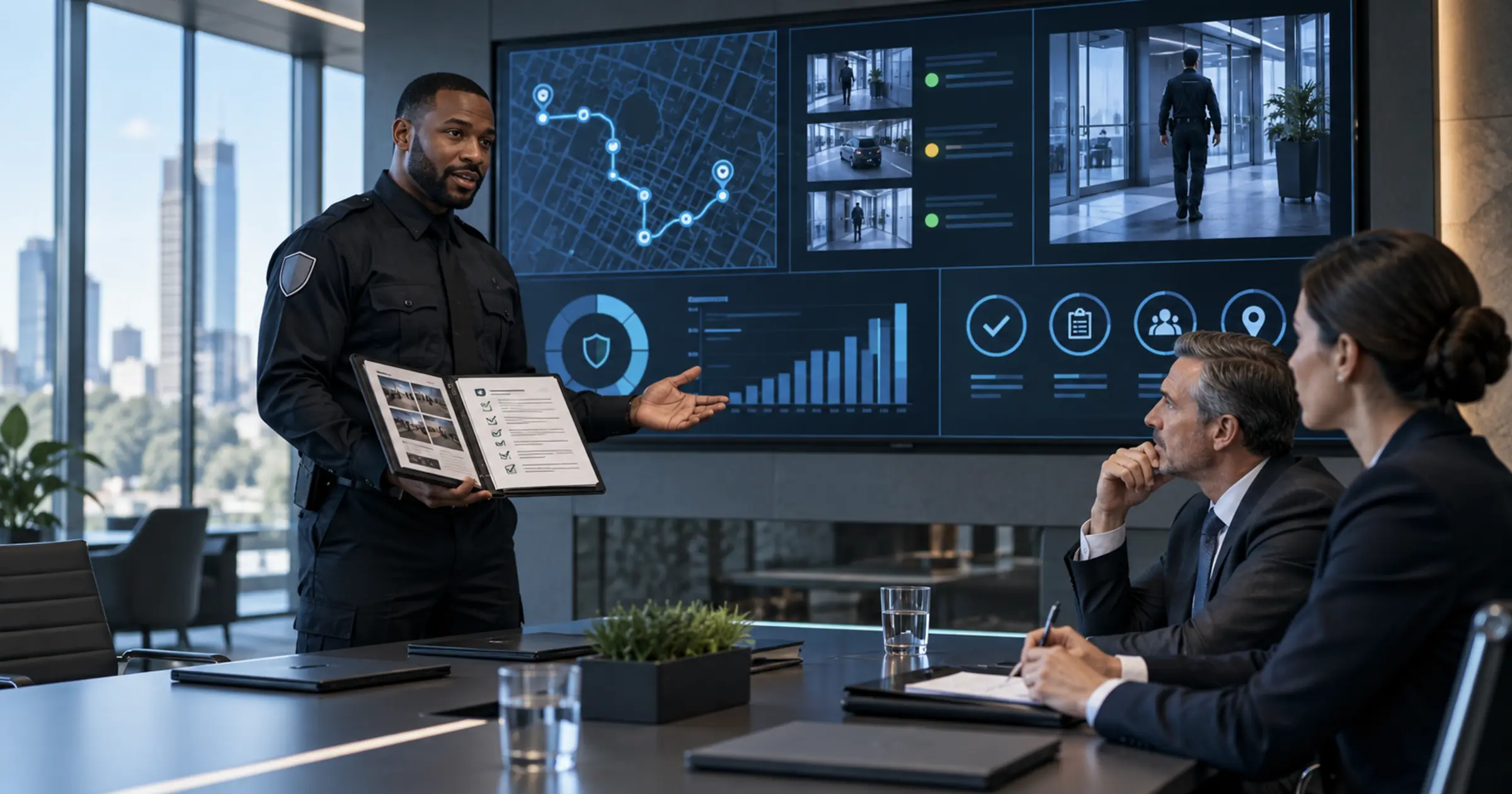
Maintaining a consistent flow of communication between the customer and your business is equally as important as training your employees. Ideally, all officers would maintain a high level of professionalism at all times. But that is not always the case. Integrating some form of security guard management software will allow you to easily communicate what your guards do in the field with the client and close the feedback loop. Showing off this type of technology during the sales process will only increase your probability of closing the deal.
Implementing technology like this is a great way to prove to your prospects that your services are cutting edge and modern in an industry typically thought of as behind the times. There are few better ways to push a premium brand image than with technology that optimizes your operations.
In a bid meeting the technology has to do one specific job: answer the question of how the client will see the work without taking your word for it. Three parts of the platform carry most of that weight. A security guard tour system produces timestamped, geotagged proof that checkpoints were covered in the right order. Security incident reporting gives every incident a consistent structure, so a report reads the same whether it came from a veteran supervisor or a new hire on nights. And a client-facing portal lets the buyer look at their own site rather than waiting for your summary of it.
The Proof Pack: What To Bring To A Bid Meeting
Assemble this once and reuse it for every bid, swapping in the sector-relevant examples. It turns a sales conversation into a review of evidence:
- A tour completion record from a comparable site over 90 days, including the exceptions and what you did about them. Showing the misses is more persuasive than a perfect sheet nobody believes.
- One real incident, end to end. The report, the timestamps, the escalation, the resolution and the follow-up.
- A live view on a phone. Open the security guard tour app in the room and walk a checkpoint. Demonstrations beat screenshots.
- A coverage and fill-rate number for your existing book, with how you handle a call-off at 3am.
- A written escalation path with names, channels and target response times.
- A 30-60-90 day transition plan if they are moving from an incumbent, covering recruitment, post orders, site familiarization and the first review date.
Keeping The Contract After You Win It
Winning is the cheaper half. Contracts are usually lost quietly, through a year of small unreported gaps that surface all at once at renewal, when the client has no record of the value you delivered and you have no record to show them.
Set the review rhythm at the start rather than negotiating it later. Agree what will be reported, how often, and which numbers define success, then report on it whether or not anyone asks. Business intelligence turns a year of tours, incidents and hours into the trend lines a client actually responds to, and because ReportPro AI drafts the narrative from what officers logged, the reporting keeps happening in the months when the team is busy. For an in-house buyer, that same record is what an enterprise security team takes to its own board.
A 30 Day Plan To Get Bid Ready
- Days 1 to 7: pick your two best sites and pull 90 days of tour, incident and coverage data. This becomes your evidence base, so choose sites you are genuinely proud of.
- Days 1 to 7: secure two references in the sector you are targeting, and ask each for one specific number you are allowed to quote.
- Days 8 to 14: rebuild your rate card from wage, burden, supervision, training and margin, and write down the margin you will not go below.
- Days 8 to 14: audit compliance. Put every licence, certificate of insurance and officer certification in one place with its expiry date visible.
- Days 15 to 21: build the reusable proof pack from the section above, as a document you can tailor in an hour rather than rebuild each time.
- Days 22 to 30: run a dry run. Present to your own team and have them play a hostile procurement panel. The questions you cannot answer are your real gaps, and you would rather find them internally.
Each of these components plays a role in the creation of a compelling company image and should be evaluated separately. However, when combined they have the potential to bring your company to the next level. If you want to see what the evidence side of a bid looks like in practice, you can book a TrackTik demo and walk through it against your own sites.
Frequently Asked Questions
Latest Articles





Featured Resources





See Trackforce in action
Book a walkthrough with our team and see how it fits your operation.