Why Your Security Proposals Aren’t About You

Trackforce
February 5, 2015 · 12 min read
We recently circled back to a webinar we did on partnering with the property management industry. In it we covered the ways a security company can begin shifting from a vendor to a partner. If you have not seen it yet, you can browse our webinar library to watch it.
Here is a quick snippet to refresh your memory.
Your security proposals, services, and efforts should be about your client and their needs. If your proposal talks more about you than it does about them, you are probably losing contracts.
Key takeaways
- Most proposals describe the bidder, not the property.
Years in business, screening standards and proprietary systems appear in every competing bid, so none of them differentiate anything. - With no visible difference in service, price becomes the only difference.
That is how a proposal gets flipped straight to the pricing page, and how a bid turns into a race to the bottom. - Specificity is the differentiator.
What you observed on the site walk, what has gone wrong at that property before, and what changes in week one cannot be copied by a competitor who did not do the work. - A plan is only persuasive if you can show it will happen.
Verified tours, structured incident reports and a client-facing view in security operations turn promises in a proposal into something the client can check. - Vendors get replaced, partners get renewed.
The shift is not a tone of voice. It is whether the client can see the work without asking you for it.
The mistake most security proposals make
Let’s take a closer look at this and uncover the major mistake most security companies make when preparing a proposal.
Imagine being on a safari deep in the Serengeti and coming upon a large herd of zebra grazing in a wide open field. Suddenly your guide directs your attention to a specific zebra he says has amazing markings. You scan the vast herd with your binoculars, searching in vain. “Where, which one?” you ask, still scanning intently.
“There, the one with black and white stripes,” your guide points and says.
With a quizzical look on your face you drop your binoculars and look at your guide. “Really?”
Giving such an obviously generalized description is no help at all. It differentiates nothing specific that would help in your search.
That sounds exactly like the security industry to me. I know, because I fell into that exact same trap. When I was selling security services, my proposal and bid packages were so amazing and filled with information that I thought made me different.
It turned out that my proposals were exactly the same as everyone else’s. There was really nothing that separated them from the herd of other proposals and bid packages coming across my prospect’s desk. If that sounds familiar, it is worth reading about the specific proposal habit that costs the most money alongside this.
When nothing differentiates you, price does
Then an amazing thing happened. After talking to a few property managers and asking for an honest critique and their input, I discovered the proposal process is not about me or the company I represent. All the proposals and bid packages from security companies that talked about how great they were got flipped right to the back page to see what the pricing was. I found out that no matter how much I included about officer training or my “unique” management systems, it did not provide me with an advantage at all.
What I learned was simple. Without any noticeable differences in service, the price became the only perceived difference between me and my competition.
That is the trap, and it is avoidable. There is a whole discipline around competing without being the lowest bid, and it starts with giving the buyer something other than rate to compare.
Make the proposal about their property
That means it was extremely important that I actually included information that was important to them. I needed to find a way to include information in my security proposal that addressed specific issues unique to that property and account.
This realization sent me on a journey to discover as much as I could about my client. What are their goals, motivations, issues and expectations?
Years in the industry, accountability, and how I was miraculously able to sift through the same gene pool of officers and magically find all the best ones meant nothing to my prospect.
What is truly important to them, and what the focus of your proposals and bid packages should be, is how you address specific issues. It is important to highlight a clear plan of action and an implementation plan that accomplishes the result your prospect is looking for. The same principle scales down to a single community: it is exactly how you win an HOA security proposal, where the board cares about their gate and their parking lot and nothing else.
Vendor language versus partner language
The fastest way to audit your own proposal is to read each claim and ask what a property manager hears when they read it. Most boilerplate falls apart immediately:
|
What most proposals lead with |
What the client actually hears |
What to lead with instead |
|---|---|---|
|
“25 years in the industry” |
So has every other bidder on this desk |
What you found on the site walk, and what you would change in week one |
|
“Rigorous officer screening and training” |
Everyone claims this and nobody proves it |
The certifications this specific site needs, and who on the roster holds them |
|
“Our proprietary management system” |
I am never going to log into that |
A live view of their own property, and the three reports they would get weekly |
|
“24/7 responsive supervision” |
Unverifiable until something goes wrong |
A named supervisor, a written escalation path and target response times |
|
“Competitive rates” |
Skip to the pricing page |
A rate broken into wage, burden, supervision and margin, and which part flexes |
|
“We are a trusted partner” |
Prove it |
Two references from comparable properties, each with one number they will share |
Notice that everything in the right-hand column requires you to have done something first: walked the site, read the incident history, named a supervisor, built the rate honestly. That is the point. It cannot be copied from a template, which is precisely why it differentiates you.
Four questions to answer before you write a word
- What does this property actually lose sleep over? Tenant complaints, after-hours access, liability exposure, a board that wants fewer surprises. Ask, rather than assume it is theft.
- What has already gone wrong here? Incident history, the previous provider’s failures, and the one event nobody wants repeated. This is the single richest source of proposal material and almost nobody asks for it.
- Who reads this, and what are they judged on? A property manager is measured on tenant satisfaction and budget predictability, not on your officer screening process. Write to their scorecard.
- What visibly changes in the first 30 days? Name the specific things they will notice, and how they will know they happened without having to take your word for it.
How to prove the plan will actually happen
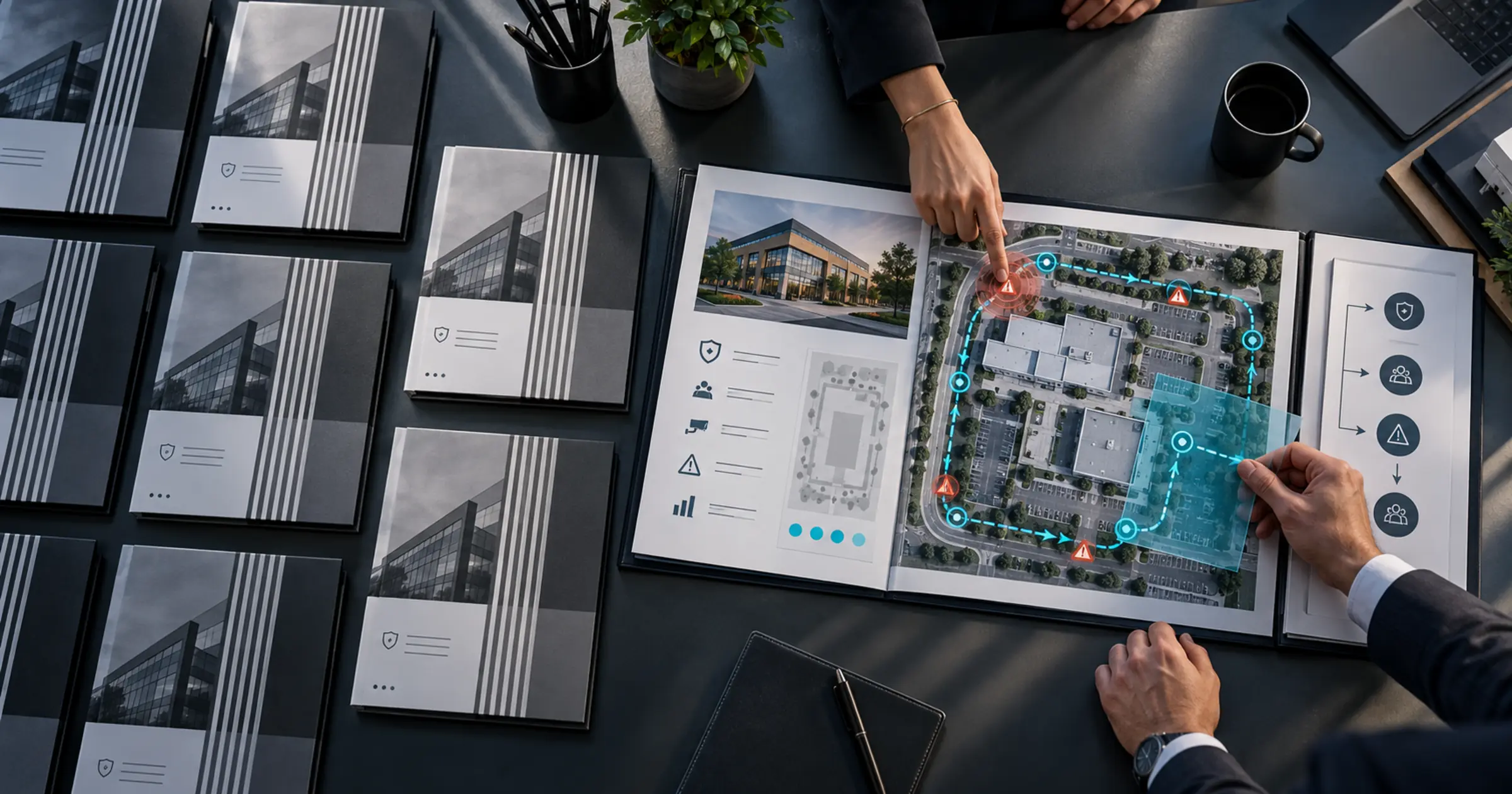
A client-focused proposal creates a new problem for you: you have just made specific commitments about someone else’s property. The proposals that win are the ones that also answer how the client will see those commitments being met. Five things do most of that work:
- Verified patrols instead of a signed sheet. A security guard tour system timestamps and geotags every checkpoint scan, so covering the loading dock at 2am is a record rather than a claim.
- Incident reports that read the same every time. Security incident reporting gives every officer one structure, so quality does not depend on who was on shift.
- A view the client opens themselves. Business intelligence turns the operational record into the weekly and monthly reporting you promised, without anyone assembling it by hand.
- A named escalation path that holds at 3am. Security guard dispatch makes the response time in your proposal something you can report against later.
- Coverage and certification you can evidence. Guard management holds fill rates and current certifications per post, which is what turns “trained officers” into a verifiable statement.
Become the spotted zebra
Imagine being on that same hypothetical safari and the guide shouts and points out to you, “Look at that zebra with spots!”
You would probably see it immediately, because it stands out from all the others, it is something you have never seen before, and it is so different.
It is amazing that such a seemingly minor change, making a proposal or bid package about the client and their goals, motivations, issues and expectations instead of about yourself, nets an astonishing shift in your success at winning contracts. You can become the spotted zebra.
What happens after you win
A client-focused proposal sets a standard you then have to hold for the length of the contract, which is where most vendor relationships quietly fail. The commitments that won the bid need to keep producing evidence at month nine, not just in the pitch. Keeping verified hours connected to contracts and invoicing means the billing matches the service the client agreed to, and the reporting you promised keeps arriving whether or not anyone chases it. That is genuinely the whole difference between a vendor being replaced and a partner being renewed.
If you have not had a chance to watch the Vendor to Partner webinar, I highly recommend it. We packed a lot of useful information into a short amount of time, and you can find it in our webinar library linked above. If you would rather see the operational side, you can book a TrackTik demo and walk through what a client-facing view of your own sites would look like.
Frequently Asked Questions
Latest Articles



Featured Resources
See Trackforce in action
Book a walkthrough with our team and see how it fits your operation.