Ollivier a géré l’approche de la sécurité en matière de détection et de réponse unifiées
Ollivier a géré l’approche de la sécurité en matière de détection et de réponse unifiées
« La séparation entre la protection des opérations et les flux de travail des systèmes de sécurité m’a toujours dérangé. »
For Louis Boulgarides, President and CEO of Ollivier Managed Security, that frustration goes back decades. He started his career as a security guard more than 30 years ago, walking patrols and turning physical keys to prove he’d been on site. Over time, he transitioned into leadership roles across both guarding and security technology.
What never changed was the disconnect. “People spend a lot of money on both,” Louis says, “and they never leverage both resources together. Technology people are on one side, guarding people are on the other.”
When Louis acquired Ollivier, he saw an opportunity to do something different. Instead of operating as a traditional guarding company or a systems integrator, Ollivier rebranded as a managed security company, focusing on managing the entire security program from end to end.
Headquartered in Los Angeles and founded in 1987, Ollivier has grown from a family-run business into a technology-driven provider serving commercial, corporate, and institutional clients. By blending people, systems, and cybersecurity expertise, the company delivers fully integrated security solutions — from access control and video surveillance to cloud-based systems, visitor and workforce management, and remote monitoring. With these capabilities, Ollivier not only supports its clients’ day-to-day operations but also sets the stage for bridging the gaps between technology and on-the-ground security personnel.
Un Incident, Deux Mondes
Before integrating TrackTik and Immix, Ollivier’s monitoring and guarding workflows looked like most others. Alarms flowed into Immix. Operators assessed them. Guards were dispatched by radio, phone, or text.
« Il n’y avait aucune connexion entre les informations provenant des systèmes électroniques et ce qui était transmis au personnel de sécurité », explique Louis.
If an incident occurred, answers were fragmented. Monitoring logs told one part of the story. Security guard reports told another. Dispatch timing often lived in between, undocumented, and challenging to audit.
“At a very basic level,” Louis says, “all we wanted to do was take the inputs from Immix and create a dispatch to security personnel so that everything could be audited.”
But once that connection was established, something even bigger became possible.
Seeing the Whole Picture in TrackTik
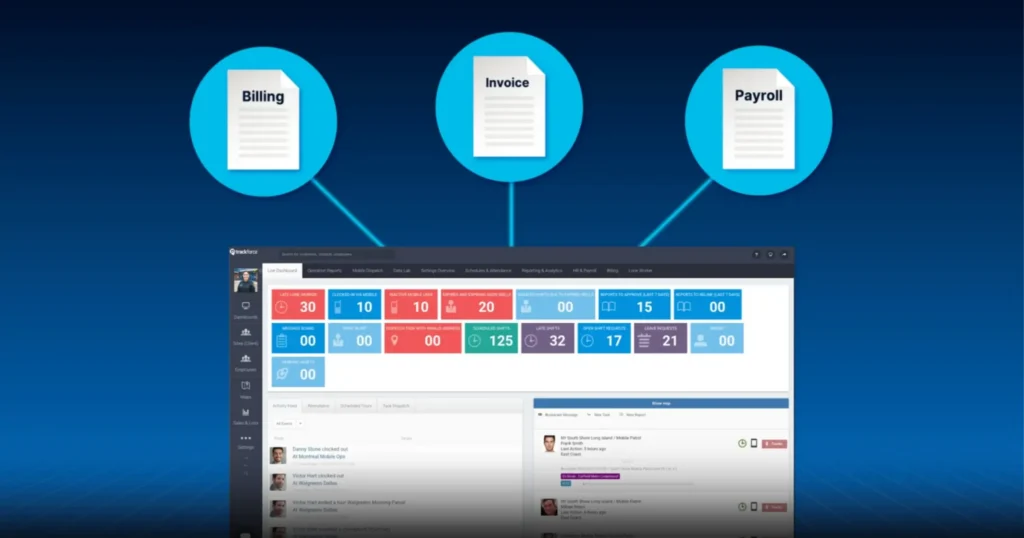
Once Ollivier connected TrackTik and Immix, everything changed. The integration created a seamless operational flow where alarms, dispatch activity, and guard locations are all visible in a single system. An alarm triggers, an operator acts, a guard is dispatched, and arrival and response are automatically tracked. Reports are consolidated, providing a full picture of the incident from start to finish.
« Il n’y a plus de séparation entre le côté garde de l’entreprise et le côté système », dit Louis. « Tout est ensemble. »
This unified view transformed how incidents are understood and how decisions are made afterward. “When something happens at a property, the first question is always, ‘Where was security?’” Louis explains. “The next question is, ‘Do we have cameras there? Do we have access control there?’ Why are we trying to pull all that information from different places?” Now, all of that insight is available at a glance.
Changer la conversation avec le client
For Ollivier, this isn’t about adding another feature. It’s about reinforcing their role as the manager of the entire security program.
“Businesses trust us to manage their security program, not just guards, not just systems,” Louis says. “The integration with TrackTik and Immix allows us to do that.”
L’intégration offre aux clients une visibilité simultanée sur l’activité du système de sécurité et l’activité de garde. Cette visibilité devient un facteur de différenciation.
“It’s a competitive advantage for us,” Louis says. “Our clients no longer make decisions based on assumptions or isolated reports. With real-time visibility into both security systems and guard activity, they can see response times, coverage, and proximity all at once — and make decisions based on actual data, not past incidents or subjective impressions.”
Measuring What Wasn’t Measurable Before
The ability to track dispatch and response is still new for Ollivier, but the impact is already clear. With the TrackTik Command Center integrated with Immix, measuring incident creation to dispatch, and dispatch to on-time response is now possible.
“Even basic efficiencies — like dispatching directly from the command center instead of calling guards manually — are now measurable,” Louis says. “It’s inherently more efficient, but more importantly, it’s trackable. This data isn’t just about saving time; it’s how we demonstrate value to our clients and differentiate ourselves in ways that weren’t possible before.”
Un modèle que d’autres commencent à remarquer
Louis doesn’t expect everyone to follow this path easily.
“Guarding companies do security guard stuff. Systems companies do systems stuff,” he says. “This lives in the space between.”
However, as margins tighten across the industry, he believes that more companies will be compelled to think differently.
« Toutes les entreprises vont devoir devenir des entreprises de services », dit Louis. « C’est extrêmement précieux pour les gens. »
For Ollivier, connecting TrackTik and Immix wasn’t about technology for technology’s sake. It was about removing a long-standing barrier and creating a more comprehensive, defensible approach to managing security.
« Une fois que tu auras éliminé cette barrière, » dit Louis, « la question devient : que peux-tu faire avec les données? »
Pour Ollivier, cette question ne fait que commencer.
About the TrackTik + Immix Integration
The TrackTik + Immix integration bridges remote monitoring and physical security operations by automating incident intake, dispatch, and response tracking. The result is faster response times, greater accountability, and a unified operational view across systems and personnel.
Articles connexes
Articles en vedette
Perspectives et conseils du corps professoral de Spear et d’experts de l’industrie