Key Physical Security Technologies Transforming Private Security

Trackforce
March 20, 2025 · 10 min read
From the basic use of locks and keys, physical security has come a long way. With the integration of technological advancements such as RFID badges and facial recognition software, the security landscape continues to evolve. This article looks at the emerging physical security technologies shaping the future of private security, and how to connect them to the work your officers do every day.
Key takeaways
- AI makes detection faster, not optional for humans.
AI video surveillance flags threats in real time, but trained officers still verify and respond. - Predictive analytics moves security from reactive to proactive.
Patterns in past incidents show where and when to focus patrols. - Training is getting more realistic.
VR lets officers rehearse high-risk scenarios safely before they face them on the job. - Detection without response is only half the job.
The real value comes from connecting alerts to dispatch, reporting and analytics. - TrackTik ties it together.
Command Center, dispatch, ReportPro AI and integrations with Scylla AI and Immix connect detection to resolution in one platform.
AI-Powered Video Surveillance
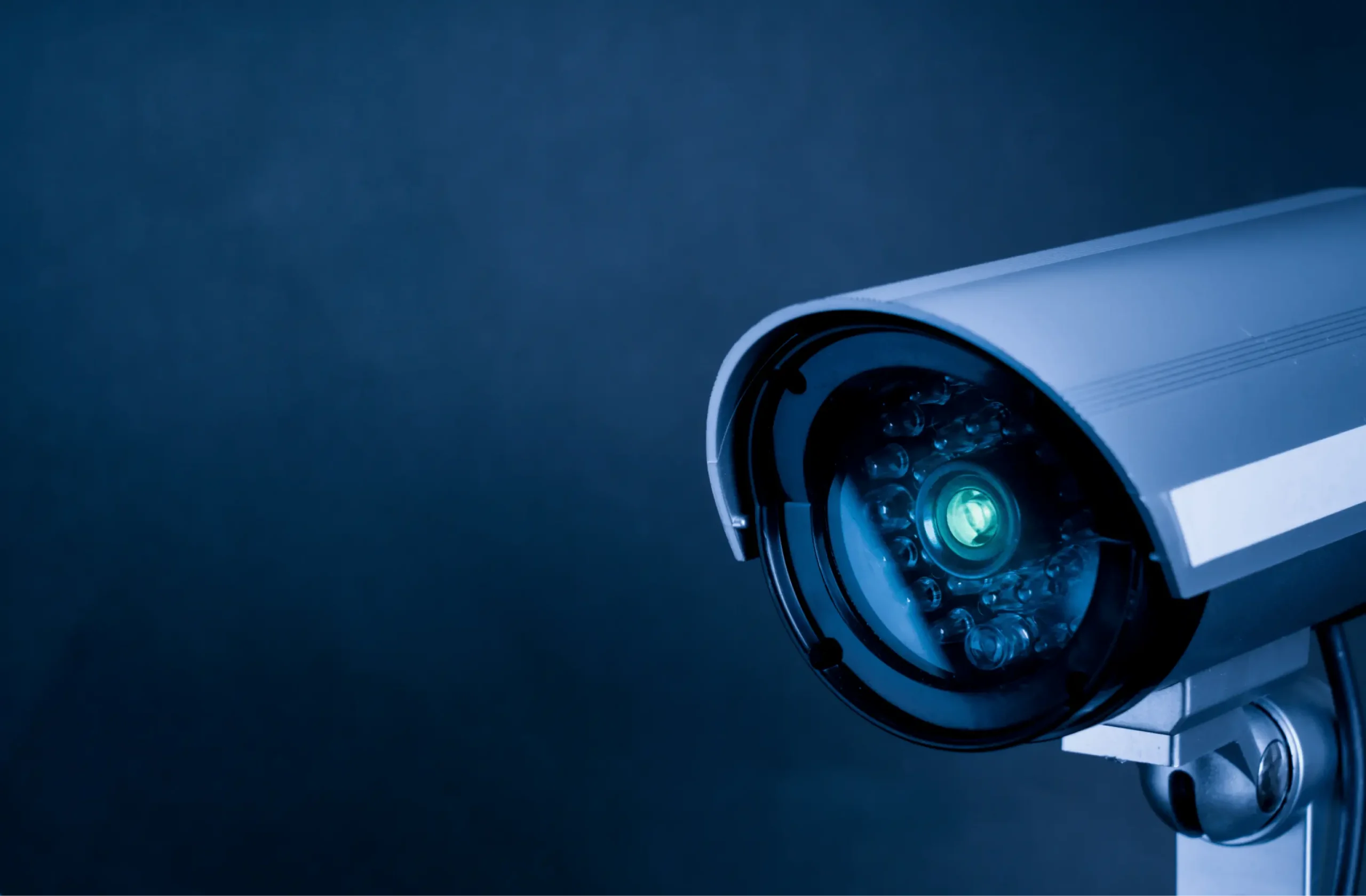
AI-powered video surveillance is the future of video monitoring, and it is changing private security services by making threat detection faster and more accurate. These advanced systems analyze video feeds in real-time, enabling immediate identification of potential issues like unauthorized access or suspicious behavior. The major changes introduced by AI in video surveillance include:
- Improved Threat Identification: AI algorithms can distinguish between different objects and movements, reducing false alarms and allowing security personnel to focus on actual threats.
- Proactive Monitoring: With AI, security systems offer quicker response options by alerting personnel to unusual activities, allowing for immediate intervention.
- Valuable Operational Data: Beyond just security, AI-driven insights can inform decisions by highlighting trends such as crowd gatherings or movement patterns.
- Quick Analysis: AI-driven programs can analyze and identify key visuals within seconds, eliminating the need for hours of manual video review.
- Automated Responses: When connected to access control and other systems, real-time AI alerts can trigger automated actions, such as locking doors or restricting access to sensitive areas.
How Guards Work With AI Video Surveillance
AI technology complements but does not replace the human element in security. Here’s how guards can engage effectively with these systems:
- Real-time Response: Guards can use AI-generated alerts to address the most urgent threats as they arise, improving their efficiency and effectiveness.
- Collaborative Interaction: By working alongside AI tools, guards can enhance their awareness and make informed decisions based on data-driven insights.
- Ongoing Education: Continuous training in AI technologies is crucial for guards to integrate these tools into their security routines seamlessly.
Predictive Security Analytics
Predictive security analytics is transforming the landscape of private security by using data-driven insights to anticipate and prevent incidents before they occur. Leveraging historical data and advanced algorithms, these systems can identify patterns and predict potential security threats. The key changes and improvements introduced by predictive security analytics include:
- Proactive Threat Management: Predictive analytics can forecast possible security breaches by analyzing past incidents and identifying trends, allowing for preemptive measures.
- Resource Optimization: By predicting the likelihood of incidents, resources can be allocated more efficiently, ensuring that security personnel are deployed where they are most needed.
- Enhanced Decision-Making: Security teams receive actionable insights that inform strategic decisions, improving overall security operations.
How Guards Work With Predictive Analytics
Despite the advancements in predictive security analytics, the role of security guards remains crucial. Here’s how they can effectively engage with these systems:
- Preventative Measures: By utilizing predictive insights, guards can take proactive steps to mitigate identified risks, such as increasing patrols in high-risk areas.
- Focused Attention: Predictive analytics help prioritize areas or times of heightened risk, allowing guards to focus their efforts where they can be most impactful.
- Data-Driven Training: Ongoing analysis provides valuable feedback that can be used to train guards on emerging threats and effective response strategies, ensuring they are well-prepared for potential scenarios.
Predictive insight depends on good data. TrackTik business intelligence turns tour, incident and patrol records into dashboards that reveal patterns across sites, and TrackTik physical security uses AI and machine learning to make predictive suggestions, including assistance during scheduling.
Virtual Reality Training for Security Officers
Virtual reality (VR) training is transforming the way security guards are prepared for their roles by offering immersive and realistic training experiences. This technology allows guards to practice their skills in simulated environments that closely mimic real-life scenarios. The key changes and improvements introduced by VR training include:
- Realistic Simulations: VR creates lifelike scenarios that help guards practice their responses to various security threats, from handling intruders to managing emergencies, in a controlled environment.
- Enhanced Skill Development: Through repeated exposure to different situations, guards can sharpen their decision-making and problem-solving abilities, leading to better performance in real-world situations.
- Cost-Effective Training: VR training reduces the need for physical training setups, making the process more efficient and cost-effective while allowing for consistent training standards.
How Guards Benefit From VR Training
Virtual reality training provides safe and controlled environments with extensive customization, ensuring that program leaders can be confident that security guards are acquiring the right skills effectively. Here’s how VR training enhances the training experience for security guards:
- Scenario-Based Learning: Guards can engage in a variety of training modules that simulate real-life incidents, enabling them to practice and refine their responses without real-world consequences.
- Immediate Feedback: VR systems provide instant feedback on performance, helping guards understand their strengths and areas for improvement, and allowing for continuous skill enhancement.
- Adaptability and Preparedness: By training in a wide range of scenarios, guards become more adaptable and prepared for any situation they might encounter on the job, ensuring a high level of readiness.
AI-Assisted Incident Reporting
AI is also changing what happens after an incident. Report writing has long taken officers away from their posts, and inconsistent reports can weaken a case or frustrate a client. AI-assisted reporting helps officers produce clear, complete documentation in a fraction of the time.
- Faster reports: Officers capture rough notes in the field, and AI turns them into complete, structured reports.
- Consistent quality: Every report follows the same standard, regardless of who writes it.
- Instant summaries: Managers and clients get concise executive summaries without reading every detail.
- Full accountability: An audit trail records every change to the report.
TrackTik ReportPro AI turns rough field notes into compliance-ready incident reports, writes executive summaries in seconds and audit-trails every change.
From Detection to Response: Connecting the Technology
Each of these technologies is powerful on its own. The real gains come when they work together, because detection alone is not response. Here is how an alert should move from camera to resolution:
- Detect: An AI-enabled camera flags unusual activity, such as a person in a restricted area after hours.
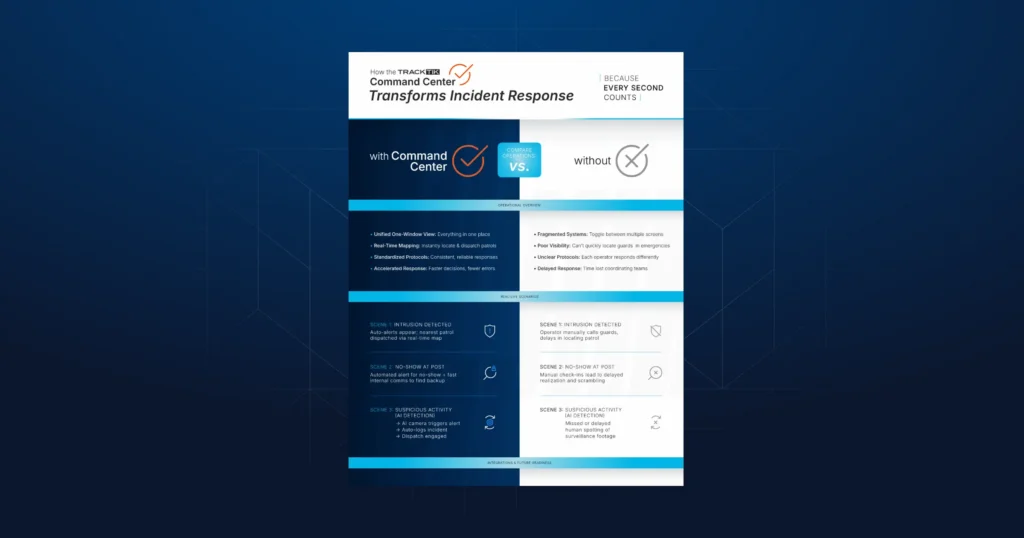
- Triage: The alert reaches a central workspace with live video and site details. TrackTik Command Center brings alarm monitoring, video access and dispatch together in one place.
- Dispatch: The best-qualified nearby officer is sent with a live ETA through TrackTik security guard dispatch.
- Respond and document: The officer verifies the situation, acts and records it with time-stamped evidence and AI-assisted reporting.
- Learn: The incident feeds your analytics, so patrols and staffing adapt to the patterns you see.
TrackTik connects with the systems that power this workflow, including Scylla AI threat detection and Immix remote guarding, plus an open REST API and webhooks. See all TrackTik integrations.
Physical Security Technologies at a Glance
| Technology | What it does | What officers do | How TrackTik connects |
|---|---|---|---|
| AI video surveillance | Flags unusual activity on camera feeds in real time | Verify and respond to prioritized alerts | Command Center unifies video, alarms and dispatch, with AI detection integrations |
| Predictive analytics | Finds patterns in past incidents to forecast risk | Patrol high-risk areas at high-risk times | Business intelligence dashboards built on tour and incident data |
| VR training | Simulates real incidents in a safe setting | Rehearse responses before they happen | Training and certification records alongside scheduling |
| AI incident reporting | Turns field notes into complete reports | Spend less time writing and more time patrolling | ReportPro AI with summaries and audit trails |
| Remote guarding | Combines video monitoring with on-site response | Respond when remote operators escalate | Integration with Immix remote guarding |
How to Evaluate New Security Technology
- Does it integrate? Look for an open API and proven connections to the systems you already run.
- Who owns the data? Make sure you can export your records if you ever switch vendors. Learn who really owns your security data.
- What outcome will it improve? Tie each tool to a measurable result, such as response time or incident volume.
- Will officers use it? Simple, mobile-first tools get adopted. Complicated ones get ignored.
- Does it scale? Choose technology that works across every site, not just one pilot.
- Is support included? Ask about onboarding, training and ongoing help.
Embracing Technological Innovations in Security
AI-powered video surveillance, predictive security analytics, and virtual reality training are not just innovations but essential tools that enhance the effectiveness and efficiency of security operations. By integrating these advanced technologies, security teams can proactively identify threats, optimize resource allocation, and provide realistic and thorough training experiences for security guards.
Security guards remain at the heart of these operations, and their role is becoming increasingly vital as they collaborate with these state-of-the-art systems. Through real-time responses, data-driven decision-making, and ongoing education, security personnel can harness the full potential of these technologies to protect assets, people, and information more effectively than ever before.
Ready to connect detection, dispatch and reporting? Book a TrackTik demo to see how it all works together.
Frequently Asked Questions
Latest Articles


Featured Resources
See Trackforce in action
Book a walkthrough with our team and see how it fits your operation.