What Cyber-Physical Convergence Means for Manufacturing Security

Trackforce
March 31, 2026 · 6 min read

What Cyber-Physical Convergence Means for Manufacturing Security
Key takeaways
- Convergence is already the operating reality.
Cyber and physical risk overlap in manufacturing, which means visibility has to span systems and teams rather than sit inside one function. - Connected systems spread a single failure.
IT, OT, and physical security tools now share networks and credentials, so one gap can reach multiple systems and sites. - Security incidents are production incidents.
Disruptions affect uptime, worker safety, and business continuity, not just the security function. - Third-party access is the common entry point.
Contractors, vendors, visitors, and remote support users sit outside the normal employee lifecycle, and stale access is where gaps open. - Coordination, not technology, is the usual failure.
Siloed IT, OT, and facilities teams slow response because they lack shared escalation paths, ownership, and incident records.
Manufacturing security teams are dealing with a problem that cuts across departments. A disruption might start with a credential issue, move through a connected physical security system, and end in production delays, safety concerns, or both.
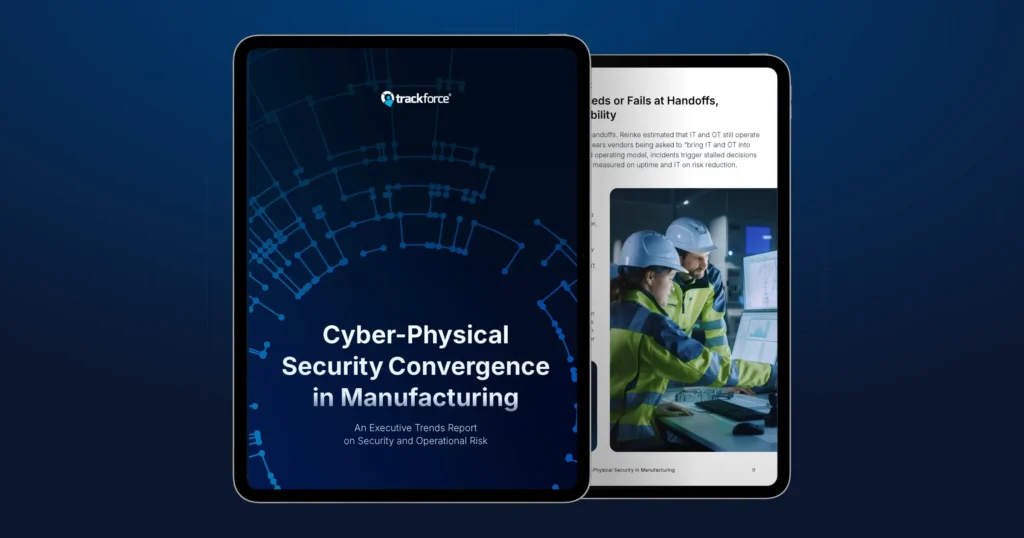
If you’re seeing these overlaps in your own environment, the full report breaks down where manufacturers are most exposed and what’s changing next.
The Problem Reaches Beyond a Single Security Function
For years, manufacturers treated cyber risk and physical risk as separate issues. That split is getting harder to maintain.
Operational technology, industrial control systems, access control platforms, cameras, visitor tools, and remote support workflows are more connected than they were before. A single gap can affect multiple systems, teams, and sites.
Manufacturers are also starting from different places. Some have made progress on cyber hygiene and asset tracking. Others are still working through basic issues such as credential discipline, access control gaps, and incomplete asset inventory.
What the Data Shows
Trackforce’s latest manufacturing trends report covers five trends shaping manufacturing security through 2027. A few patterns keep coming up across all of them.
- Containment now has to protect production continuity.
In manufacturing, segmentation affects how far a disruption spreads, how quickly teams recover, and whether production can continue while the issue is contained. - Third-party access is harder to control than many teams expect.
Contractors, vendors, visitors, and remote support users often fall outside the normal employee lifecycle. When offboarding slips or temporary access stays open too long, those gaps can create problems across physical and digital systems. - Connected physical security tools need the same scrutiny as other connected assets.
Cameras, access control systems, and visitor platforms may still be treated like site tools in some environments. Once they run on networks, rely on credentials, and connect to other systems, they become part of the broader risk picture.
Where Teams Get Stuck
Many manufacturers run into trouble at the handoff point. IT, OT, facilities, and physical security may all be involved in the same event, but they do not always share escalation paths, clear ownership, or the same language for response. Decisions slow down. Documentation gets uneven. Recovery becomes harder to manage from one site to the next.
Organizations that handle this better usually are not doing anything flashy. They tend to have clearer ownership, stronger incident records, and response processes people can follow under pressure.
Another Pressure Point: Insurance
This is also showing up in cyber insurance and claims review. Underwriters want more than written policies. They want time-stamped activity logs, standardized incident records, and proof that controls were actually carried out. For manufacturers, day-to-day operating discipline can affect renewals, claims defense, and how the organization’s actions are judged after the fact.
What This Means for Security Leaders
Few manufacturers are going to rebuild their operating model overnight. Still, the basics carry more weight than they used to.
The manufacturers handling this well are not doing anything exotic. They have a current asset inventory, clear ownership when incidents cross domains, and response processes that hold up under pressure. Those day-to-day operating decisions shape uptime, recovery, and how well a team can stand behind its response when it matters.
Frequently asked questions
Latest Articles



Featured Resources
See Trackforce in action
Book a walkthrough with our team and see how it fits your operation.