Security Officer Tracking Software Guide: TrackTik vs. QR-Patrol vs. GuardsPro (2026 Comparison)

Trackforce
September 1, 2026 · 10 min read

Security Officer Tracking Software Guide: TrackTik vs. QR-Patrol vs. GuardsPro (2026 Comparison)
Key takeaways
- Checkpoint proof and GPS tracking answer different questions.
Scanning proves an officer reached a specific point at a specific time. Continuous GPS shows the movement in between. Platforms that do both give supervisors the fuller picture. - Offline capability is a hard requirement, not a nice to have.
Parking structures, warehouses, basements, and rural sites break any platform that needs a live connection to log activity. - Published pricing is easier to budget, not always cheaper.
Per-guard and per-user tiers look predictable, but advanced incident and reporting tools often sit behind the higher tiers. - Most platforms stop at verification.
Purpose-built patrol tools hand off to separate systems for billing and payroll, which is where the manual work reappears. - TrackTik by Trackforce is the only platform here tying patrol proof to the contract.
Geofenced clock-out alerts and Site Tasks turn shift activity into renewal documentation, and none of the other five publish an equivalent.
Methodology
We compared six platforms against the criteria that determine whether officer tracking data actually holds up: GPS accuracy (how precisely and how often location is captured), checkpoint types supported (NFC, QR, GPS geofence, or a combination), real-time alerts (what triggers a notification and how fast), reporting depth (what supervisors and clients can see and export), and integration breadth (how tracking data connects to the rest of a security operation, including billing, payroll, and incident management). Ratings reflect each vendor’s own published product documentation and pricing pages as of August 2026.
| Platform | Checkpoint Types | GPS Tracking | Real-Time Alerts | Mobile App | Reporting | Pricing Model |
|---|---|---|---|---|---|---|
| TrackTik | NFC, barcode, QR, GPS geofence, and manual check-ins | Continuous GPS with geofence clock-in and clock-out verification | Configurable geofence entry/exit alerts, early/late clock-out alerts, missed and late Site Task alerts | TrackTik Guard Tour and SHIFT mobile apps | Client-facing reporting, audit trail, Site Task documentation for renewals | Custom quote |
| QR-Patrol | QR code, NFC, and Beacon checkpoints (“3play technology”) | GPS location monitoring during patrols | Real-time push notifications; Man Down and SOS alerts on Pro tier and above | QR-Patrol mobile app (iOS/Android) | Daily activity reports; Advanced Customized Reporting on Gold tier | Tiered per-guard pricing from $3.20/guard/month (Base) |
| TARGPatrol | QR code, NFC, and GPS check-in | GPS-based location verification at check-in | Real-time alerts on missed rounds/checkpoints, configurable incident escalation | Mobile app (iOS/Android) for tasks, checklists, incident reporting | Reporting tied to task completion; not security-specific out of the box | Free tier available; paid plans |
| GuardMetrics | Checkpoint scanning via mobile device, no dedicated hardware required | GPS officer tracking with perimeter and exception alerts | Perimeter and exception alerts, daily activity logs | Mobile app for any smart device; works offline without cell/Wi-Fi | Branded client reports, daily activity logs, time and attendance | Custom quote; entry plans reported from free/low-cost tiers |
| GuardsPro | QR location-tag guided site tours | GPS tracking with geofencing (allowed and restricted zones) | Entry/exit geofence notifications | GuardsPro mobile app, plus guard web portal | Client portal with tracking history and replay; scheduled reports | Per-user tiers from $5/month (Essential) to $10/month (Professional), 3-user minimum |
| Novagems | QR and NFC checkpoint scanning | GPS tracking with offline capability | Real-time visibility into missed, late, and completed checkpoints | Mobile app for guards, works offline and syncs on reconnect | Client-ready automated reports, digital timesheets | Per active user, published rates, free trial |
TrackTik
Best for enterprise operations that need patrol proof tied directly to contract billing and renewal conversations.
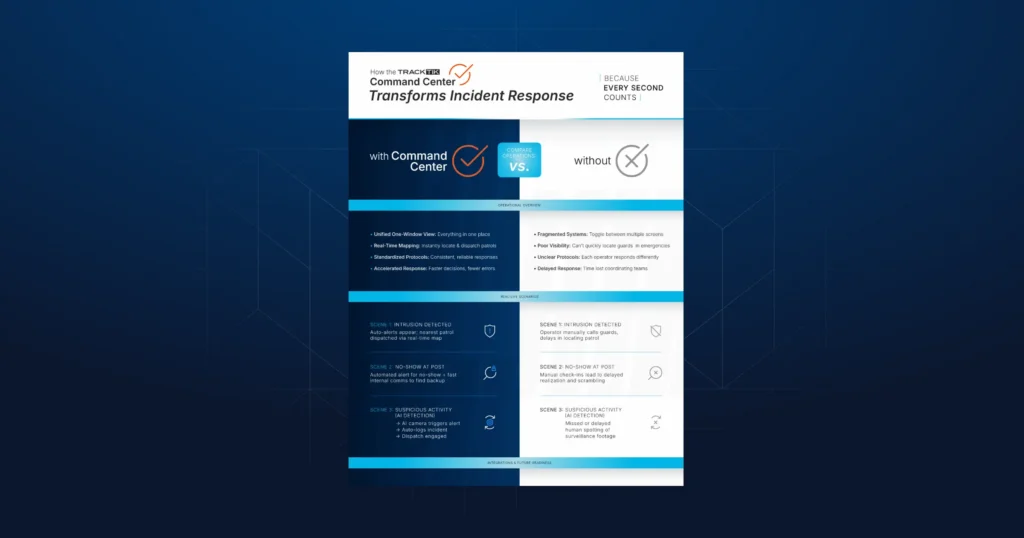
TrackTik covers the full range of checkpoint methods (NFC, barcode, QR, GPS geofence, and manual) so firms aren’t locked into one hardware approach across a mixed portfolio of sites. Continuous GPS tracking runs alongside those checkpoints, and geofencing extends to both ends of a shift: entry and exit alerts fire automatically instead of relying on a supervisor to notice a gap. The Command Center dashboard consolidates alerts, patrol tracking, and dispatch into one view, and the Guard Tour and SHIFT mobile apps keep officers connected to that system in the field.
Two capabilities set TrackTik apart from the rest of this table. Geofenced clock-out alerts catch a guard clocking out from outside their site boundary, closing a gap that checkpoint scanning alone can’t. And Site Tasks extend accountability to the unscheduled work between patrols: every task gets an owner, a status, and a timestamped record, with automatic flags for anything missed, postponed, or completed late. When a contract renewal conversation comes up, that’s documentation instead of a verbal account of the shift. None of the other five platforms in this comparison currently publish an equivalent to either feature. Reporting is client-facing by default, and pricing runs on a custom quote.
QR-Patrol
Best for firms already using NFC and beacon hardware across multi-level or indoor sites.
QR-Patrol’s core pitch is what it calls “3play technology”: guards can scan QR code checkpoints, NFC tags, or Beacons interchangeably, which matters for sites where GPS accuracy alone isn’t reliable, like parking structures or multi-story buildings. GPS live tracking runs during patrols to show movement between those checkpoint scans, and the mobile app pushes real-time notifications the moment something is missed.
Incident handling is a strong point. Guards can attach incident photo uploads, along with video, voice notes, and a signature, directly from the mobile app, and route the report straight to a client’s inbox in real time. Man Down and SOS alerts are available starting on the Pro tier, adding a lone-worker safety layer on top of patrol verification. Reporting scales with the plan: daily activity reports come standard, while Advanced Customized Reporting and an AI query tool are reserved for Gold-tier subscribers. Pricing is tiered per guard, starting from a published base rate, which makes QR-Patrol easier to budget for smaller deployments than a custom-quote platform, though the more advanced incident and reporting tools sit behind higher tiers.
TARGPatrol
Best for teams that want patrol tracking bundled with general task and checklist management.
TARGPatrol combines QR code, NFC, and GPS check-in methods, verifying location at the moment of each check-in rather than tracking continuously between points. Real-time alerts cover missed rounds and checkpoints, with configurable escalation rules for incidents. Guards can capture photos, comments, and exact locations directly from the mobile app, and the platform supports offline check-ins, photo capture, and notes that sync automatically once connectivity returns, which helps in basements or rural sites with patchy coverage.
Where TARGPatrol differs from purpose-built patrol platforms is scope: it’s built as a broader task-scheduling tool that happens to include security patrol features, rather than a security-specific system from the ground up. That shows up in reporting, which ties to task completion generally rather than offering security-industry-specific report templates out of the box. For firms that already run informal task tracking alongside patrols, that overlap can consolidate tools. For firms that need client-ready security reporting on day one, it may mean more setup. A free tier is available, with paid plans scaling from there.
GuardMetrics
Best for sites with unreliable cell coverage where offline verification matters most.
GuardMetrics checkpoints run through a mobile device, so there’s no dedicated scanning hardware to deploy or maintain. Every checkpoint scan is time-stamped and geo-tagged, and the platform’s offline app keeps recording activity without a live cell or Wi-Fi connection, which sets it apart from platforms that need an active connection to log events in real time.
The reporting workflow is built around getting more than a bare scan confirmation. When a guard opens a scan report, time and location data auto-populate, and the guard can add photos, video, and dictated notes before submitting, on the reasoning that a completed checkpoint scan doesn’t by itself confirm everything at that location was fine. Incident alerts route automatically to whichever internal staff are assigned. Reporting includes branded client reports, daily activity logs, and time and attendance tracking. Pricing is quote-based, with entry-level tiers reported at free or low cost for smaller teams, making GuardMetrics a reasonable fit for firms that want offline reliability without the overhead of a full enterprise platform.
GuardsPro
Best for smaller security firms that want guard management and patrol tracking in one lower-cost platform.
GuardsPro pairs QR location-tag guided site tours with GPS geofencing, letting supervisors define allowed and restricted zones per site and get notified the moment a guard enters or leaves one. Tracking history is available through the client portal, so clients can replay a guard’s movements across a shift rather than relying on a summary report after the fact.
Beyond patrol tracking, GuardsPro bundles in a mobile time clock, scheduling, visitor and vehicle management, and a dispatcher, positioning it closer to full guard management software than a standalone patrol-verification tool. That breadth is also its trade-off: reviewers note the feature set can feel dense for teams that only need core patrol tracking. Pricing runs per user across three tiers, with a 30-day free trial and a three-user minimum, making it accessible for smaller operations that want room to grow into the more advanced tiers.
Novagems
Best for multi-site operations that need reporting to keep working when guards go offline.
Novagems checkpoints use QR and NFC scanning, backed by GPS tracking that includes offline capability: the mobile app keeps working without a live connection and syncs automatically once a guard reconnects. Supervisors get real-time visibility into which checkpoints were completed, missed, or scanned late, without waiting on a batch sync at the end of a shift.
Reporting is built to be client-ready without extra formatting work, and digital timesheets tie attendance directly to the same system tracking patrols, so time and location data don’t live in separate tools. Pricing is per active user with published rates and a free trial, giving firms a clear cost before committing, which is less common among platforms in this comparison that default to custom quotes.
Frequently asked questions
Latest Articles



Featured Resources
See Trackforce in action
Book a walkthrough with our team and see how it fits your operation.