Fortifying Corporate Security: Workforce Management Systems for the Modern Enterprise

Trackforce
November 26, 2024 · 11 min read

Businesses now grapple with protecting their property, people and data amid an array of threats. This can get tricky because of how big and complex operations and processes are, especially for multinational organizations. But with the right security workforce management system in place, companies can not only handle these challenges but also use them as chances to grow.
Key takeaways
- Enterprise security needs one operating platform.
Sites, regions, in-house officers and contract providers all need to work from the same standards and the same data. - Scalability and open APIs come first.
A platform that grows with you and connects to the systems you already run avoids costly re-platforming later. - Own your security data.
Incident reports, patrol logs and schedules should live in your system, not your vendors’. - Security software must be secure itself.
Look for independently audited certifications such as SOC 2 Type II and ISO 27001. - TrackTik is built for enterprise security.
Command center, standardized field operations, enterprise analytics and integrations run on one audited platform.
What is enterprise physical security software?
Enterprise physical security software is a platform that lets large organizations run their entire security program from one system: in-house officers, contract providers, patrols, incidents, emergency response and reporting, across every site, region and country. Often called enterprise security workforce management software, it gives security leaders the visibility, control and data they need to reduce risk and prove the program’s value to the business.
10 must-have features for enterprise-level physical security software
Here are 10 features of a corporate security software platform that every enterprise should be looking for:
1. Scalable solutions
As businesses expand, so do their security needs. A robust, end-to-end workforce management platform designed with scalability in mind can grow with the company. This means organizations don’t have to constantly reinvest in new corporate security solutions as they expand, allowing for smoother transitions and scaling operations in new regions or markets without compromising on security.
2. Flexible, open API ecosystem
An open API ecosystem in a physical security workforce management platform for enterprise customers enables seamless integration with various systems, offers customization to meet specific operational needs, and supports scalability. This flexibility allows enterprises to adapt and grow without frequent system overhauls, significantly boosting operational efficiency and cost-effectiveness. An all-in-one platform also supports compliance with industry-specific regulations and strengthens security by allowing integration of state-of-the-art technologies.
3. Simplified cost management
The financial implications of maintaining in-house security are considerable. However, a workforce management solution with automation and smart allocation of resources can help reduce unnecessary spending by optimizing guard scheduling, preventing overlap, and improving reporting accuracy to ensure that every dollar spent on security counts.
4. Easy tech updates
With rapid advancements in security technology, staying current can be a daunting task. The right workforce management solution keeps pace with the latest innovations. Through regular updates and technology integrations, such corporate security systems help enterprises stay one step ahead without the need for constant manual overhauls.
5. Identification of threats
The sophistication of insider threats calls for corporate security solutions that are both robust and discreet. Workforce management software can provide detailed access tracking, anomaly detection, and incident reporting to root out potential insider threats as well as physical bad actors before they act, all while maintaining user privacy.
6. Automation for compliance and regulation adherence
Enterprises operate in a world of complex, ever-changing regulations. A robust workforce management solution will assist in meeting compliance standards by offering automated reporting, audit trails, and customizable workflows that align with legal and industry-specific regulations.
7. Enhanced data analytics
Analyzing the enormous volumes of data from corporate security systems is no small feat. Advanced workforce management solutions come equipped with data analytics tools, offering actionable insights for threat detection and informed security decisions while safeguarding data privacy and integrity.
8. Improved emergency response
Preparedness is key to mitigating the impact of emergencies. Workforce management solutions enhance preparedness through digital emergency response plans that the security team can access in real time, streamlining coordination and response during critical events.
9. Integrated cyber-physical security measures
As cyber threats permeate the physical security realm, integrated cybersecurity in physical security workforce management becomes paramount. A comprehensive solution will offer robust encryption, regular security patches, and protection against cyber intrusions that could compromise physical security systems. TrackTik, for example, holds SOC 2 Type II, ISO 27001 and ISO 27017 certifications and follows NIST SP 800-171 guidelines. Learn more about TrackTik’s security certifications.
10. Global operation support
Managing security on a global scale brings its own set of challenges. An advanced security workforce management solution should accommodate varying international regulations, languages, and cultural nuances, ensuring that security protocols are consistent yet customized for each locale. Tools like ReportPro AI, with real-time language support, also help multilingual teams produce consistent reports.
Enterprise security software evaluation scorecard
Use this scorecard to compare platforms and structure your vendor demos:
| Capability | Question to ask vendors | What good looks like |
|---|---|---|
| Scalability | Can the platform add new sites, regions and vendors without a new system? | One platform that scales from a single site to a global program |
| Open APIs and integrations | Which systems does it connect to, and is there an open API? | Two-way integrations with HR, payroll, access control and detection tools |
| Cost control | How does it prevent overtime and overlapping coverage? | Scheduling that flags overtime and coverage gaps before they cost you |
| Threat identification | How are incidents captured, escalated and analyzed? | Guided reporting with photo, video and GPS evidence, plus automatic escalation |
| Compliance | What audit trails and reporting controls are built in? | Time-stamped records, scheduled mandatory reports and configurable workflows |
| Analytics | Can we see trends across every site and vendor, and do we own the data? | Custom dashboards plus data replication to your own BI tools |
| Emergency response | How do operators coordinate alarms, video and officers during a critical event? | A command center that unifies alerts, patrol status and dispatch |
| Data security | Which independent security certifications does the vendor hold? | SOC 2 Type II, ISO 27001 and similar audited standards |
| Global support | Does it support multiple countries, languages and regulations? | Consistent global standards with localized workflows |
Managing a blended workforce of in-house and contract officers
Many enterprises run security with a mix of in-house officers and one or more contract providers. Without a common platform, every vendor reports differently, and the enterprise ends up depending on its providers for its own data. Software built for enterprise security should let you:
- Standardize across vendors: apply the same post orders, tours and report templates to every provider and site.
- Own your data: keep incident reports, patrol logs and schedules in your system, not your vendor’s.
- Compare performance: measure every provider against the same service levels and KPIs.
- Change providers without losing history: your records stay with you when contracts change.
One global automotive manufacturer discovered its outsourced providers owned every incident report, patrol log and schedule. Read how it took its security data back.
How TrackTik supports enterprise security teams
TrackTik, from Trackforce, is built to be the operating system for enterprise security, standardizing operations across sites, vendors and countries:
- Command and response: TrackTik Command Center consolidates alarm monitoring, video surveillance access and guard dispatch in one workspace.
- Standardized field operations: configurable tours, post orders and report templates applied consistently across every site and provider.
- Enterprise analytics: business intelligence dashboards, custom KPIs and automated data replication to your own cloud environment and BI tools.
- Integrations: two-way connections to HR and payroll, ERP and accounting, access management through RightCrowd and AI threat detection through Scylla.
- Audited data security: SOC 2 Type II, ISO 27001 and ISO 27017 certifications, NIST SP 800-171 alignment, and GDPR and CCPA compliance.
The path forward with the right security workforce management solution
Automation, integration and smart technology not only streamline security operations but also enhance the ability to pre-empt and respond to threats. The right workforce management solution not only mitigates risks but also serves as a growth catalyst by safeguarding assets efficiently and effectively, allowing organizations to focus on expanding their business horizons.
Here’s how these platforms drive organizational growth:
Efficient resource management
By automating schedules, optimizing guard deployments, and minimizing redundancies, organizations can reduce operational costs. These savings can then be allocated to other growth-focused initiatives like expanding market reach or investing in research and development. This shift enables leadership to focus on core business strategies and growth rather than getting bogged down by day-to-day operational challenges.
Data-driven decision making
Data analytics tools provide valuable insights that help in strategic planning and threat assessment. By understanding security patterns and identifying potential vulnerabilities, organizations can make informed decisions that align with their growth strategies and enhance overall security.
Building customer trust
When clients know that an organization is well protected and adheres to the highest security standards, they are more likely to engage in long-term partnerships. An advanced workforce platform also provides an added level of transparency for security activities performed across sites, as well as evidence-based reporting that productivity and service levels are being met. This trust is crucial for sustainable growth and expanding into new customer bases.
For enterprises seeking to strengthen their physical security while enabling growth, investing in a suitable security workforce management platform is indispensable.
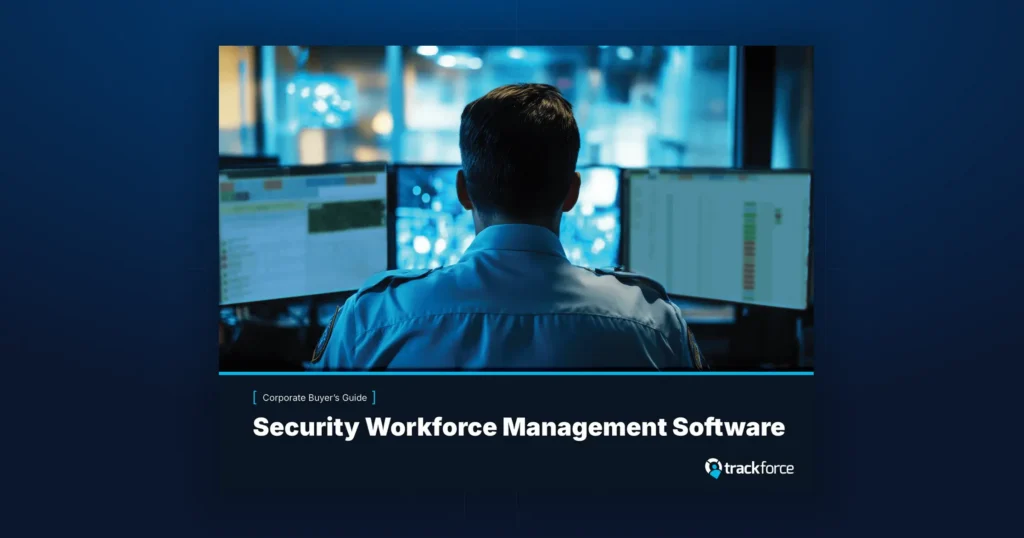
Explore critical considerations to streamline your technology adoption and bolster corporate security by downloading The Complete Buyer’s Guide for Corporate Physical Security Workforce Management Software, or book a TrackTik demo to see the platform with your own sites.
Frequently Asked Questions
Latest Articles





Featured Resources
See Trackforce in action
Book a walkthrough with our team and see how it fits your operation.
One platform for your entire security program
Book a demo to see how TrackTik standardizes security operations across your sites, vendors and countries on one audited platform.