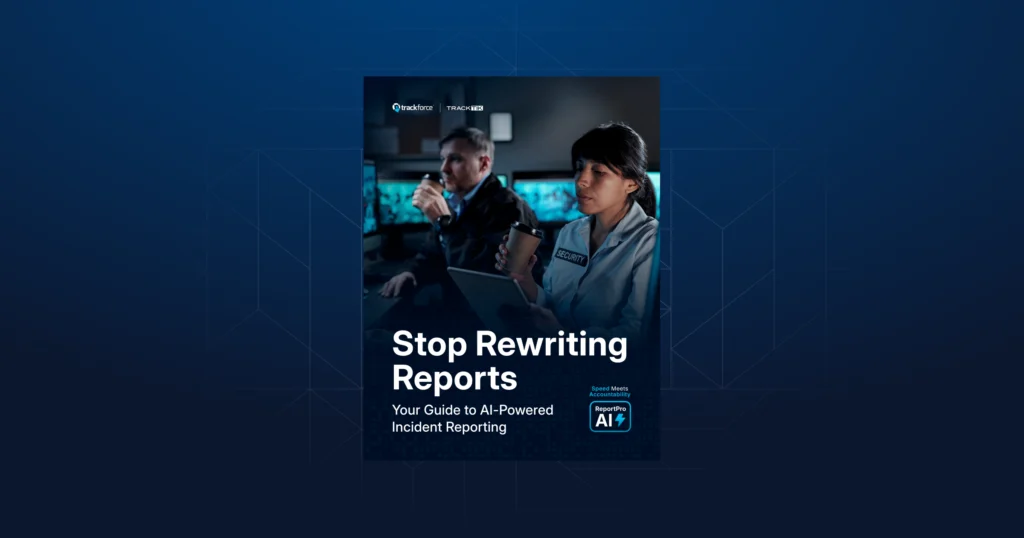
Checklist: Incident Reporting Essentials for Manufacturing Security Teams

Trackforce
March 14, 2026 · 6 min read

Checklist: Incident Reporting Essentials for Manufacturing Security Teams
Key takeaways
- Eight categories cover a defensible report.
Basic facts, objective narrative, sequence of events, action taken, outcome, supporting evidence, compliance checkpoints and professional tone. - Neutral language is a compliance control.
Speculation and blame in a narrative are what get a report challenged later, so the wording matters as much as the facts. - Evidence turns an account into a record.
Photos, CCTV snapshots and witness statements attached at the time are what separate documentation from recollection. - Consistency is what auditors actually check.
OSHA, ISO and C-TPAT reviewers look for the same structure every time, across every plant, not for longer reports. - Trackforce builds the checklist into the form.
Required fields, evidence capture at the point of report, and ReportPro AI structuring the narrative mean officers meet the standard without memorising it.
In a fast-moving manufacturing environment, incident reporting is more than a formality—it’s a safeguard for your people, assets, and compliance standing. Weak or incomplete reports can cause delays in investigations, trigger OSHA or ISO compliance risks, and weaken trust with auditors and plant managers.

To help your security teams stay consistent and compliance-ready, we’ve built this Incident Reporting Essentials Checklist. Whether you’re filling out reports by hand, using digital templates, or leveraging AI-powered tools, every manufacturing incident report should cover the following:
Want a clean, printable version of this checklist?
Download the one-pager PDF now →.
Incident Reporting Essentials
- Basic Facts
☐ Date, time, and location of the incident
☐ Facility zone (e.g., loading dock, production line, restricted lab)
☐ Names or IDs of all personnel involved
☐ Accurate incident type classification - Objective Narrative
☐ Events described in clear, neutral, professional language
☐ Avoids speculation, blame, or subjective phrasing - Sequence of Events
☐ A clear timeline from first observation to resolution
☐ Entries that can withstand regulatory or internal audits - Action Taken
☐ Steps documented, such as alerting a supervisor, securing equipment, or notifying emergency responders - Outcome/Resolution
☐ Notes on whether the issue was resolved on-site, escalated, or remains ongoing - Supporting Evidence
☐ Photos of damaged equipment or hazards
☐ CCTV snapshots or logs
☐ Witness statements or safety logs - Compliance Checkpoints
☐ Alignment with OSHA logs, ISO documentation, or C-TPAT protocols
☐ Verification against company-specific audit needs - Clarity & Professional Tone
☐ Report is polished and easy to understand
☐ Free of spelling errors, vague language, or inconsistencies
Prefer a checklist you can print and use on the go?
Download the one-pager PDF now →.
How to Use This Checklist
- For Guards & Security Officers: Keep a digital or printed version handy during patrols to ensure nothing gets missed.
- For Supervisors & Managers: Use it as a quick reference to review reports for audit-readiness.
- For Compliance Teams: Incorporate it into training materials or onboarding for new hires.
Make your team’s job easier with a ready-to-use, printable checklist.
Download the one-pager PDF now →.
Going Beyond the Checklist
Traditionally, hitting every point on this list required extensive training, constant rewrites, and lengthy compliance reviews. With AI-powered reporting tools and standardized incident reporting available on Trackforce platforms, guards can write naturally while the system enhances reports to meet every standard—saving time, reducing errors, and strengthening compliance across the board.
Want to see how Trackforce can streamline your incident reporting?
Book a demo today →.
Frequently Asked Questions
Latest Articles




Featured Resources


See Trackforce in action
Book a walkthrough with our team and see how it fits your operation.