

Security Guard Management

Every Role Has a Different Definition of a Good Shift. Now They Have a Different View.

Every Role Has a Different Definition of a Good Shift. Now They Have a Different View. Introducing Job-Based Views — five role-specific, live views now available to every TrackTik customer. Security operations don’t run on one job. They run on five, six, ten different roles, each with a completely different picture of what a good […]

Every Role Has a Different Definition of a Good Shift. Now They Have a Different View. Read More »

The Work Nobody Sees: How security firms are losing credit (and revenue ) for tasks that happen every single day

The Work Nobody Sees: How security firms are losing credit (and revenue ) for tasks that happen every single day More than likely, your guards are doing more than the contract says. A site manager flags a suspicious vehicle and asks someone to keep an eye on it. A fire extinguisher check is due and

The Work Nobody Sees: How security firms are losing credit (and revenue ) for tasks that happen every single day Read More »

Security Guard Business Administration Software Compared: TrackTik vs. Belfry vs. WinTeam

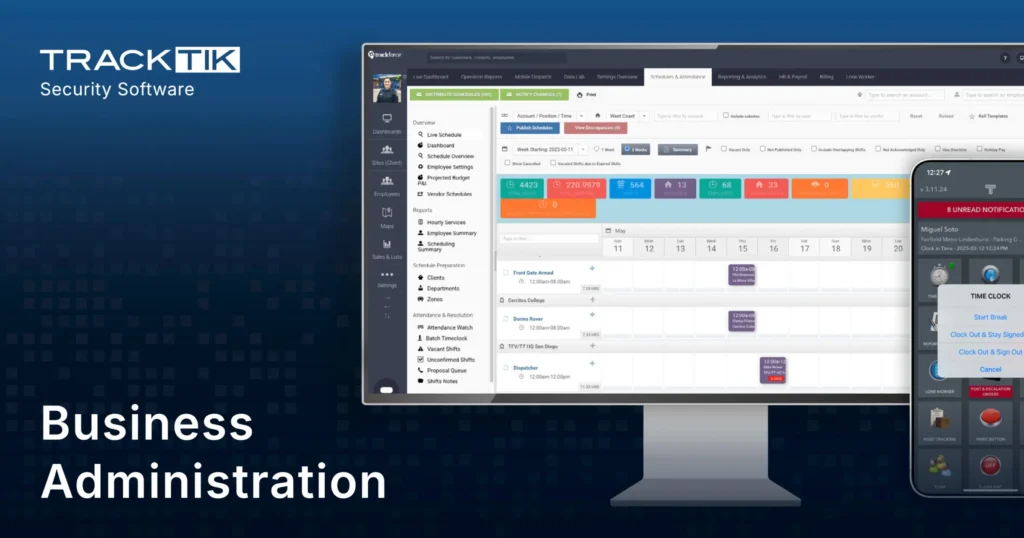
Security Guard Business Administration Software Compared: TrackTik vs. Belfry vs. WinTeam When security guard companies evaluate workforce management software, the back-office suite is often the deciding factor. Scheduling errors drain margin. Billing mistakes damage client relationships. Payroll mistakes create compliance exposure. The software that ties all three together wins the business. This comparison breaks down

Security Guard Business Administration Software Compared: TrackTik vs. Belfry vs. WinTeam Read More »

Breaking free from the spreadsheet prison: The true cost of disconnected security systems 

Breaking free from the spreadsheet prison: The true cost of disconnected security systems  If you run security operations and you’ve never said, “Just put it in a spreadsheet,” you’re either lying or very new to this industry.  Spreadsheets aren’t the problem. The problem is that they become the connective tissue between systems that should be talking to each other but aren’t. One spreadsheet tracks guard hours.

Breaking free from the spreadsheet prison: The true cost of disconnected security systems  Read More »

Integrating Physical Security into the Enterprise Stack: A Practical Guide for IT Leaders

Integrating Physical Security into the Enterprise Stack: A Practical Guide for IT Leaders Physical security software has traditionally existed outside IT’s purview. Guards use mobile apps. Incidents are logged in vendor-specific systems. When IT requires visibility, it receives monthly Excel exports at best. This dynamic creates the kind of integration debt that compounds with every

Integrating Physical Security into the Enterprise Stack: A Practical Guide for IT Leaders Read More »

Covered isn’t compliant: What security firms get wrong about scheduling

Covered isn’t compliant: What security firms get wrong about scheduling Post Orders Aren’t the Problem. Disconnected Systems Are. There’s an assumption baked into most security operations: if a shift is covered, it’s covered correctly. Covered and compliant, though, are two different things. The gap between them is where wage liability, certification violations, and joint employer

Covered isn’t compliant: What security firms get wrong about scheduling Read More »

The Human in the Middle: How AI and Workflow Automation Are Redefining Security Guard Protocol Management

The Human in the Middle: How AI and Workflow Automation Are Redefining Security Guard Protocol Management Post Orders Aren’t the Problem. Disconnected Systems Are. If you’ve worked in security operations long enough, you’ve seen this scenario play out: an incident happens, a guard makes the wrong call, and the post-mortem reveals that the guidance they

The Human in the Middle: How AI and Workflow Automation Are Redefining Security Guard Protocol Management Read More »

What Cyber-Physical Convergence Means for Manufacturing Security

What Cyber-Physical Convergence Means for Manufacturing Security Key Takeaways: Manufacturing security teams are dealing with a problem that cuts across departments. A disruption might start with a credential issue, move through a connected physical security system, and end in production delays, safety concerns, or both. If you’re seeing these overlaps in your own environment, the

What Cyber-Physical Convergence Means for Manufacturing Security Read More »

Solving Physical Security’s Last Mile Problem: Bridging the Gap Between Threat Detection and Response

Solving Physical Security’s Last Mile Problem: Bridging the Gap Between Threat Detection and Response Key Takeaways: Physical security companies face a critical challenge: the gap between alarm monitoring and guard response. While security technology detects threats instantly, coordinating effective response from security personnel remains the industry’s persistent ‘last mile problem. In the logistics industry, “the

Solving Physical Security’s Last Mile Problem: Bridging the Gap Between Threat Detection and Response Read More »

The Migration Dilemma: When to Replace Your Security Management System (And When to Wait)

The Migration Dilemma: When to Replace Your Security Management System (And When to Wait) Key Takeaways: Every security company reaches a breaking point with their management software. Maybe it’s the third time this month your guard patrol system has failed at a client site. Maybe it’s the spreadsheet you’ve been maintaining because your scheduling software

The Migration Dilemma: When to Replace Your Security Management System (And When to Wait) Read More »