
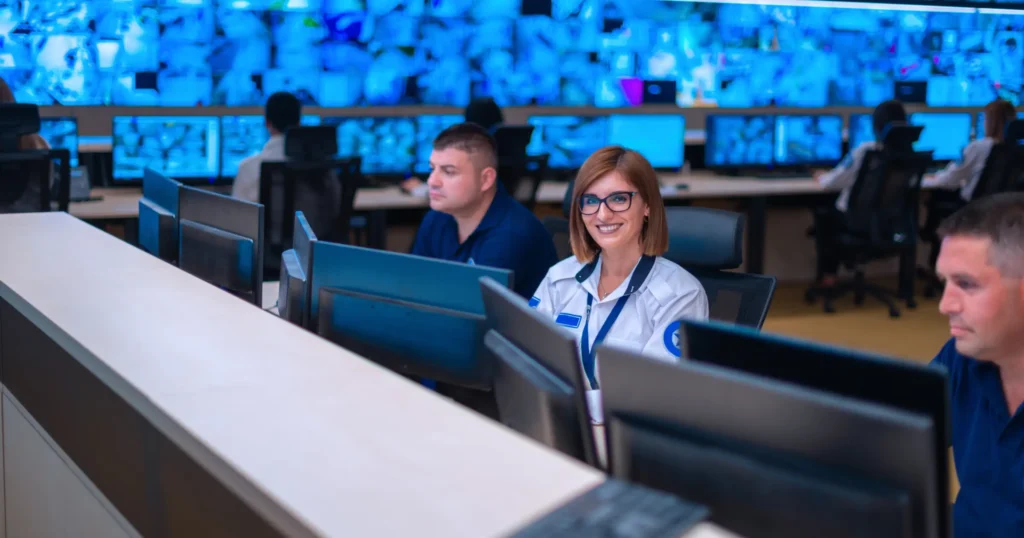

When Security Teams Become Everything Teams
If you asked a security professional ten years ago to describe their job, you would likely hear about access control, incident response, and keeping people safe. Ask that same question today, and you might hear about environmental compliance audits, business continuity planning, IT security protocols, facilities management, and still keeping people safe.
This represents the emergence of the multi-disciplinary security professional, where the traditional boundaries of physical security have dissolved into something far more complex, strategic, and demanding.
The Expanding Universe of Security Responsibilities
According to Trackforce’s 2025 Physical Security Operations Benchmark Report, security teams across enterprise organizations are being asked to shoulder responsibilities that would have seemed foreign to the role just a few years ago. The data reveals a striking pattern: 64% of security teams now handle health and safety responsibilities, while 51% have taken on facilities management duties. Another 33% are managing environmental compliance, and business continuity planning has been assigned to security teams in 36% of organizations.
More significantly, 12% of respondents report their security teams are handling all of these expanded responsibilities. This represents a complete transformation from specialized security function to operational command center.
This shift is not simply scope creep. It represents a fundamental reimagining of what security means in modern organizations. The physical security team, once viewed as a cost center focused narrowly on preventing theft and managing access, is evolving into a strategic operational hub that touches virtually every aspect of how a company functions and protects itself.
The Logic Behind Expanding Security Mandates
The expansion follows a certain operational logic when considering the connective tissue running through these diverse responsibilities. Security teams already operate around the clock. They already focus on risk, compliance, and incident response. They maintain relationships across every department and possess access to most physical and digital systems. They represent the only function that truly sees the entire organization from a risk and operational continuity perspective.
When the COVID-19 pandemic began, many organizations discovered their security teams were the logical choice to coordinate pandemic response activities including health screening, capacity management, contact tracing, and facility modifications. That experience accelerated a trend that was already underway: executives recognizing that security teams possessed unique capabilities that extended far beyond their traditional mandate.
Business continuity planning exemplifies this pattern. The teams already managing crisis scenarios are well-positioned to coordinate emergency response procedures. Facilities management shares obvious overlap with physical access and building operations. Environmental compliance often intersects with physical plant security and monitoring systems.
The result is a security function that increasingly operates as a versatile, essential capability able to handle diverse organizational challenges.
The Confidence Gap in Cyber-Physical Convergence
However, being assigned expanded responsibilities does not automatically translate to teams feeling adequately equipped to handle them all equally well.
The benchmark data reveals a significant confidence gap. While 39% of enterprise security teams express confidence in managing unauthorized access and insider threats, and 34% report similar confidence about personnel safety and workplace violence, only 28% indicate strong confidence when addressing cyber-physical attacks. These are scenarios where digital incidents impact physical security systems, or physical breaches compromise digital infrastructure.
This gap proves particularly concerning given that 31% of security teams now have IT security responsibilities added to their portfolios. The convergence of physical and cyber risk is accelerating faster than many teams can adapt. IoT-enabled access controls, cloud-managed surveillance systems, and network-connected building management systems have blurred the lines between traditional security domains. Yet many teams are operating with skillsets, tools, and organizational structures designed for an earlier, simpler operational environment.
Transformation at the Frontline Level
This multi-disciplinary evolution extends beyond security leadership to reshape roles at every organizational level. The modern security officer is no longer simply a presence at a post. Equipped with mobile technology, officers are expected to conduct safety inspections, document environmental compliance issues, coordinate facility maintenance requests, and serve as first responders for situations ranging from medical emergencies to IT system failures.
Service providers are experiencing this shift acutely. The guards they recruit, train, and deploy are being asked to operate as tech-enabled generalists rather than specialized sentries. This requires different training approaches, different technological tools, and different candidate profiles. The job description for a security officer in 2025 differs radically from what it was in 2015.
The Sustainability Challenge
The fundamental challenge lies in the finite nature of human capacity. Security teams stretched across health and safety, facilities, IT, compliance, and traditional security duties face a tangible risk of burnout. When teams are responsible for everything, maintaining true excellence in any single area becomes difficult.
Organizations are beginning to recognize that simply assigning additional responsibilities to security teams without providing appropriate technological infrastructure, additional resources, or process optimization creates unsustainable conditions. Teams managing manual compliance reporting, operating disconnected systems, and responding to recurring false alarms cannot simultaneously execute strategic initiatives around business continuity or cyber-physical risk management.
The most forward-thinking organizations are adopting a different approach. Rather than merely expanding security’s mandate, they are investing in the tools, integration, and automation necessary to make that expanded role sustainable. They are dismantling silos between physical security, IT, facilities, and other functions. They recognize that if security is going to serve as an operational backbone, it requires infrastructure-level support.
The Path Forward for Multi-Disciplinary Security Functions
The multi-disciplinary security professional represents a permanent evolution in organizational structure. Organizations have discovered the value of a function that can see across domains, respond to diverse threats, and coordinate complex operational challenges. The question is not whether security teams will continue carrying these expanded responsibilities but rather whether organizations will provide what is needed to execute them effectively.
This requires unified platforms that eliminate system fragmentation. It demands automation that frees teams from manual administrative burdens. It necessitates training that builds competence across physical, cyber, and operational domains. Perhaps most importantly, it requires organizational structures that recognize security as a strategic function rather than a tactical afterthought.
The security professional managing multiple disciplines is not becoming a generalist with shallow expertise. When properly supported, they become masters of integration, serving as the connective tissue that holds modern operations together. The organizations that recognize this distinction and invest accordingly will be better positioned to manage the increasingly complex risk landscape that defines contemporary business operations.
How are security teams managing this expanded mandate in practice? What technologies and strategies are proving effective? The full 2025 Physical Security Operations Benchmark Report includes detailed data on how enterprise security teams are balancing multiple responsibilities, where their confidence gaps exist, and what tools are helping them manage operational complexity. Download the complete report to see how your organization compares and discover what is working for teams navigating this multi-disciplinary evolution.
